The Lincoln Memorial has always been special. Its siting is perfect, facing the Capitol, across the length of the Mall, as if speaking truth to power. The symmetry of its proportions adds to its moral grandeur. It feels balanced and open to all, like Lincoln's vision of democracy.
A Design Rooted in Democracy
That was consciously on the mind of the architect, Henry Bacon. It is not a towering monolith; instead, it invites the visitor in. There are some steps to climb, but not too many; 87 in all, chosen specifically because of the 'four score and seven' in the Gettysburg Address, the number separating the year of Lincoln's speech (1863) from 1776, the year of the Declaration of Independence.
Other elements of the design are precise and perfect. It has 36 fluted Doric columns, symbolizing the states in the Union at the time of Lincoln's death. Already, that is a gesture toward peace and reconciliation – it includes the states in rebellion throughout Lincoln's presidency, now readmitted to the temple. Lincoln would have wanted it that way.

Above all, it is uncluttered; with no unnecessary ornamentation, and certainly no gilt. Doric is the simplest of the Greek orders; and the most appropriate for a democracy. It stands for civic virtue. The Parthenon, another symbol of democracy, also has Doric columns.
A History of Inclusivity
To get it right, imperfect plans were discarded along the way. An early one, designed by Clark Mills, would have built a tall monument surrounded by equestrian statues, as a statement about conquest, not unlike the garish arch currently being planned behind the Lincoln Memorial. But the Mills plan was happily rejected.
Still, some objected to Bacon's Greek-influenced design; they would have preferred something more modest, like a log cabin. Or perhaps both? Some of that ambivalence was built into another memorial, at Lincoln's birthplace where an elaborate neoclassical structure surrounds a small wooden log cabin, similar to the one in which Lincoln was born. Fortunately, Bacon avoided that confusion, and succeeded in getting his clear vision built.
Ever since it was dedicated in 1922, the Lincoln Memorial has been a hit with the public. People drift there naturally, following the sightlines that point the way. It is open to all, of course, as it must be. But one group has always found a special resonance there.
African American Legacy
From the moment it opened, African Americans understood that it spoke to them. In 1922, the principal of the Tuskegee Institute, Robert Moton, gave a speech there, arguing for racial equality. Then, over the course of the 20th century, a series of powerful public performances and speeches deepened this connection.
In 1939, Marian Anderson sang My Country 'Tis of Thee from the steps of the Lincoln Memorial before 75,000 people and a national radio audience, after being denied access to Constitution Hall by the Daughters of the American Revolution. In 1947, President Harry Truman gave an important speech about civil rights to the National Association for the Advancement of Colored Persons (NAACP). But the greatest event of all on the hallowed steps was the I Have a Dream speech given by Dr Martin Luther King Jr, on 28 August 1963, to an enormous throng, and again, a national audience.
As these powerful connections were formed, the Lincoln Memorial became an even more powerful symbol than the designers could have understood in 1922, at a time when racism was rampant in the federal government and in the country at large. It is almost as if the actors in this drama understood that they were speaking to each other. Dr King invoked Lincoln powerfully at the beginning of his I Have a Dream speech. But at times, Lincoln seemed to reach toward the 20th century, and the idea of a special civic space. On at least two occasions, he spoke intuitively about a 'temple of liberty', modeled on his color-blind interpretation of the Declaration of Independence, and the rights offered to all by our founding document.
Threats to the Temple
Of course, any building that excites feelings of reverence for the Declaration of Independence, Lincoln and Dr King will prove threatening to a president who does not share their egalitarian vision. Donald Trump keeps returning to the Lincoln Memorial, as if seeking to dominate it.

In 2019, a 'Salute to America' included a display of military hardware on the Mall – exactly the kind of military imagery that Bacon refused to build into the Memorial – and the president delivered a 46-minute speech that did not mention Lincoln. He later claimed that he had drawn a larger crowd than Dr King did in 1963 (the Reflecting Pool did not stimulate much self-reflection that day).
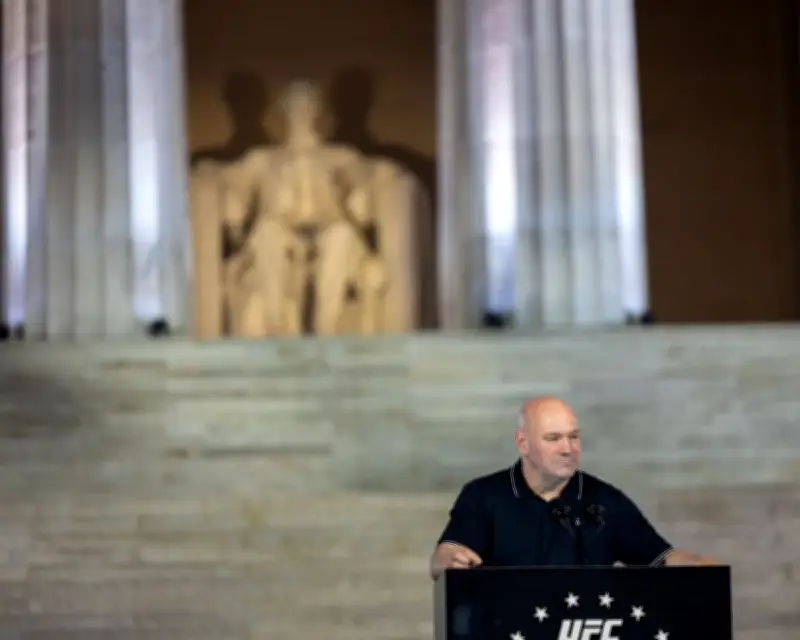
Another desecration is planned for this weekend, when the Lincoln Memorial will become the backdrop for a Friday night press conference and weigh-is for the UFC cage fight to be held on the White House lawn. The Memorial will survive these indignities, and the enormous arch being built nearby, almost as if its intent is to cast a shadow on Lincoln's temple of liberty.
But it's fair to surmise that the architects of the Declaration would be dismayed by these displays of gladiator combat, so close to July 4, a day they hoped Americans would celebrate by drawing closer together. Jefferson and Adams, the two men most responsible for the Declaration, wrote to each other in 1813, and the subject of gladiators came up. Jefferson, specifically, wondered if he and Adams should air their differences in public, and 'exhibit ourselves, as gladiators, in the Arena of the newspapers?' Then he gave his answer: 'Nothing in the universe could induce me to it.'