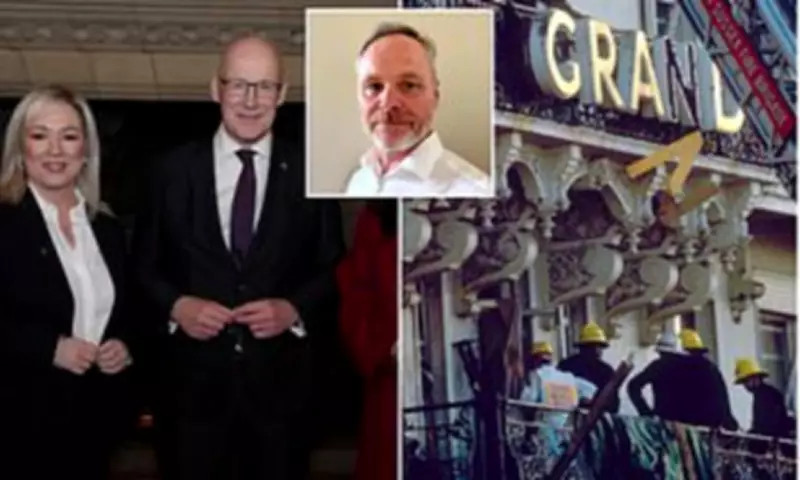
John Swinney and I were lucky. We grew up in the Scottish Lowlands, untroubled by war, untouched by terrorism. Our childhoods were free from the dread that scarred others not so far away.
Across the Border in England, IRA bombs killed 21 in the Birmingham pub bombings of 1974, 12 died in the M62 coach bombing that same year. Harrods was bombed in 1983, the Grand Hotel in Brighton in 1984—an attempt to assassinate Prime Minister Margaret Thatcher. Trade and Industry Secretary Norman Tebbit was gravely injured, his wife Margaret left in a wheelchair for life. Five died. In 1996, the biggest bomb since WWII left over 200 injured in Manchester, causing damage equivalent to £1.3 billion today.
None of this carnage came to Scotland. For John Swinney and me, these were atrocities we heard about on the news, but we did not live them. We lost no one close to us. Across the Irish Sea, the Troubles marked every childhood with trauma—a shadow John Swinney and I can scarcely imagine. Every family knew victims. Many lost household members.

Well, Mr Swinney has a message for those less lucky: they should move on. And lest we suspect he is a newbie to Northern Ireland politics, he wants people to know he wrote a dissertation on the subject at Edinburgh University 40 years ago. 'I looked at it very closely,' he said. 'I really do think people have got to move on.'
The reason the First Minister would prefer to view this murder and mayhem as water under the bridge is his recent dialogue with Michelle O'Neill, his counterpart in Northern Ireland and vice president of Sinn Fein since 2018. Sinn Fein, as Mr Swinney will know from his coursework, is historically the political wing of the IRA, which sought a united Ireland through terrorism.
But, hey, forgive and forget. Or, as Mr Swinney would have it, 'the world's moved on'. It may be politically convenient for him to assume so. After all, he and Ms O'Neill and the new Welsh First Minister, Plaid Cymru's Rhun ap Iorwerth, all want to rip their countries out of the UK. So Ms O'Neill's party has historical ties with monsters who tried to bomb their way out of the UK—terrorist thugs wearing balaclavas and toting automatic weapons. So their methods were a little different back in the day. But it's a bygone.
Like I say, my childhood was as free from terrorism's shadow as Mr Swinney's, but I squirmed with embarrassment when I heard him deploy his 1986 undergraduate essay as evidence of insight. He sounded like a little boy who thinks his water wings make him a real swimmer. If that was my reaction, how might those whose lives were destroyed respond to the suggestion that he's up on Troubles history because he wrote about it once as a student?
Among the dead were Scottish soldiers. Ayrshire brothers John and Joseph McCaig, aged 17 and 18, and Dougald McCaughey, 23, from Glasgow, were lured from a Belfast pub and executed by the IRA in 1971. No one was ever arrested. Last year Dougald's cousin David described the atrocity as 'a scar that never healed and never will'. John Swinney reckons they should move on.
What he misses is that the Troubles are not a finite event. They are woven into the collective psyche of those who endured them, whose lives have been shaped by them, who daily count the emotional cost. Their healing does not happen at Mr Swinney's political convenience. It is the lived experience of those people—still suffering, still working through their trauma—which weighs more heavily with me than a student essay Scotland's First Minister wrote in 1986.
Move on, he says. John Swinney, of all people. We had a referendum in Scotland back in 2014. No one died. There were no bombings, shootings, or kneecappings. The people went to the polls and delivered their verdict: Scotland should remain in the UK. It was, we were assured by Mr Swinney's party, a once-in-a-generation vote. It didn't go his way. Still, we move on from life's disappointments, don't we? No sense in letting grievances fester when the matter was settled fair and square.

Oh, the supreme irony—a Scottish First Minister urging others to move on from experiences more searing than any his land has known in modern times, when moving on is precisely what his party is singularly incapable of doing. Indeed, the SNP's whole schtick is a refusal to move on, however badly Scotland needs it to do so. Every area of devolved power—education, health, transport, you name it—runs a poor second to its obsession with fighting a battle already lost. Moving on? Scotland has not been granted a single day of this since 2014.
Ours is a land whose wheels spin endlessly in the mud, digging ever deeper trenches, making forward motion an ever less feasible prospect. Attainment gaps widen, waiting lists lengthen, the economy tanks, but the SNP soldiers on in government because its policy of wallowing in a lost constitutional crusade absolves the party of every failure in the eyes of a sizeable enough rump of the electorate. So much for Mr Swinney's explanation for dealing with Sinn Fein. The world has moved on. People should too, even if he is Scotland's poster boy for not letting things go.
Have you heard a coherent explanation yet for his refusal to deal with politicians rather closer to hand, namely the 17 democratically elected Reform MSPs who were sworn in at the Scottish parliament? I don't recall any Reform bombing campaigns. They laid out their prospectus for change, same as everyone else, and proved the breakthrough party of the Scottish election. The First Minister lets it be known he will have nothing to do with them. What kind of message does that send to the thousands of Scots who voted for Reform? That he'll have no truck with them either?
So this is what governing for all of Scotland looks like. Dialogue with Sinn Fein over the water, the door slammed in the face of Reform at home, and a sense that policy is decided in a paddling pool—by a man in water wings.