

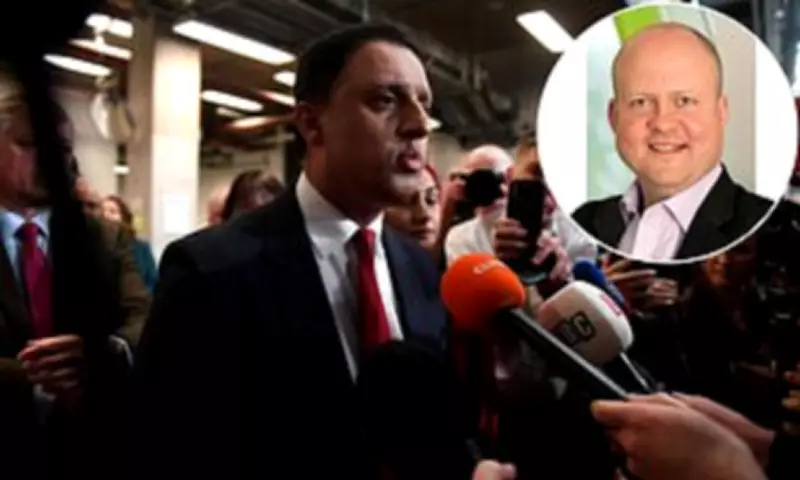
Anas Sarwar declared on television his desire to see Reform 'pumped' in the Scottish Elections. It appears, however, that it was the Scottish Labour leader who ultimately faced the backlash.
While the magnitude of Labour's defeat surpasses any predictions, many had long foreseen little chance of victory. Now, let us first address Sarwar's ready-made excuse. In the coming days, he will attribute everything to Sir Keir Starmer's unpopularity. If, as seems likely, a challenge to the Prime Minister emerges, expect Sarwar to join it enthusiastically, claiming that it was he, not John Swinney, who prevented him from entering Bute House.
Like all plausible excuses, there is some truth in this. The public's disdain for Starmer made him an insurmountable barrier to victory. However, that does not absolve Sarwar of responsibility for a defeat of this scale. The blame lies squarely in the office of the Scottish Labour leader.

Foundations of Defeat
The foundations of this result were laid well before Starmer became the voters' enemy number one. As early as 2023, Sarwar and the Scottish Labour leadership believed the seemingly inevitable Labour landslide in the UK general election would translate into a landslide at the Scottish election two years later. When victory came in 2024, confidence in the plan grew—but it was a plan for victory with no effort. It would simply materialise.
Senior members of the UK party confidently opined that the SNP were finished. Indeed, none other than Sarwar's one-time 'old friend' Peter Mandelson came north to declare the Nats were done. Yet even the most cursory knowledge of Scottish electoral history would have revealed no correlation between general election results and votes for Holyrood.
Historical Precedents
Tony Blair's 1997 landslide was followed by a decent but unspectacular victory for Donald Dewar in 1999. Blair's 2001 landslide was followed by First Minister Jack McConnell losing seats in 2003. The 2010 general election saw a landslide in Scotland for Gordon Brown, yet just 12 months later Alex Salmond's SNP routed Scottish Labour. Sarwar's 'cunning plan' was flawed from the start.
Since Salmond's victory by one seat in 2007, Scottish Labour has been in a huff with voters, expecting a repentant Scottish public to eventually see the error of their ways, instead of asking themselves why they have lost seats at every successive Holyrood election since Dewar's victory.
A Flawed Strategy
In July 2024, the party decided the day of repentance had come. Sarwar saw no need for policy, no need for a vision of what a Labour Scotland might look like. It was Labour's turn after 20 years, as they pleaded with the Scottish public that the SNP had hogged government for too long and it was time for them to get a shot—like a younger brother complaining his elder had dominated the family Xbox for too long.
Unfortunately, the public did not see things that way. On the doorstep, voter after voter told them that, yes, the SNP were terrible, but so were Scottish Labour. The Nats had been a poor government for nearly 20 years, but Scottish Labour had been an even worse opposition.
Sarwar's Missteps
Sarwar nonetheless believed his charm would beat the charisma-free Swinney in a head-to-head race. This self-confidence meant he did not address any of his negatives nor recognise that his approval ratings were worse than the First Minister's. To many, Sarwar appears lightweight, vain, and entitled.
Putting out videos of his giggling out-takes during his Christmas message, of him go-karting, or upbraiding a photographer for making him look like a 'stroke victim' underlined these negatives. Unable to take the blame for anything, Sarwar tried to blame Starmer. For 18 months, he had said his close relationship with the PM was a unique selling point that should make people vote for him. Suddenly, he called on Starmer to resign, ironically over the Mandelson affair—a man Sarwar used to describe as his 'old friend'.
This backfired badly in focus groups with Labour voters and undecideds. Voters could see what he was doing and saw it as a cheap, insincere trick that reeked of disloyalty. Sarwar had nothing left in his locker because he had not done the hard work he should have started at least two years ago.

Conclusion
He did not try to persuade Scotland with a vision of a Labour future. Instead, he tried to make us fall for his charm and got a helluva knockback. Grins and gimmicks do not pave the way to government.
Paul Sinclair is a former senior Scottish Labour adviser.





