Record Antarctic Krill Haul Sparks Fears for Marine Ecosystem
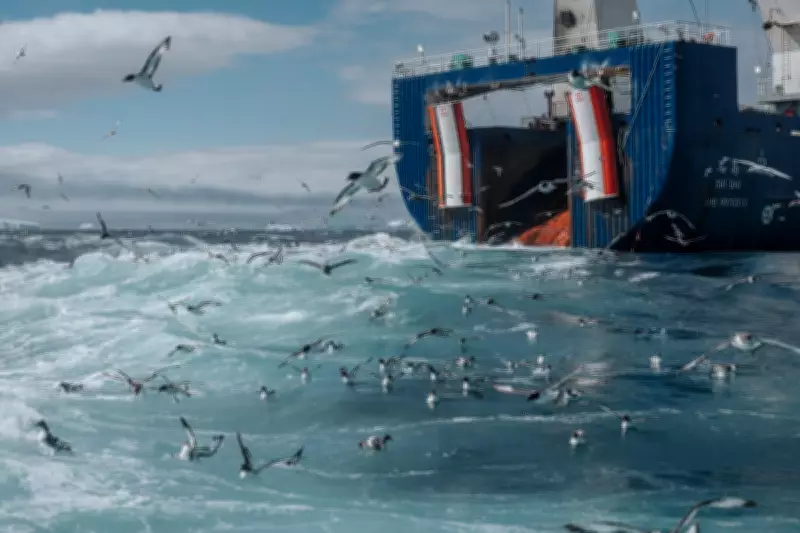
In the frigid waters off Coronation Island in the South Orkney Islands, a stark industrial scene unfolds as giant ships compete for a lucrative catch. Last year, about 620,000 tonnes of krill were trawled in the Antarctic, marking a record haul that was only halted when the annual quota limit was reached. This fishery, while regulated by an intergovernmental body, is increasingly criticized by experts who warn it is wreaking havoc on the delicate Antarctic food chain.
The Battle for Krill in Isolated Waters
Gordon Peake joined a Sea Shepherd mission aboard the Allankay to observe this remote operation firsthand. The Allankay, which sailed 34 days from New Zealand via Argentina, is crewed by 31 volunteers from 12 countries, including bosun Luca Massari, a heavily tattooed veteran of the environmental organization. Massari and his team launch a small boat into the Antarctic waters, where survival time in the wind-whipped cold is just five minutes without protective gear.
Krill, small shrimp-like crustaceans known scientifically as Euphausia superba, are a foundational food source for the Antarctic ecosystem, sustaining birds, penguins, seals, and whales. They also hold significant commercial value, estimated at over $450 million annually, as they are processed into fish oil capsules and fishmeal for farmed salmon.

Environmental Impacts and Scientific Concerns
Despite regulations set by the Commission for the Conservation of Antarctic Marine Living Resources (CCAMLR), which caps the annual catch at 620,000 tonnes, evidence suggests krill fishing is already having severe consequences. A peer-reviewed study from US and German universities indicates that current krill populations are insufficient to support both the existing whale population and commercial fishing. Additional research shows declines in humpback whale breeding and penguin species, linked to reduced krill availability.
Moreover, krill are described as "carbon-storage powerhouses" by WWF research; their depletion could lead to increased carbon dioxide emissions into the atmosphere, exacerbating climate change. The fishing fleet, comprising vessels from China, Chile, Norway, South Korea, and a Ukrainian ship registered in Namibia, operates around Coronation Island, with Norway and China taking the largest shares of the catch.
Sea Shepherd's Campaign and Industry Response
Sea Shepherd's campaign aims to halt all krill fishing in the Antarctic, a challenging goal given CCAMLR's consensus-based structure, which includes the very nations engaged in the trade. The organization employs a two-stage strategy: first, generating media attention through captivating footage captured by photographers and videographers on small boat sorties; second, conducting scientific research on the impact of industrial fishing on whales.
During the mission, the Allankay's small boat approached Chinese-flagged vessels like the Fu Yuan Yu 9199, a 139-meter factory ship that processes krill onboard. Norwegian supertrawlers, such as the Antarctic Sea and Antarctic Endurance, displayed banners promoting their adherence to scientific guidelines and CCAMLR regulations. Aker Biomarine, a company involved in the trade, emphasizes on its website that catch limits are capped at less than 1% of total krill biomass and operations are monitored by independent observers.
Future Risks and Conservation Efforts
At CCAMLR's last session in October 2025, Norway proposed nearly doubling the catch trigger limit, despite concerns from other members about over-concentration of fishing. The commission stated that while most members urged better distribution of the catch, no scientific evidence has yet indicated a specific threat to krill as a keystone species. However, Sea Shepherd argues that the industry's expansion is outpacing the ability to gather robust ecological data, risking irreversible damage to one of Earth's last wildernesses.

Baptiste Brebel, the Allankay's chief officer, warns, "Without robust evidence to assess ecological impacts, the push to raise catch trigger limits risks irreversible damage to one of our planet’s last true wildernesses." As Massari and his team continue their missions, they hope to draw global attention to what they see as a tipping point for Antarctic marine life, urging stronger conservation measures before it's too late.