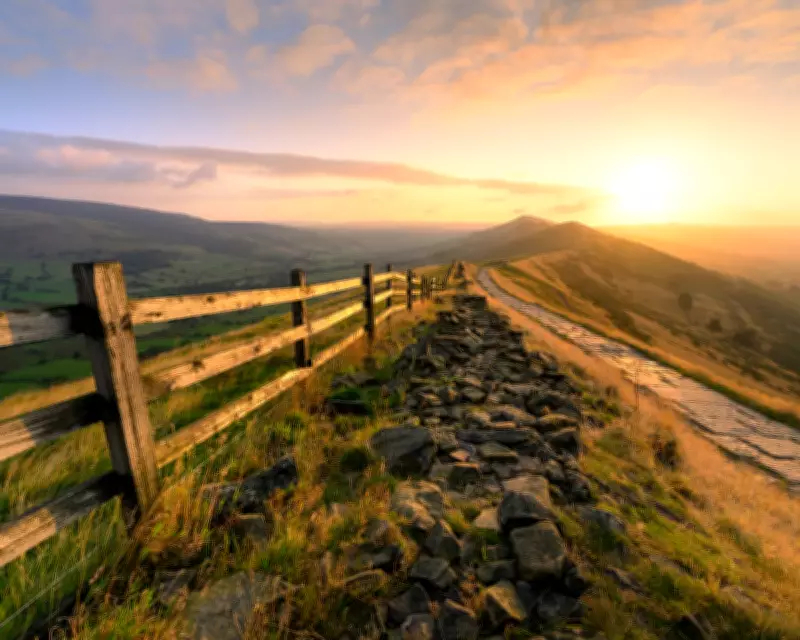
Peak District National Park Celebrates 75 Years of Wild Beauty and Public Access
The Peak District national park, established in April 1951 as Britain's inaugural national park, is commemorating its 75th anniversary this year. This milestone highlights its enduring role as a sanctuary of wild moors and gentle dales, inviting exploration just as it did upon its creation. From space, the park's distinctive, cupped-hand-shaped boundary stands out as an island of darkness amidst the glowing lights of northern England's industrial conurbations, underscoring its strategic placement near densely populated areas.
A Vital Escape for Urban Populations
Located at the heart of northern England, the Peak District is uniquely positioned, with an estimated one-third of England and Wales' population residing within an hour's travel. Cities such as Manchester, Sheffield, Derby, Leeds, Nottingham, Stoke-on-Trent, and Birmingham contribute to over 13 million annual visitors, who regard the park as their backyard and playground. This proximity has cemented its status as one of the world's busiest national parks, offering a Great Escape for workers from cotton mills and steel foundries, as noted by the late journalist Brian Redhead.
When Sir Arthur Hobhouse proposed the park in his 1947 report, he emphasized its unique value due to its surroundings by industrial towns, making it both vulnerable and invaluable. Today, well-equipped walkers are a common sight in urban centers like Manchester's Piccadilly or Sheffield's Fargate, heading out for a day in the hills.

Geographical Diversity: Dark Peak vs. White Peak
The park is divided into two distinct regions: the White Peak, known for its glorious limestone dales such as Dovedale and Lathkill Dale, and the Dark Peak, characterized by gritstone moorlands like Mam Tor and Bleaklow. Personal preferences vary, with some favoring the top-of-the-world feeling of the Dark Peak's peaty expanses, such as Kinder Scout or Stanage Edge, while others enjoy the subtler joys of the White Peak.
Not all share this admiration; Alfred Wainwright famously disliked Bleaklow's bogs, and John Hillaby described Kinder Scout's summit as resembling dinosaur droppings. Yet, Kinder Scout, the highest point at 2,087 feet, holds a special place in rambling folklore due to the 1932 Mass Trespass, a pivotal event for public access rights.
Iconic Landmarks and Legends
Among the Dark Peak's treasures are the atmospheric Alport Castles, Britain's largest landslip, where peregrine falcons nest, and Lud's Church, a chasm linked to Arthurian legend as the Green Chapel from Sir Gawain and the Green Knight. The Old Nags Head pub in Edale serves as a traditional hub for walkers and the starting point of the Pennine Way.
In the White Peak, Dovedale's gin-clear waters, praised by Izaak Walton, attract crowds, but Lathkill Dale offers a quieter alternative, though its river often disappears underground. The Church Inn at Chelmorton provides a cozy post-walk pint, while prehistoric sites like Arbor Low stone circle and Magpie Mine reveal the area's rich history.
Conservation Challenges and Innovations
As a pioneer, the Peak District has implemented traffic management schemes and converted former railways into trails like the Tissington and High Peak Trail. However, it faces significant challenges, including a 50% real-terms cut in government funding over the past decade, leading to staff reductions and the establishment of the Peak District Foundation to raise income. A proposed visitor tax has sparked debate, echoing past struggles for access.
During the Covid pandemic, the park proved a vital lifeline for locked-down urban residents, a role it has proudly served for 75 years. With its blend of natural beauty, historical significance, and ongoing conservation efforts, the Peak District national park continues to inspire and protect, ensuring its legacy for future generations.