
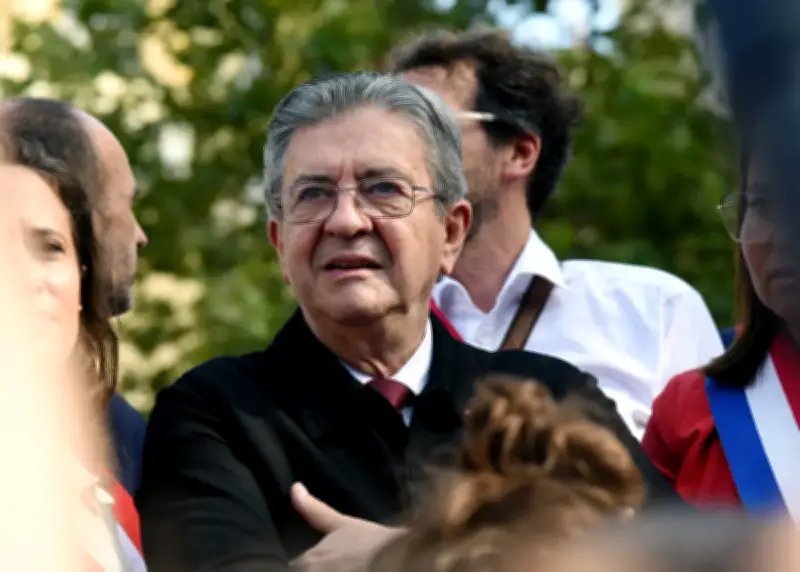
Jean-Luc Mélenchon, leader of La France Insoumise (LFI) and a 2027 presidential candidate, is drawing significant support among French voters under 35, but his stances on Russia, Ukraine and the EU are alienating some progressive voters who might otherwise support him.
Théodore Abitbol, a 34-year-old self-described “militant antifascist” with degrees in political science and comparative literature, is a regular participant in pro-Palestine protests and has a decade of full-time activism under his belt. His bookshelf ranges from the gender and queer theory of bell hooks to the anti-capitalist social analysis of Marxist theorist Mike Davis. Yet Abitbol, who opposes Macron’s economic policies, says he cannot stomach voting for Mélenchon because of the LFI leader’s positions on Russia, Ukraine and the EU.
“A part of the [French] left retains a cold-war mentality where Russia is an ally against American imperialism, without seeing that Putin and Trump are in agreement about almost everything in their foreign and domestic policies,” Abitbol said.
LFI’s domestic appeal
LFI is doing something necessary by focusing on some of France’s most left-behind urban areas and giving voters in them a voice. Bally Bagayoko faced down racist abuse to win the mayoral race in Paris’s inner banlieue of Saint-Denis. David Guiraud defeated the right for the first time since 1983 in Roubaix, one of France’s poorest large cities. The party’s success in these heavily working-class and minority areas is due to its willingness to draw new lines around old identity debates and an intransigent anti-capitalist attitude. LFI parliamentarians such as Clémence Guetté are making innovative and radical proposals, such as recognising close friendships and extending legal rights to them.
Mélenchon consistently polls at around 17%, enough to qualify for round two of the presidential election. The combined non-Mélenchon left, split between the Ecologists, Socialist party and Communist party, just trails him, with Raphaël Glucksmann leading a split field with around 10% of a first-round vote. Polling also shows that Marine Le Pen would defeat Mélenchon 69% to 31% in a second round run-off.
Mélenchon’s Russia record
Since the mid-2010s, Mélenchon has consistently advanced many of the claims that make up what is called the “zombie lie” of Russia’s propaganda about Ukraine. In 2014, he denounced the Maidan Revolution, saying that Russia would have to defend itself against “an adventurous putschist regime in which neo-Nazis wield a thoroughly reprehensible influence”. When Putin annexed Crimea shortly after Maidan, Mélenchon defended it by claiming that “Crimea has always been Russian”.
In 2015, after France cancelled the sale of two advanced Mistral-class helicopter carriers in response to Putin’s aggression, Mélenchon joined Marine Le Pen in decrying the cancellation as the “vassalisation of France to Nato’s bellicose rhetoric”, and accused the then president, François Hollande, of “unbearable betrayal” for having “devalued the worth of France’s word” by refusing to deliver the warships.
Mélenchon filled the next seven years alternately invoking international law to condemn the US’s unilateral action in Syria, and dispensing with the same international law when it came to defending or minimising Russia’s unilateral action and war crimes in Syria, which killed, by moderately conservative estimates, 20,000 civilians. All while denying Russia’s former Soviet colonies their right, under international law, to freely choose their alliances by joining Nato.
Accepting Georgia’s request for membership would be, he said, an “offensive and stupid provocation”. As for Estonia, Lithuania and Latvia, Mélenchon’s dismissals have been scathing. “I feel nothing in common with them, it’s the end of the world, even the Romans never made it that far!” he said in 2017.
Impact on the 2027 election
It’s little surprise that Putin’s 2022 invasion of Ukraine did nothing to rock Mélenchon’s fixed position. Ukraine was “without a doubt” the aggressor, he claimed, whereas Russia felt “humiliated, threatened, aggressed” by the US’s decision “to annex Ukraine into Nato”. In the four years since Putin’s war, Mélenchon’s personal blog and media appearances have included bringing Russia “back into the fold” and re-opening the Nord Stream gas pipelines; castigating Zelenskyy as “president of nothing” while promoting the Kremlin’s narrative about his lack of political legitimacy; and haranguing other Europeans for having “demonised Putin”.
Mélenchon is not trying to hide his Eurosceptic ideas. What he loudly said during the first presidential debate, in late August, is also in his programme: he will “assume confrontation with European institutions” and “disobey” EU rules “whenever necessary”.
If the presidential contest comes down to Mélenchon v Le Pen in the final round, then Abitbol says he would vote Mélenchon, but “with vomit in my mouth”. Pity him and the others like him who might have to choose between two equally disastrous visions of France in Europe and the world.




