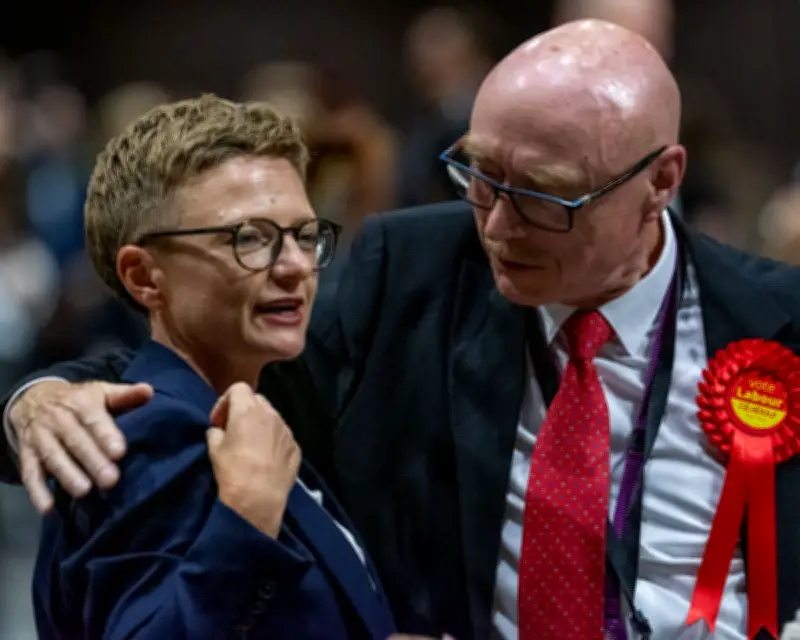
Bev Craig was elected Greater Manchester mayor on Friday, succeeding Andy Burnham. Under the supplementary vote system, Labour took 47% of the first-round vote, well down on Burnham, who never achieved below 63% in his three campaigns. But when second preferences were counted, an estimated seven in 10 progressives who had backed other parties piled in behind Craig.
Neal Lawson, director of the cross-party campaign organisation Compass, argues that this result confirms British politics now operates as two blocs: left versus right. Few voters move between blocs, but many switch parties within their own bloc. The Manchester result saw the progressive bloc consolidate behind Labour, just as it did for Burnham in Makerfield. However, earlier this year those same voters backed the Greens in Gorton and Denton, and Plaid Cymru in a Senedd byelection at the end of last year.
Progressive voters are promiscuous yet disciplined
Two trends are visible in this progressive bloc. Voters are becoming more promiscuous in who they genuinely support, yet highly disciplined in how they actually vote. They appear to back the progressive candidate best placed to beat the right, but only if that candidate is considered sufficiently progressive. This fluid group can ruthlessly flock around the same candidate when necessary.
Given the fragmentation of UK politics, progressive parties and voters face two challenges: winning and governing. Within the fragmented bloc lies the danger of "progressive tragedies", where a majority progressive vote splits and allows the right bloc through. The bloc that wins today is the one that most efficiently organises its total vote.
Quantity of votes is not enough
But the quantity of the progressive vote is not all that matters; its quality matters too. Majorities can be won on a small percentage of the vote, as in the 2024 general election, but such victories do not produce strong government because people are merely backing the least bad option. As soon as the going gets tough, this negative support melts away. Unless Labour can reach and maintain something like 40% of the national vote, governing will remain treacherous.
Lawson argues that Labour has been trapped in a doom loop of failure for too long. By deciding to go it alone and refusing to work with other progressive parties, it can only win under first past the post by appealing to centre-right voters. That means promising little or no change. With no mandate for radical change, Labour sets itself up to fail and wonders why it loses the red wall, Scotland, Wales, Muslim voters and now inner-city seats.
Burnham's cross-party legacy
The clever move, Lawson says, would be to mobilise the country's entire progressive majority around a transformative offer. This fragmented landscape can and must be woven together by combining values, policies and electoral performance. There are good omens, starting with Burnham himself. He built a long-term cross-party consensus in Manchester, which formed the basis for sustained state and private sector investment and the fastest-growing economy in the country. His experience of the supplementary vote, where securing second preferences required listening to and engaging with non-Labour voters, led him to back a fully proportional voting system.
But mobilising any latent progressive majority requires deeper roots than transactional electoral politics. That is why Burnham's cross-party move on social care matters, even though he should have involved the Greens. He recognises that some large issues need a broad and permanent consensus. This principle should be extended, not least to delivering a low-carbon economy. Such processes build trust across parties and reveal how much progressives have in common.
Clacton and the problem of general elections
Problems remain. Progressive consolidation works in byelections, where media attention and polling signal to voters which candidate to back. But unless progressives work out how to organise their bloc in a general election, the chaos of many progressive tragedies will ensue. In this regard, Clacton shows the way. It is woeful that the progressive parties have all pulled out, leaving Clacton voters with no serious choice about who represents them.
As in Tatton in 1997, where the anti-corruption journalist Martin Bell stood against the sitting Tory MP and won, moves should have been made to field a credible centre-right independent to challenge Reform. A critical precedent has now been re-established: the so-called "national" parties do not always put up candidates. Having stood aside once, they can do it again. Why stand a candidate in a seat with no hope of winning, and by doing so only make it more likely that the national populist right wins? At the next election, local parties should be empowered to decide whether to stand or not.
Proportional representation as the key
The change that could unlock all of this is proportional representation (PR). The promise of PR massively helps consolidate the progressive vote at the next election. Burnham and the Labour party staunchly back it. Combined with manifesto promises from the Liberal Democrats and the Greens, a super-majority for change could transform the political system for good. That is why the vote in the Commons on 2 September on an elections bill amendment setting up a national commission to pave the way for PR is a critical litmus test of Burnham's commitment to a new politics for a new society.
British politics has never been more volatile and will continue to be so. The Burnham bounce is welcome, but will it last? No one should think the resourceful and ruthless British right will simply sit back and let progressives win. They will unite the right if they must.
As ever, the people are ahead of the politicians. If the parties can catch up and stop their self-defeating tribalism, progressives won't just beat Reform – they will beat the causes of Reform. Neal Lawson is director of the cross-party campaign organisation Compass.