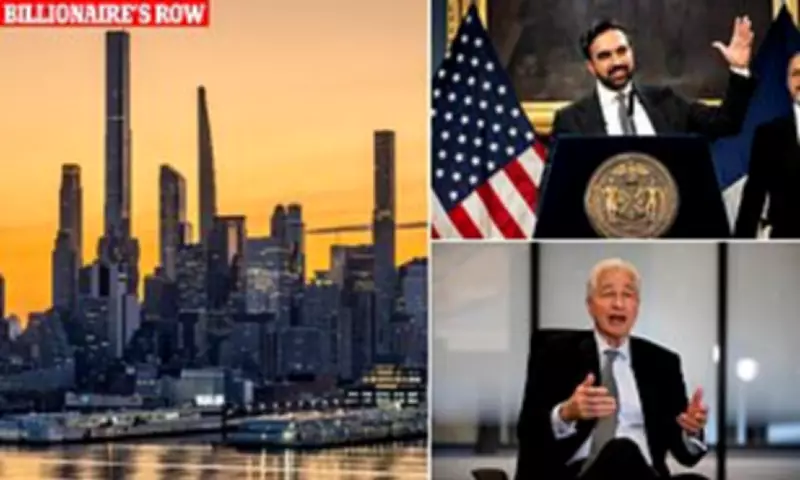
Jamie Dimon has joined a growing chorus of billionaire critics slamming New York City Mayor Zohran Mamdani over his proposed tax hikes targeting the wealthy. The JPMorgan Chase CEO warned that Mamdani's fiscal agenda risks undermining New York's long-standing status as a global business hub, following a recent meeting with the mayor.
Dimon's Warning
'People think that somehow being anti-business is going to help the city - it's not,' Dimon told Bloomberg TV. He also argued that New York's talent base is already beginning to erode, pointing in part to Texas' aggressive efforts to attract companies away from the city.
Mamdani's Tax Proposals
Mamdani, who has been outspoken in his criticism of Wall Street executives, is pushing ahead with a series of tax measures aimed at closing the city's budget gap - including a controversial pied-à-terre tax on luxury second homes valued above $5 million. Aside from Dimon, the mayor has also met with prominent business leaders such as Goldman Sachs CEO David Solomon and Blackstone president Jonathan Gray. However, his proposals have drawn sharp opposition from real estate executives and industry figures.

Critics have particularly pointed to a recent video released last month promoting the second-home tax, in which Mamdani stood outside Citadel CEO Ken Griffin's $238 million penthouse at 220 Central Park South. Griffin broke the record for the most expensive home purchase in the US when he snapped up the Manhattan penthouse in 2019, but his primary residence is now in Miami, Florida after relocating his hedge fund in 2022. In the video, Mamdani celebrated the policy while using the property as a prominent example of homes that would be affected.
Griffin's Response
Griffin responded by calling the video not only 'creepy' but also 'frightening,' saying it evoked memories of the political dysfunction that prompted him to leave Chicago. Dimon echoed some of those concerns, saying, 'I think he realized he made a mistake in naming Ken and vilifying a name and a person. It's probably why he's seeing a bunch of us now. He'd like to maybe have a better relationship with the business community.'
Broader Concerns
Beyond tax policy, Dimon argued that rising crime and anti-business sentiment are driving companies out of New York, pointing to JPMorgan's own workforce shift toward Texas as evidence that people 'vote with their feet' when cities become less desirable. At the same time, Dimon stressed he is not fundamentally opposed to Mamdani, saying he understands the importance of addressing issues such as affordable housing and childcare. However, he emphasized that the mayor should ultimately be judged on his actions rather than his rhetoric. 'Hopefully he'll learn,' Dimon said. 'I want him to do a good job. I'm not against him.'
Budget Adjustments
Mamdani has made some concessions on his tax hikes. His property tax hike that would have raised property taxes by 9.5 percent to generate $3.7 billion in revenue was quietly dropped from his executive budget after weeks of backlash. Mamdani unveiled the executive budget for the current fiscal year on May 12, confirming his administration had closed a budget gap of more than $12 billion that he said he inherited upon taking office. Alongside Governor Kathy Hochul, Mamdani announced that New York State had secured an additional $4 billion in aid to help plug the deficit, bringing total new state assistance to nearly $8 billion over two years.
He argued that the deficit was ultimately closed through aggressive cost-cutting, efficiency measures across city government and negotiations with Albany, while using the prospect of higher property taxes - one of the few revenue tools directly under the city's control - as leverage in talks with the state. 'We scoured for savings and demanded greater efficiency from every part of city government,' Mamdani said. 'We partnered with Albany, securing billions in new funding and reversing many of the cost burdens that Andrew Cuomo shifted to the city over his decade as governor. And we taxed the rich, asking those with the most to contribute a little bit more to support those with the least. We pulled New York City back from an existential fiscal break.'

Another tactic Mamdani is floating to overcome the budget disparity is allowing the city to delay billions in pension payments, which would push back retirement contributions into its vast municipal pension system - freeing up at least $1 billion in the next fiscal year. For now, the city remains on track to meet its long-term pension funding obligations by its 2032 deadline.