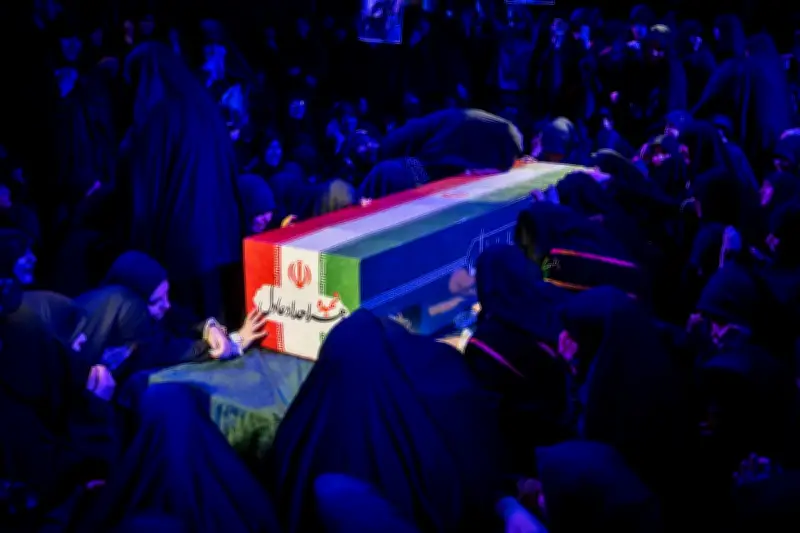
Iran has commenced a six-day funeral ceremony for Ali Khamenei, the country's supreme leader for 36 years, who was killed in a US-Israeli attack on February 28 at age 86. The event, expected to draw up to 30 million mourners, is designed to project national power, resilience, and social cohesion while conveying a message of resistance to the world.
Preparations and Early Ceremonies
In the days leading up to the funeral, Tehran saw the installation of roadblocks, stalls, posters, and army vans. Banners featuring a red fist—the funeral symbol—alongside the slogan "We must rise" lined the streets. A giant statue of a clenched fist was erected in Revolution Square. Special hostels were set up across the city for pilgrims.
On Thursday evening, an indoor ceremony dedicated to families of war victims displayed Khamenei's coffin for the first time. Crowds pushed forward, throwing scarves for attendants to brush against the coffin. Gen Ahmad Vahidi, commander-in-chief of the Islamic Revolutionary Guard Corps (IRGC), made his first public appearance since February 8. The body was then transported to the Grand Mosalla mosque, where it will lie for three days.
Political and Religious Dimensions
Friday saw Iran's political, judicial, and military elite pay respects. The coffin was covered with the sacred flag of the Imam Husayn shrine. Senior IRGC commander Mohsen Rezaee wept openly, while President Masoud Pezeshkian shed a tear. Foreign dignitaries from Iraq, Pakistan, Armenia, and Tajikistan attended at senior levels, along with 12 heads of parliament from Arab states. No Western leaders were invited; Iran's foreign ministry spokesperson Esmail Baghaei accused European countries of standing on the "wrong side of history."
The funeral also includes the coffin of Khamenei's 14-month-old granddaughter, killed in the same blast that killed the supreme leader and three other family members. The body will be carried through the Iraqi Shia cities of Kerbala and Najaf at the request of Iraqi politicians.
Security and Political Strains
Organizers face security threats from terrorism and crowd control, especially given the context of an uncompleted war with the US and Israel. Previous mass funerals, such as those for Ayatollah Khomeini in 1989 and Qassem Suleimani in 2020, were marked by chaos. Iran's first vice-president Mohammad Reza Aref, the lead funeral organizer, called the ceremony "the most important event of this century."
Throughout Friday, Iran's leadership emphasized resistance and revenge. Vahidi vowed Iran would never surrender, stating Khamenei "has a place in our hearts and souls... and we will never say goodbye to him." Hardline MPs spoke of blood vengeance. Mohammad Bagher Ghalibaf, Iran's chief negotiator, said: "We must rise up and convey the nation's call for bloodshed to the world."
Absence of Successor
Khamenei's son and successor, Mojtaba Khamenei, is not expected to appear at the funeral. He was severely injured in the same US-Israeli strike and has only issued written statements. His physical absence, combined with rival political factions claiming his support and soaring inflation, is straining Iran's political system. Israel's defence minister Israel Katz threatened to kill Mojtaba, prompting hardliners to call for a re-examination of Iran's fatwa against nuclear weapons.
Procession and Public Sentiment
A 6-mile (10 km) procession through central Tehran from Imam Hossein Square to Azadi Square is planned for Monday, echoing the route of the 1979 revolution. Organizers, aware of potential backlash over economic suffering, have erected posters proclaiming "a bright future for Iran." The funeral coincides with Muharram, a period of Shia mourning for Husayn ibn Ali, drawing parallels to Khamenei's resistance. In one of his last speeches on February 17, Khamenei referenced this symbol of defiance, saying: "Someone like me does not pledge allegiance to someone like Yazid."