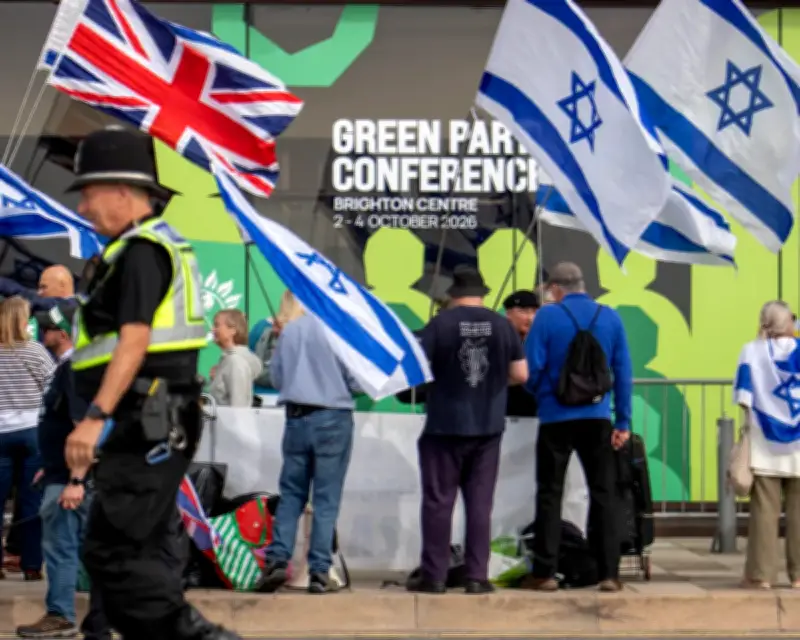
The Green party of England and Wales is in turmoil after a vote to adopt a policy that equates Zionism with racism and calls for Israel to be replaced by a single Palestinian state “with equal rights for all”. Some Jewish members say they are considering whether they are welcome in the party.
While Green members celebrated, or mourned, the motion passing, some have questioned its purpose, arguing it will distract from what’s important – keeping eyes on Gaza and holding the Israeli government to account – instead igniting a divisive discussion about ideology that will only harm the party.
Fallout from the vote
Yesterday, the head of the Jewish Greens Vivien Lichtenstein confirmed that she is considering leaving the party after Sunday’s vote. Many other Jewish Greens – a significant majority of whom described themselves as anti-Zionists when polled – are similarly taking stock.
The chief rabbi, Ephraim Mirvis, described the motion as “poisonous antisemitism” and Israel immediately barred Zack Polanski, the Green party’s Jewish leader, from entering the country. The Israeli foreign ministry denounced the motion as “a stain on the history of the United Kingdom”.
With four of the Green’s five MPs opposing the new policy, yesterday evening the group representing European Green parties expressed dismay at the move which runs counter to their support for a two-state solution for Israel and Palestine. There is now growing anger internally with Polanski, who avoided the debate to campaign in the Holborn and St Pancras byelection, where he is running for former prime minister Keir Starmer’s seat.
What the motion says
Zionism isn’t a clearly defined, singular ideology. Broadly speaking, it means support for Jewish self-determination, realised today in the state of Israel. The motion argues that Zionism is racist because it “privileges one ethnic group on the basis of the subjugation of others” and that in Israel this is based upon “European settler-colonial systems of domination and oppression”. It adds: “This motion is aimed at the political ideology and practice of Zionism … and not at the religious or ethnic background of those who may identify as Zionists”.
The motion was put forward by Greens for Palestine, an internal pressure group that calls for the creation of a single Palestinian state, in which Jews and Palestinians can freely live. There is clearly broad support for this general principle – the motion passed by 1,022 votes to 813. One of the sponsors, Kieran Andrieu, a British Palestinian, described it as a “unifying motion”, arguing there was “enormous virtue” in naming what he said was a “damaging ideology”. During the debate, he added, “everyone was agreeing that we need to disagree agreeably”.
Legal and internal challenges
A legal case against the new policy is highly likely – some Green members are already consulting lawyers over whether the party could be challenged for breaching equalities legislation. Barrister Adam Wagner KC, who led a case that decided Jeremy Corbyn’s Labour party broke equalities laws over antisemitism, told Peter he believed such a case would have a good chance of success.
There is huge frustration, particularly from longer established members, at what they consider a lack of leadership from Polanski. First, in trying to cancel the conference to free up his supporters to campaign for him, and second for missing the debate on a hugely divisive matter. Other senior party figures, such as the former co-leader Carla Denyer, have voiced concern that the motion draws attention away from what’s important.
“I’m concerned that elected Greens will be forced to spend our time and energy debating and defending definitions, at the expense of focusing on the essential actions that only we can take to make things materially better for people in Palestine,” Denyer said in a statement on X.
Polanski has said he agrees that Zionism, when defined as “the displacement and genocide of the Palestinian people”, does “clearly” constitute racism. Critics say he could have supported what was regarded as a “safeguarding” amendment, which offered reassurance that members would not be disciplined for their membership of Jewish organisations with Zionist affiliations, even synagogues – as the amendment did not garner enough support to pass.
This is now a “genuine fear” among some Jewish members. Greens for Palestine have consistently stated this was not its intention, emphasising that the policy refers to Zionism as a political ideology, supporting the state of Israel which they believe relies on apartheid and racism to uphold a majority Jewish population.
“But as the Jewish Greens pointed out, Zionism can mean so many different things,” said Peter. A Palestinian in the West Bank or Gaza, a left-leaning kibbutznick and a Netanyahu supporter will each have different interpretations. “Many now worry that this enshrines a definition of Zionism that only reflects an extreme, right wing version of it.”
Broader implications
“To brand everyone under that one umbrella as a racist shows a deep ignorance of what the word Zionism means and the sheer range of people who identify with it,” is the point Guardian columnist Jonathan Freedland made ahead of the Green conference vote. He told that the motion’s success marked “a shift in the Overton window” that has left many people well beyond Green party activists alarmed: “A mainstream political party has adopted a position, which functionally identifies most British Jews as racists,” he suggests.
Jonathan references the celebrated Israeli writer and peace activist Amos Oz, who described Zionism as a ‘family name’. “‘Zionist’ alone doesn’t tell you much. You need to have a first name to make sense of it: whether that’s socialist Zionism, Marxist-Zionism, religious Zionism or cultural Zionism,” he says.
For many British Jews – nearly two-thirds of whom identify as Zionist according to a report by the Institute for Jewish Policy Research published on Monday – this is not about support for Israeli government policy, current or past. “For many Jews, when you use the term Zionism rather than Israel, you’re in the realm of a dream or an aspiration; one that is a constitutive part of the Jewish identity,” he says.
Meanwhile, younger Jewish people, aged sixteen- to 29-year-olds were less likely to say Israel was “very important” to their identity, with the percentage falling by one point – to 27% – in 2024. This aligns with some Jewish commentators who argue there is a generational shift in the Jewish diaspora, with those younger people appalled by Israel’s actions in Gaza identifying less as Zionist than their parents’ generation.
Impact on the Greens
Most close observers believe that the Zionism motion is unlikely to make a difference to the outcome of Thursday’s byelection: Labour are very confident of transforming Starmer’s base and Burnham’s bounce into a win, while Polanski himself has rolled the pitch in advance, saying it’s a 50/50 outcome that won’t impact his authority as leader.
The longer term problem for the party, Peter argues, is that this one policy dispute overshadows all others, and might even cap Green support at a point when the party was on the cusp of an electoral breakthrough. “On Sunday, after the Zionism vote, they announced a series of key economic policies that no one paid any attention to. This is all they’re going to be able to talk about, maybe up to the next election, and voters don’t like parties that look like they are mired in chaos,” he says.