

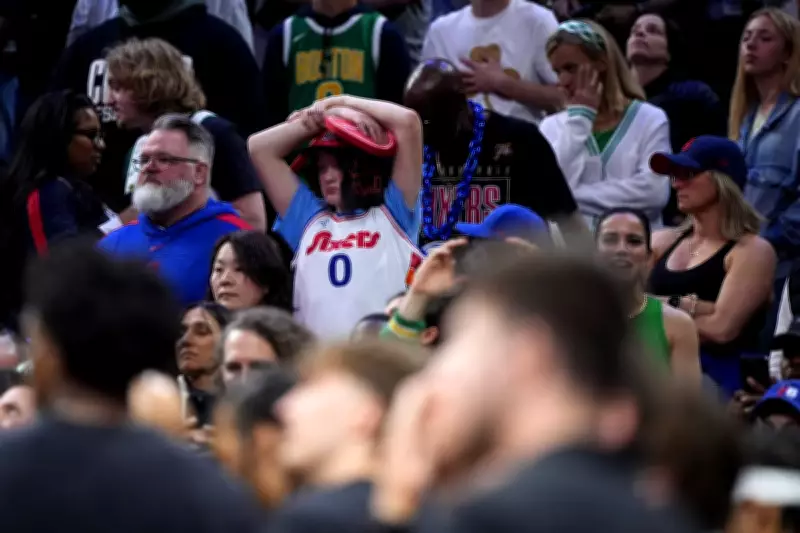
After witnessing New York Knicks fans dominate the Philadelphia 76ers' home arena for years, Joel Embiid has made an impassioned plea for local supporters to refrain from selling their tickets on the open market for playoff games.
"Don't sell your tickets," Embiid said. "This is bigger than you. We need you guys."
Of more immediate concern for the Sixers and their followers is Embiid's health. The 2023 NBA MVP missed Game 2 of the second-round series against the Knicks due to a sprained right ankle and a sore right hip. Despite a much stronger performance without him compared to the 137-98 blowout in Game 1, Philadelphia fell 108-102 on Wednesday night. The Knicks now hold a 2-0 lead in the Eastern Conference semifinals as the series shifts to Philadelphia for Game 3 on Friday and Game 4 on Sunday.

Recent history suggests the Knicks will feel quite at home in Philadelphia. Encouraged by affordable train fares, cheaper tickets compared to Madison Square Garden, and a fervent passion for Jalen Brunson, Karl-Anthony Towns, and the rest of the Knicks—now a legitimate championship contender—New York fans have flooded Philly, providing a road home-court advantage.
The Sixers attempted to counter this by using Ticketmaster to geographically restrict ticket sales, a practice known as geo-fencing. A message on their website read: "Xfinity Mobile Arena is located in Philadelphia, PA. Sales to this event will be restricted to residents of Greater Philadelphia area. Residency will be based on credit card billing address. Orders by residents outside Greater Philadelphia area will be canceled without notice and refunds given."
However, the 76ers—and other sports teams employing similar tactics—effectively close the front door but leave the windows open. Numerous resale platforms allow buyers to circumvent these restrictions without proof of Philadelphia residency, making the effort seem futile.
"I think they're soft," said Knicks fan Bryan Reinah from Queens at Game 2. "They're afraid of the Knicks takeover. Last time we played them it was 47% Knicks fans. Everybody hops on the trains and goes right down. Tickets are cheaper and the Knicks fans travel well. They're afraid of it."
The 76ers' policy sparked national headlines, though it is neither new nor uncommon. The Detroit Pistons used similar geo-fencing last season, limiting Ticketmaster sales to residents of Michigan, Ohio, Indiana, and Ontario. The Carolina Hurricanes did the same to New York Rangers fans during the 2024 and 2022 NHL playoffs.
Such policies are not limited to New York. In 2001, Washington Capitals owner Ted Leonsis wrote a computer program banning Pittsburgh residents from buying tickets on the Capitals' website. "Pretty cool, isn't it?" Leonsis said. "I got a lot of emails from Pittsburgh saying I was mean-spirited and unfair. I don't care. I'm going to keep doing it."
The Sixers stated this season's effort aimed to keep tickets with local fans who supported the team all season. Neither the team nor Ticketmaster disclosed how many face-value tickets were sold on Sunday. Ticketmaster released a video explaining its geo-fencing policy: "Sometimes, sports teams put limits on who can buy tickets for big, in-demand matchups. This is a way to give local fans the best shot at attending the event and to limit scalpers who are located hundreds of miles away, who are trying to flip the tickets just for a profit."
When the Knicks played in Philadelphia during Game 6 of a first-round series in 2024, Sixers owners Josh Harris, David Blitzer, and David Adelman, along with former minority owner Michael Rubin, bought over 2,000 tickets to distribute to community service members.
As of Thursday, tickets for Game 3 on StubHub started at around $220 in the upper deck and exceeded $1,000 in the lower bowl. The number of blue-and-orange and Brunson jerseys in the stands on Friday will reveal whether Sixers fans heeded Embiid's call to keep tickets in Philadelphia.






