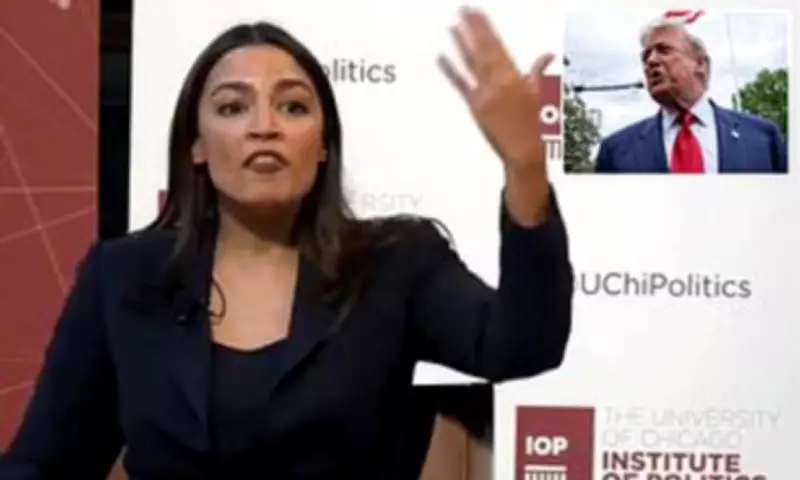
Alexandria Ocasio-Cortez has argued for the elimination of the Senate filibuster, finding herself in a rare moment of agreement with President Donald Trump. The left-wing congresswoman discussed the parliamentary procedure—which requires 60 votes to pass most legislation—with former Barack Obama advisor David Axelrod. Trump has repeatedly urged Republicans to 'nuke it' to advance his proposals, such as the 'SAVE America Act.'
Ocasio-Cortez's Argument
Ocasio-Cortez contends that the filibuster allows senators to avoid accountability for unpopular votes. 'When you have to meet a 60-vote threshold, you're not really responsible for any consequential decisions,' she stated. She challenged moderate Republicans like Susan Collins of Maine and Lisa Murkowski of Alaska to take a stand on the Save Act. 'Let Lisa Murkowski take that vote. Let Susan Collins take that vote. I dare you. Call the question. Let these senators assume personal responsibility for their own decisions instead of hiding behind this amorphous lack of responsibility. That's what the filibuster represents,' Ocasio-Cortez added.
Historical Context
She also criticized the filibuster's origins, calling it a legacy of racism and the Jim Crow era. 'I do not appreciate the wholesale fictionalization of American history—the idea that the filibuster is a grand compromise intentionally put in our system. It was created by a clerical error, and Jim Crow segregationists realized they could use this error as a loophole delaying the enfranchisement of black Americans for decades,' she said.

Reactions
Reaction to Ocasio-Cortez's statement was mixed. Liz Mair wrote, 'God is this lady dumb as a box of rocks.' Patrick Goldstein added, 'I like AOC but pushing to get rid of the filibuster when the rival party controls the Senate is just asking for trouble.' However, another commenter called it practical: 'I'm with AOC. Filibuster will be killed by one party or another soon enough anyway. Get on with it. Make the jerks in the Senate show themselves for what they are, on both sides.'
The Save America Voting Eligibility Act
The legislation in question, officially the Save America Voting Eligibility Act, would require proof of US citizenship to vote—a measure Trump has demanded to 'protect American elections.' Proof includes a passport, birth certificate, or REAL ID explicitly showing citizenship; student IDs and utility bills do not qualify. Trump has insisted the Senate version should go further, including voter ID, proof of citizenship, strict limits on mail-in ballots, and bans on transgender surgeries for minors and biological men competing in women's sports.
Political Dynamics
This stance has created a rift with House Republicans, who passed a 'watered-down' version last month focusing solely on election rules. Trump has long called for ending the filibuster to lower the threshold to 51 votes, while Democrats have used it as leverage against Republican legislation. Republicans currently hold a 53–47 Senate majority and a 219–213 House majority. Opponents argue that eliminating the filibuster would benefit Democrats when they next hold power, according to CNN.
Majority Leader John Thune has stated that the filibuster 'makes the Senate the Senate,' arguing that votes are not there to change the rules. He and other Republicans stress that the filibuster has benefited their side when Democrats were in power. Trump was particularly frustrated during the Democrat-led government shutdown, claiming that world leaders in Asia asked him, 'How did the Democrats shut down the United States of America and why did the powerful Republicans allow them to do it?' In a Truth Social post, he called Democrats 'Crazed Lunatics' suffering from 'Trump Derangement Syndrome' and urged Republicans to 'play their Trump Card' and go for the 'Nuclear Option' to eliminate the filibuster now.