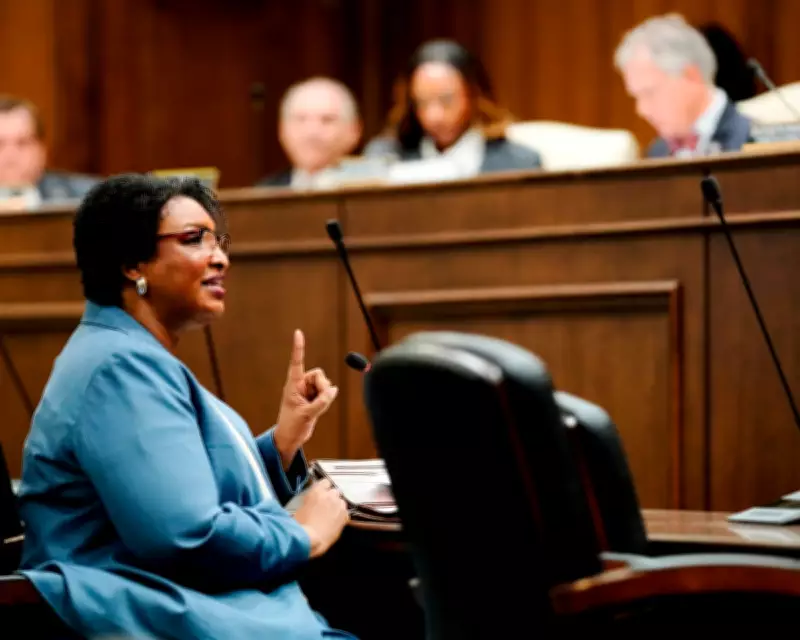
Stacey Abrams, the former Democratic gubernatorial candidate in Georgia, has denounced Republican-led efforts to redraw congressional maps in several states as 'evil incarnate.' In an interview with the Guardian's new podcast, Stateside with Kai and Carter, Abrams argued that these actions amount to intentional 'cheating' designed to suppress the voting power of racial minorities, and must be challenged both in the courts and at the ballot box.
Abrams: 'This is not just cheating'
'We've got to point out that they are not just rigging the game,' Abrams said. 'They are not just cheating. They're kneecapping the players. They are taking out the opposition. That's not fair. That is not right. That is not American.' She stressed that the gerrymandering issue transcends party lines, warning that it is not merely about Republicans beating Democrats, but about authoritarians dismantling democratic systems to avoid future competition.
Supreme Court ruling sparks redistricting rush
The comments come two weeks after the US Supreme Court effectively gutted a key provision of the Voting Rights Act in the case of Louisiana v. Callais. Since then, a number of Republican-led states have moved swiftly to redraw their congressional maps to favor the GOP, often by eliminating majority-minority districts. 'Let's be clear,' Abrams stated. 'This is evil. When evil is about what you strip from another in pursuit of power, this is evil. This is evil incarnate.'

Abrams noted that her nieces and nephews are 'the first generation to lose civil rights during their lifetime since Reconstruction.' The Voting Rights Act, while imperfect, had provided a 'cheat code to overwhelm voter suppression,' she said, but is now significantly weakened.
Fighting in courts and at the ballot box
Abrams argued that voting rights activists must continue to challenge this redistricting drive in the courts, even if they lose. 'This is no longer a battle of Democrats v Republicans,' she said. 'We're in a competitive authoritarian state,' where democratic institutions have 'become the weapons of authoritarianism because you hollow out what they mean, you compromise their accountability, you erase their legitimacy by using the very laws that people have come to accept as the tools for governance.'
In Tennessee, one of the first states to have Section 2 of the Voting Rights Act effectively stripped away, the last remaining majority-Black district has been erased. The state's ninth congressional district, which includes Memphis, has been split into three parts, each containing roughly a third of the city's Black voters. The new maps mean all nine of Tennessee's congressional districts now lean Republican.
Opportunity in adversity
'Winning in Tennessee was never going to be about stopping the maps,' Abrams said, but about how voters respond. One response is to continue the legal fight, even if courts do not rule favorably. 'Long before we got Brown v Board of Education, we had Plessy v Ferguson, we had Dred Scott. Fighting in the courts is how we build the record, but it's also how we build the muscle memory – for why we fight and how we sharpen and refine our arguments.'
The other response is to boost voter registration and turnout in those fractured districts. While the GOP is now likely to win in those areas, Abrams noted that the redistricting has 'created three new opportunities.' 'Our job is to grow. Our job is to use the scattering and say, OK, fine. You took the one we had. Well, now you've given us three opportunities to come back,' she said.
'The numbers are on our side,' Abrams argued. 'We've got to remember the reason for the urgency, the reason for the speed – the reason it took less than a week for Tennessee to take advantage of the Callais decision is that they can look at demographic numbers across this country. And in 2046, this is a country that becomes majority-minority. They can count, and so should we.'
She pointed to recent events in Hungary, where exceptionally high voter turnout led to the historic election of Péter Magyar last month, ousting authoritarian leader Viktor Orbán after 16 years. 'Hungary pulled it off,' Abrams said. 'But we don't have 16 years to wait.'