

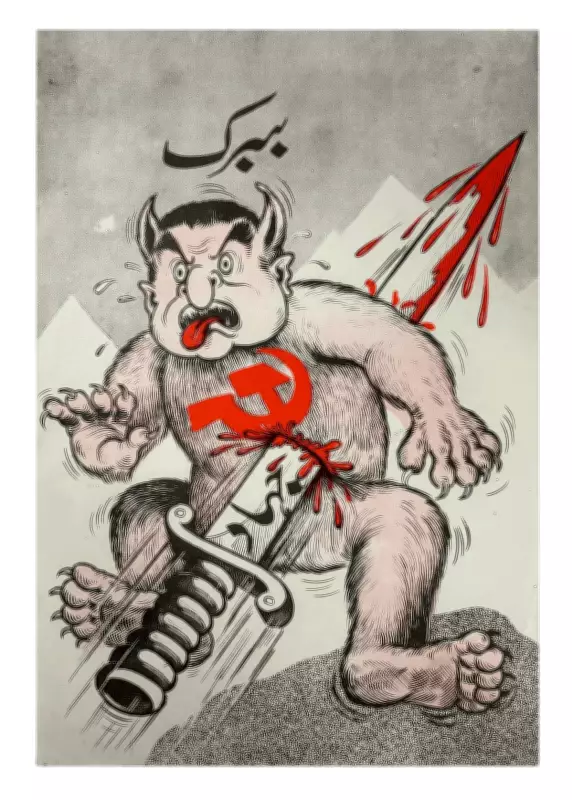
For over a century, the United States military has deployed propaganda leaflets in deliberate psychological operations, or psyops, aiming to achieve success in war. However, the fundamental question remains unanswered: does it actually work?
Historical Context of Leaflet Campaigns
In 1918, the US released more than 3 million leaflets behind enemy lines by plane and hydrogen balloon. Officials claimed these efforts helped erode morale and unit cohesion among Germans in World War I. Between 1942 and 1945, the Office of War Information coordinated much of this effort, and leaflet drops continued in every major US war since.
Thanks to Khajistan, a New York-based digital archive group, many of these leaflets are now on display in an interactive exhibit titled Office of War Information (OWI) at Pioneer Works in Brooklyn. Since 2022, Khajistan—which preserves “art, words, and media from forgotten or silenced communities, from the Indus to the Maghreb”—has collected hundreds of propaganda leaflets from US wars in Iraq, Afghanistan, and Libya, along with a collection from World War II Japan.

Internal Documents Reveal Mixed Results
While the official narrative touts psyop leafleting as hugely successful, internal documents paint a complicated picture. A declassified 1971 US Air Force report challenged psyops’ purported successes in Vietnam. From 1968 to 1971, the US and South Vietnamese government dropped about 5 billion leaflets annually over Vietnam, Cambodia, and Laos, dispensed “by the handful in 0-2Bs or dumped wholesale in loads of 12 million from C-130s properly characterized as ‘B.S. [bullshit] Bombers.’”
Why bullshit? The report found that leaflets “often transgressed elementary rules of persuasion and therefore lacked credibility,” violating a basic rule that “allegations about oneself or the enemy should not diverge widely from the facts as the target population sees them.” Interviews with enemy prisoners of war revealed that leaflets were not used as intended. One prisoner carried two leaflets “as paper with which [the] source could roll his cigarettes,” while another explained that everyone used leaflets as toilet tissue. Soldiers in some units collected them as souvenirs.
Continued Use Despite Questionable Efficacy
Despite these revelations, the military persisted. In the Gulf War of the early 1990s, the US produced 29 million leaflets. One report claimed that psyops messaging “persuaded approximately 44% of the Iraqi army to desert, more than 17,000 to defect, and more than 87,000 to surrender.” However, these numbers are difficult to verify, and the American public has had little access to the leaflets to make independent judgments.
Saad Khan, founder of Khajistan, explained his motivation: “I come from war.” Born and raised in Pakistan, Khan described a recent Islamic State bombing near his family in Islamabad. “We heard it. It’s part of fucking life.” The name Khajistan comes from a city near Herat, Afghanistan, and the archive focuses on “people who don’t get space in real life.”
The Exhibit: Playfulness Amid War
At Pioneer Works, the OWI exhibit recreates a wood-paneled office of an earlier era. Two genuine American propaganda posters supporting the mujahideen in Afghanistan hang on one wall. An old TV plays clips of Friends and Everybody Loves Raymond on loop. A cabinet displays rare finds, including an edition of The Alphabet of Jihad—a USAID project from the early 1980s that taught children to read in Pashto and Dari through anti-Soviet passages and illustrations of missiles, tanks, and landmines. The program, now considered an embarrassment, cost $51 million and ran from 1984 to 1994.
Thousands of replicas of genuine leaflets are strewn across the floor, with new ones printed every 10 minutes. Visitors can grab a leaflet and input its number on old computers to discover translations and details. World War II leaflets dropped on Japan hang on corridor walls. The space is painted in bright Tom and Jerry yellow. “Playfulness is very important,” says Khan. “Even in war, life goes on.”

Patterns and Dehumanization
Examining the leaflets reveals patterns. Those dropped on Japan eerily resemble Donald Trump’s threats to Iran’s leadership. One leaflet shows people fleeing burning buildings with text: “Do you remember the great damage done to your country by the earthquake in 1923? America is capable of producing earthquakes that will cause damage a thousand times greater … Your homes will be destroyed, factories will vanish, and your family killed.”
Leaflets in Iraq contained more text than those in Afghanistan, which relied more on images—likely reflecting higher literacy in Iraq. Both Osama bin Laden and Saddam Hussein are frequently caricatured. Other leaflets advise cooperation or emphasize ethnic brotherhood, though much imagery appears demeaning or bigoted. More recent leaflets feature anime-style imagery.
All these materials are considered “white” propaganda, where the source is clearly identified and the message is believed true by the propagandist. However, Khan argues: “Dehumanization is at the core of this shit. Thinking that you can drop shit on people like this and think that they will change their mind. It’s the same idea [with the Americans in] Iran. You will assassinate all these people and then [believe that] people will come out for freedom and liberty? There’s racism in this.”
Are Leaflets Effective?
The exhibit doesn’t directly answer whether leaflets achieve battleground success, but it comes close. “These leaflets are just trash, like on the floor,” Khan says. “Are they even effective? They’re dropped so that, after the war, in Congress, when they summon the guy, he’ll say: ‘we dropped the leaflets before [we bombed them].’ This is self-serving for Americans, like how America bombs and then sends non-profits. It’s part of that system.”
Office of War Information (OWI) is at Pioneer Works in Brooklyn, New York, from 9 May to 9 August 2026.





