
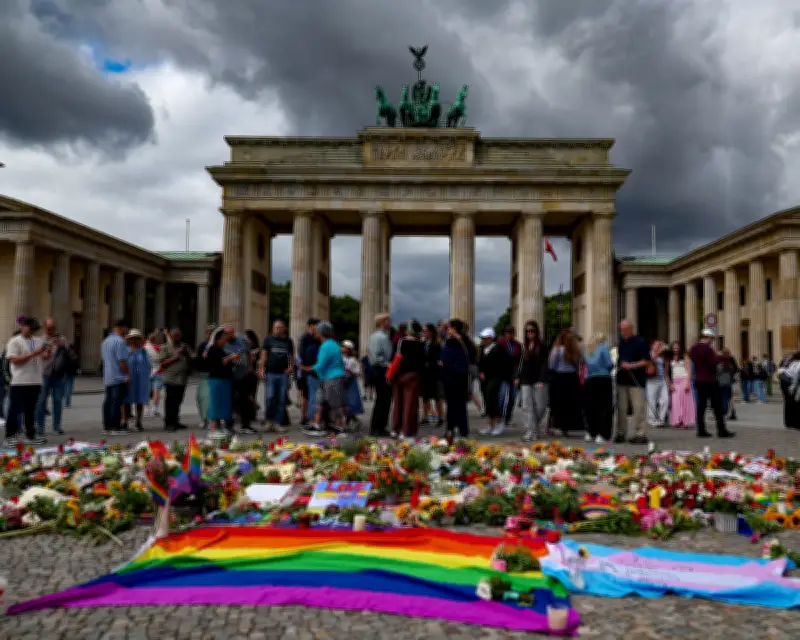
German officials have called for a tightening of laws for known extremists after a deadly attack at Berlin's Pride parade on Saturday, as the far-right Alternative für Deutschland (AfD) moved to mobilise voters ahead of three key state elections.
The Attack and the Suspect
Abdul Ballout, a 21-year-old German national with Lebanese roots who was well known to police, is believed to have rammed a van into a crowd in Tiergarten park late on Saturday, next to the finale of annual LGBTQ+ celebrations that drew hundreds of thousands of people. After the vehicle, which had been rented in Ballout's name, crashed into a tree, he allegedly attacked people with a large knife. A 65-year-old Polish woman died and 29 others were injured.
Following an hours-long manhunt, police said they shot Ballout dead in a garden allotment in the Spandau district on Sunday after he ran at them with a “bladed weapon” when they attempted to arrest him. Security authorities said Ballout was a supporter of Islamic State and last year attempted to join the group in Syria. He was arrested in Lebanon and repatriated, and in May was convicted in Germany of “preparing a serious act of subversive violence”. Berlin-born Ballout, who lived with his divorced mother and two sisters in the capital, was sentenced as a juvenile to a year and 10 months in prison. But the Berlin court suspended the sentence and he was allowed to walk free, albeit under sporadic police observation.
Political Reactions and Calls for Law Reform
Chancellor Friedrich Merz said on Monday the victims had been rallying for “openness, diversity and freedom”, and were assaulted by “an Islamist who sought to attack those values”. He pledged to act with “prudence but also determination” to address security gaps.
Berlin's top justice official, Felor Badenberg, on Monday acknowledged public anger over the case and urged an overhaul of juvenile criminal law. “In the wake of this attack, my conclusion is that, in cases such as this, the perpetrators must indeed be punished more severely,” Badenberg, a member of Merz's Christian Democratic Union (CDU), told public broadcaster ARD. While acknowledging the courts' independence, she said: “We must fundamentally examine whether the legal criteria we currently have for applying juvenile criminal law are still appropriate for the times.”
Far-Right Political Capitalisation
The anti-migration, anti-Islam AfD, the top party in national opinion polls, accused the government of failing to tackle Islamist radicalism on German soil. Party co-leader Alice Weidel accused Merz on Monday of failing to take the problem of Islamist extremism and “migrant violence” seriously. “Merz remains silent on Islamism – we are ready to take action!” she posted on X. The AfD's main candidate for the Berlin election, Kristin Brinker, blamed the Pride attack on the “catastrophic migration policy of the last few years”.
Berlin, one of Germany's federal states, will go to the polls in September along with two other eastern regions. In all three elections, the AfD is expected to perform well, and is poised to take first place in Saxony-Anhalt and Mecklenburg-Western Pomerania. Experts said the AfD could stand to gain from the tragedy. The party is already polling at between 38 and 40% in those states, within striking distance of an absolute majority for the first time at the state level.
Guido Friebel, dean of the economics faculty at Goethe University in Frankfurt, has conducted research on how terrorist attacks affect the AfD's electoral outcomes. “The AfD has made [the interplay between] migration and internal security one of its key issues,” he told Der Spiegel magazine. “It will capitalise politically on this attack.” Friebel said the AfD even benefited at the polls from attacks carried out by rightwing extremists, creating a dilemma for mainstream democratic parties such as the CDU. “If it [the CDU] ignores the issue, the AfD can claim that it is the only party taking the threat seriously,” he said. “If it adopts their issues and rhetoric, there is a risk that it will contribute to strengthening the AfD's political agenda.”
Rising Threat to LGBTQ+ Community
Counter-extremism expert Hans-Jakob Schindler, who advises the German government, told local media there were more than 9,000 Islamists living in the country in 2025, including 2,590 in the capital, 1,940 of whom are believed to be violent. The LSVD+ queer advocacy group said homophobic and anti-trans attacks had increased tenfold in Germany in recent years. With several LGBTQ+ marches still to come this summer, community activists said they had been sounding the alarm about a rising threat from Islamists as well as far-right extremists, but were not being heard. “Now we see that comes at a price,” said Alva Träbert, an LSVD+ board member.
Tributes were laid at the Brandenburg Gate in central Berlin after the attack.




