
Venezuelan men who were sent to a notorious Salvadoran terrorism prison by the Trump administration last year are suing the US aviation companies that transported them there. The lawsuit, filed this week in federal court in Washington DC, accuses CSI Aviation and GlobalX of violating civil rights, false imprisonment, intentional infliction of emotional distress, negligence, and other violations for their role in flying three planes that took the men to El Salvador.
Allegations of complicity
The lawsuit alleges that CSI and GlobalX “went to great lengths” to undertake the “rendition flights” to El Salvador “in concert with the US government, in flagrant violation of US and international law”. In March 2025, the Trump administration expelled more than 230 Venezuelan men held in US immigration custody to El Salvador, where they were detained for four months in a maximum security terrorism prison and tortured.
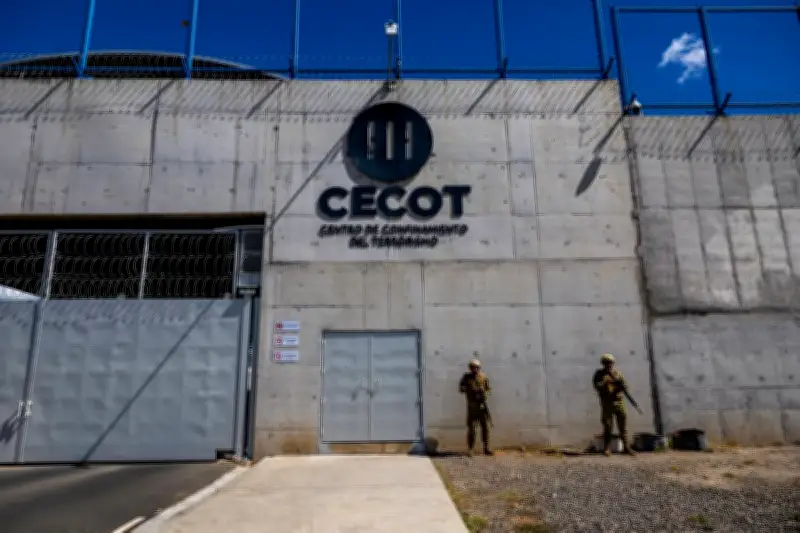
The suit claims that CSI and GlobalX deliberately transported the men despite a federal judge ordering the flights to return and despite knowing they would probably be tortured inside the country’s Terrorism Confinement Center, known as Cecot. “Without CSI and GlobalX’s complicity, neither Plaintiffs nor the Class would have been rendered to CECOT,” the lawsuit states.
Role of private companies
The lawsuit was filed by a team of human rights attorneys on 17 July and first reported by the Guardian. Anthony Enriquez, vice-president of advocacy and litigation for the Kennedy Human Rights Center and one of the attorneys representing the men, said: “Many people might not be aware of the degree to which private companies are intertwined with the human rights abuses occurring under the Trump administration through the detention and unlawful deportation schemes that are occurring.”
CSI and GlobalX, hired by the Department of Homeland Security (DHS), have “enjoyed unprecedented financial profits from the scheme”, while the Venezuelans “continue to experience severe emotional suffering from the humiliation, terror, and cruelty that they endured”, the lawsuit says. The DHS did not respond to specific claims and referred questions to the Salvadorian government. CSI and GlobalX did not respond to requests for comment by publication time.
Details of the deportation flights
CSI Aviation, incorporated in Texas, has helped broker “nearly all” deportation flights via a multimillion-dollar contract with Immigration and Customs Enforcement (ICE). CSI is the single highest-value recipient of ICE contracts, with revenue from ICE in 2025 totaling $1.23bn. For the three flights to El Salvador, CSI sub-contracted with GlobalX, headquartered in Florida.
On 15 March 2025, Donald Trump invoked the Alien Enemies Act to expel hundreds of Venezuelan immigrants, accusing the Venezuelan government of instructing members of the Tren de Aragua gang to “invade” the US. The administration rounded up 252 Venezuelan and Salvadorian men in ICE detention and expelled them to El Salvador after a deal in which the US would pay millions for their detention in Cecot. The administration never proved the men were gang members.
That same day, GlobalX, “working at the behest of CSI”, positioned three planes at a Texas airport. After the flights took off, a federal judge ordered them to return, but the administration and airline companies ignored the order and arrived in El Salvador.
Conditions in Cecot and aftermath
Once in El Salvador, Salvadorian security forces beat the deportees and transported them to Cecot. A November 2025 Human Rights Watch report found the men were subjected to arbitrary detention and enforced disappearance. The lawsuit also details brutal conditions, including beatings, pepper-spraying, rubber bullets, and sexual assault.
After four months, the Venezuelans were returned to their home country in July 2025 following a prisoner exchange. The Salvadorians sent in the same flights remain detained. The US government has not released the full list of deportees. The three main plaintiffs experience daily headaches, difficulty sleeping, and emotional distress.
Federal judge James Boasberg, presiding over the original Cecot deportation case, will oversee the lawsuit’s proceedings and determine whether the entire class of Venezuelans can sue.




