
Donald Trump has threatened to declare the Strait of Hormuz as “a territory of the United States” as his administration struggles to conclude the war with Iran.
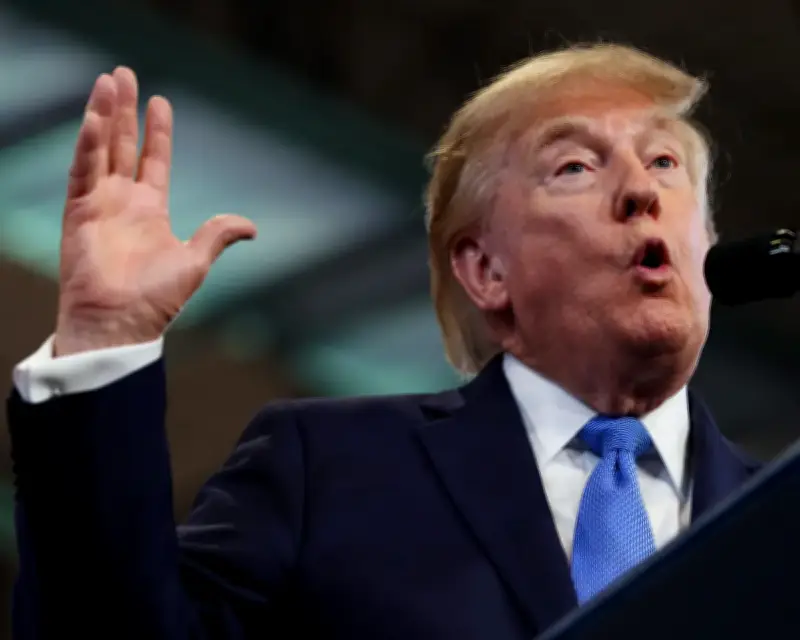
During a speech at a police academy on Long Island, New York, on Friday, the US president said he would “pretty soon” designate the waterway – a crucial chokepoint for global trade, through which about a fifth of the world’s seaborne oil supplies typically pass – a US territory.
War and blockade
The comment came as peace talks with Iran remain at an impasse following failed negotiations, with Tehran refusing to reopen the strait, which has been all but closed since the US and Israel launched their war on Iran in February.
Almost six months into the war, there is little indication that negotiations will soon yield peace, as Iranian officials continue to defy Trump’s demands. The US has been blockading Iranian shipping and ports in recent months in an effort to pile economic pressure on Tehran.
“After we finish defeating Iran, which is being very badly defeated, pretty soon I’ll be declaring the Hormuz strait a territory of the United States,” Trump said on Friday. “Essentially, that’s what it is. We have the blockade. No ships get through unless we want them to.”
Iran’s response
The seriousness of Trump’s remark, and whether it signaled a new policy position for his administration, was not immediately clear.
Responding on X, formerly Twitter, Kazem Gharibabadi, Iran’s deputy foreign minister, said Tehran would not be intimidated by threats, or a show of force, by the US – and added that the strait of Hormuz would only be opened, or closed, under Iran’s authority.
In an interview published on Saturday, Iranian foreign minister Abbas Araqchi said that Iran had not decided to resume talks with the US, and messages being exchanged via Qatar and Pakistan did not amount to negotiations, Reuters reported.
Araqchi told Iranian news outlet Shahrara News that separate talks with Oman were focused on defining a sea route through the strait of Hormuz, while the US would have to meet conditions for shipping to resume through the waterway.
Claims of control and impact
Earlier this week, Trump claimed that the US had “total control” over the strait and said “I think we will keep it” on Truth Social, despite the waterway being an internationally navigable strait bordered by Iran and Oman.
Fuel prices have risen sharply since the start of the war, forcing working Americans to pay significantly more at the pump.
Nevertheless, on Friday, Trump said that Americans who have had to “pay a tiny little bit more for your gasoline” should remember that they are “doing it so that a very evil country cannot have a – really, it’s the No 1 state sponsor of terror in the world – we don’t want them to have a nuclear weapon.
“When you have to pay a little bit more, you’re at $4, it’s OK, I mean, it’s not. I’ll never apologize. I did the right thing,” he added.
Over the past six months, the Trump administration has repeatedly claimed victory in the war, saying Iran’s regime has been pleading for a deal.
Tehran has remained steadfast in its demands, saying as recently as last Saturday that it will not reopen the strait of Hormuz unless the US “corrects its behavior”, “completely compensate[s]” Iran for war damage, lifts sanctions and “unconditionally” releases frozen assets.




