

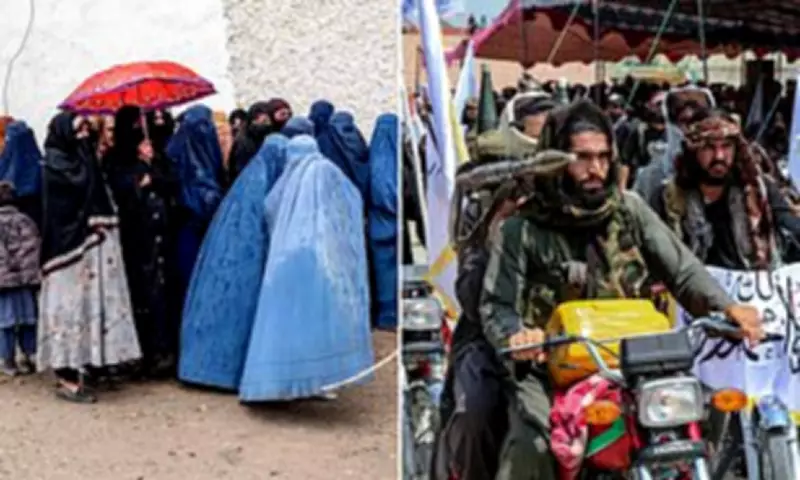
Taliban's New Criminal Code Sanctions Domestic Violence and Societal Hierarchy
The Taliban has enacted a controversial new penal code that explicitly allows husbands to beat their wives, provided no serious bodily harm is inflicted. This 90-page document, titled De Mahakumu Jazaai Osulnama and signed by Supreme Leader Hibatullah Akhundzada, formalises a regressive legal framework that has sparked international condemnation.
A Caste-Based Justice System
Article 9 of the code divides Afghan society into four distinct categories: religious scholars (ulama), the elite (ashraf), the middle class, and the lower class. This structure effectively creates a caste system, where offenders are classified as either 'free' or 'a slave,' with women being equated to slaves in legal standing.
The implications are starkly unequal: if a religious scholar or elite member commits an offense, they may only face advice or a court summons. For the middle class, the same crime can lead to imprisonment, while the lower class faces both corporal punishment and incarceration.

Institutionalising Violence Against Women
Disturbingly, the code empowers 'slave masters'—interpreted as husbands—to administer physical punishments to their wives or subordinates for minor misdemeanors. Article 32 specifies that a husband who beats his wife with a stick, causing severe injury such as a wound or bruising, could be sentenced to fifteen days' imprisonment, but only if the woman can prove the injury before a judge.
This requirement is fraught with contradictions: a woman must remain fully covered while demonstrating her injuries, and she is typically required to be accompanied by a male chaperone, often the husband himself. The code does not condemn or prohibit sexual or psychological violence against women, further eroding their protections.
Restricting Women's Freedom and Refuge
Article 34 of the code imposes severe restrictions on women seeking escape from domestic violence. A woman who repeatedly goes to her father's house or other relatives without her husband's permission, and fails to return home upon his request, faces three months in prison. Her family and relatives would also be punished, effectively cutting off avenues for refuge.
The Taliban has compounded this by passing a ruling that deems discussion of the code an offense, silencing dissent within Afghanistan. Citizens, already living in fear, are now legally barred from speaking out against these draconian measures.
International Outcry and Broader Crackdowns
Human rights activists outside Afghanistan have expressed waves of outrage online. UN Special Rapporteur on Violence against Women and Girls, Reem Alsalem, stated on X: 'The implications of this latest code for women and girls is simply terrifying. The Taliban however have understood, and understood correctly, that no one will stop them. Will the international community prove them wrong? And if so when?'
This penal code is part of a broader trend of restrictive Islamic laws in Afghanistan. Even barbers face detention for cutting men's beards too short, with the Ministry for the Propagation of Virtue and Prevention of Vice mandating beards longer than a fist. Minister Khalid Hanafi argued it is the government's 'responsibility to guide the nation to have an appearance according to sharia,' with prayer leaders instructed to describe shaving beards as a 'major sin.'
Last year, three barbers in Kunar province were jailed for three to five months for breaching these rules, according to a UN report. The new penal code, distributed across courts nationwide, underscores the Taliban's intensifying grip on societal norms and individual freedoms, with women bearing the brunt of these oppressive policies.






