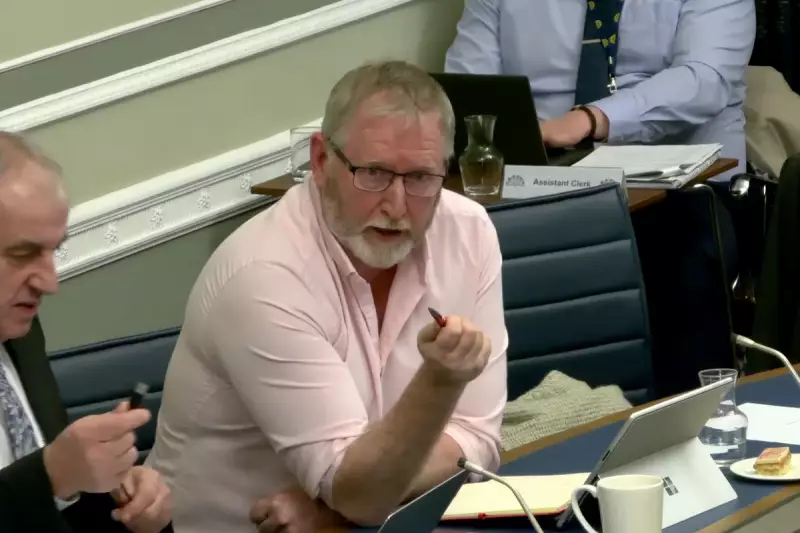
Senior police officers have told Stormont politicians that a significant "grey area" exists when dealing with children between the ages of ten and fourteen in the criminal justice system.
Committee Scrutinises Proposed Law Change
The Stormont Justice Committee examined the issue on Thursday, 15 January 2026, during its third evidence session on the Justice Bill Northern Ireland. The committee, which is currently at the committee stage of the legislative process, questioned a police delegation led by Assistant Chief Constable Anthony McNally.
Under current legislation in Northern Ireland, children as young as ten can be arrested and taken to youth court if they commit a crime. This matches the minimum age in England and Wales but is lower than in Scotland and the Republic of Ireland, where it is set at twelve.

Both the current Northern Ireland Commissioner for Children and Young People, Chris Quinn, and his predecessor, Koulla Yiasouma, have called for the age to be raised. They describe ten as one of the lowest ages for criminal responsibility in Europe. A 2023 public consultation by the Department of Justice indicated broad support for this position.
Police Stance and Practical Challenges
Assistant Chief Constable Anthony McNally stated that the police service's starting position is that they do not wish to criminalise children. "Our starting position is that we don't want to criminalise children, whatever age that's put then we'll apply the law accordingly," he told the committee.
When pressed for his view by SDLP MLA Patsy McGlone, Mr McNally drew on his experience as head of public protection, noting that only a "small proportion" of children commit crime. He refused to be prescriptive about a specific age, highlighting a "massive, massive variation" in the children he has dealt with.
The committee heard that while children under ten cannot face criminal investigation, cases are referred to social services, often due to underlying issues like hunger. Despite this, there have been instances of children aged ten and younger involved in serious public disorder, such as rioting.
System Infrastructure and Custody Modernisation
Chief Superintendent Gary McDonald acknowledged that while there is a separate justice system infrastructure for children, "like any system, there are issues within it". Ulster Unionist Party MLA Doug Beattie raised concerns about a "real grey area" for 10 to 14-year-olds, particularly in an increasingly technological world.
Mr McNally also outlined plans to modernise custody facilities across Northern Ireland. He described a "mixed economy", with modern suites in Belfast's Musgrave Street and Derry's Waterside, alongside some "very old" facilities with limited capacity to segregate detained adults and children.
Police ultimately aim to ensure a child spends "the least amount of time possible" in custody. Future plans may involve amalgamating custody suites in areas like Lurgan, Omagh, and Dungannon to build a modern facility, potentially at Mahon Road in Portadown.
The proposed amendment to the Justice Bill includes raising the age of criminal responsibility, with exceptions for the most serious crimes: murder, manslaughter, and rape. The bill also seeks to amend laws on the retention of biometric data and the bail and detention of children.