

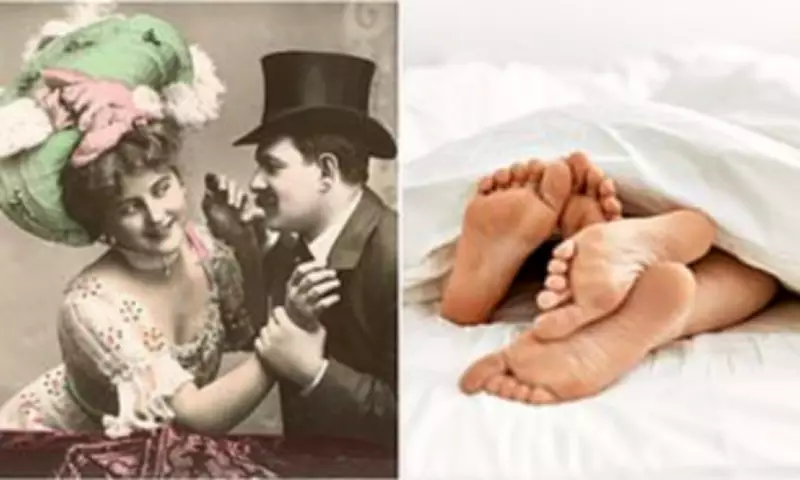
The Lost Language of Love: How Sexual Euphemisms Have Evolved Through History
Terms like 'Riding St George,' 'pully-hawly,' 'clicket,' and 'blanket hornpipe' might sound like quaint Victorian pastimes or obscure folk dances. In reality, these whimsical phrases from the 1800s served as creative euphemisms for sexual activity, demonstrating how societies have historically navigated the delicate subject of intimacy through linguistic innovation.
The Disappearing Lexicon of Wink-and-Nod Phrases
According to recent surveys, a significant portion of historical sexual euphemisms is fading from contemporary vocabulary. Today's younger generations report never having encountered phrases like 'hanky-panky,' 'how's your father,' or 'rumpy-pumpy'—once common coded references to sexual encounters. Instead, modern youth employ more direct terminology such as 'smash,' 'hook up,' and 'get with,' reflecting a broader cultural shift toward sexual openness.
This linguistic evolution mirrors changing social attitudes toward taboo subjects. Throughout history, societies have developed elaborate verbal strategies to discuss sensitive topics without crossing established boundaries of propriety.

Historical Context: From Religious Profanity to Bodily Euphemisms
The Middle Ages saw swearing primarily focused on religious profanity, with phrases like 'Gorblimey' (God blind me), 'drat' (God rot), and 'strewth' (God's truth) allowing speakers to express strong emotions while technically avoiding blasphemy. Meanwhile, references to body parts and their functions faced fewer restrictions during this period.
William Shakespeare, celebrated for both his poetic mastery and his penchant for innuendo, frequently incorporated sexual humor into his works. In Titus Andronicus, he arguably created the first recorded 'your mum' joke when Chiron tells Aaron: 'Thou hast undone our mother,' to which Aaron responds: 'Villain, I have done thy mother.'
Victorian Prudishness and Creative Circumlocution
The Victorian era brought heightened sexual repression alongside remarkable linguistic creativity. Subjects requiring euphemistic treatment might surprise modern readers—even the word 'trousers' was considered too suggestive for polite conversation, leading to such inventive alternatives as 'inexpressibles,' 'sit-upons,' and 'unmentionables.'
Victorians famously referred to chicken breast as 'white meat' and covered piano legs with cloths to avoid any association with human limbs. Yet despite their public prudishness, Victorians privately delighted in coded sexual banter, developing colorful phrases like 'hot cockles,' 'tipping one's nag the gallop,' 'catching an oyster,' and the wonderfully rhythmic 'fandango de pokum.'
The Evolution of Specific Sexual Euphemisms
Historical dictionaries reveal surprisingly strait-laced sexual synonyms including 'business,' 'correspondence,' 'arriving at the end of the sentimental journey,' and 'intercourse' (which originally meant simply 'social communication'). The phrase 'making love,' dating from the 17th century, persists today but with diminished frequency.
Particular euphemisms followed fascinating evolutionary paths. 'How's your father' began as a nonsensical catchphrase popularized by music hall performer Harry Tate in the early 20th century, used when his character couldn't think of an appropriate response. Only decades later did it acquire sexual connotations.
Similarly, 'hanky panky' originated as a variation on 'hocus pocus'—the verbal flourish of magicians—before evolving to suggest romantic deception. 'Rumpy-pumpy' gained widespread popularity through the British comedy series Blackadder, notably in King Richard's battle cry: 'Blood! Death! War! Rumpy-pumpy!'
Modern Shifts and Cultural Context
The decline of phrases like 'rumpy-pumpy' and 'getting your leg over' reflects both changing media references and growing awareness of problematic language. Many older euphemisms carried misogynistic undertones that newer generations consciously reject.

Contemporary youth continue developing their own coded language to discuss intimacy. 'Netflix and chill' recently served as a popular euphemism, though it's already giving way to even more direct terminology that might have shocked previous generations. This constant linguistic innovation allows each generation to establish its own identity while navigating the eternal challenge of discussing private matters in socially acceptable ways.
As language evolves, context remains crucial. Whether employing Victorian 'firkytoodling' (described simply as 'vigorous kissing and cuddling') or modern equivalents, successful communication about intimacy has always required careful navigation of social norms and personal boundaries.





