
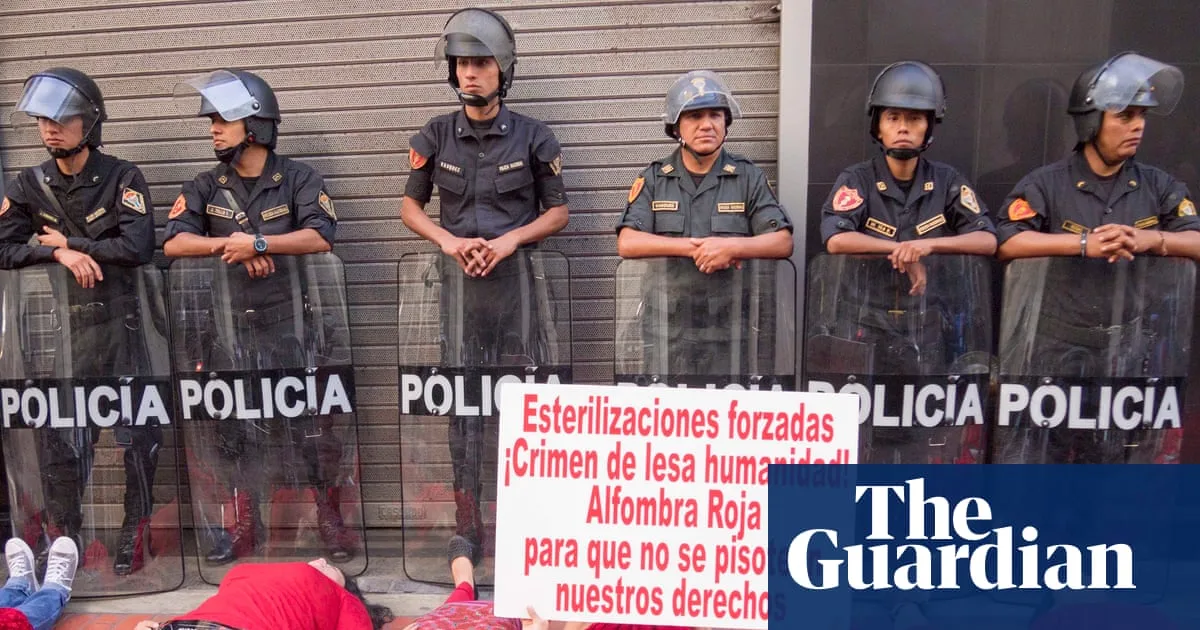
The case of a woman who died after a forced sterilisation in Peru in the 1990s will be heard by the Inter-American Court of Human Rights on Thursday. Celia Ramos, 34, died in 1997, 19 days after a tubal ligation caused respiratory failure. She was one of hundreds of thousands of poor, rural and Indigenous women subjected to the government's brutal family planning programme under former President Alberto Fujimori.
Ramos's eldest daughter, Marisela Monzón Ramos, now 38, was just 10 when her mother died. She is attending the hearing in Guatemala City. 'This is a huge step for us, considering the years of struggle. It has been nearly three decades since my mother died,' she said. 'We are looking for justice. The Peruvian state should be held responsible for the death of our mother, who was completely healthy.'
The case was presented to the Inter-American Commission on Human Rights in 2010 by the Peruvian NGO Demus. In 2021, the commission declared Peru responsible for violating Ramos's rights and recommended reparations. After Peru failed to comply, the case was sent to the court in June 2023. Legal representation is bolstered by the Center for Justice and International Law and the Center for Reproductive Rights.
Carmen Cecilia Martínez, associate director at the Center for Reproductive Rights, said the forced sterilisations were public policy under Fujimori, with financial incentives for medical workers. 'The objective was very clear: to recruit women from poor areas, Indigenous, rural peasant women and eliminate their reproductive capacity,' she said. The legal team hopes the court will declare the policy a crime against humanity, removing any statute of limitations.
In 2024, the UN Committee on the Elimination of Discrimination against Women urged Peru to compensate victims, ruling the policy could constitute a crime against humanity. Neither Fujimori nor his health ministers have been prosecuted. The court's decision could force reparations for Ramos's family and open the way for justice for thousands of other victims.




