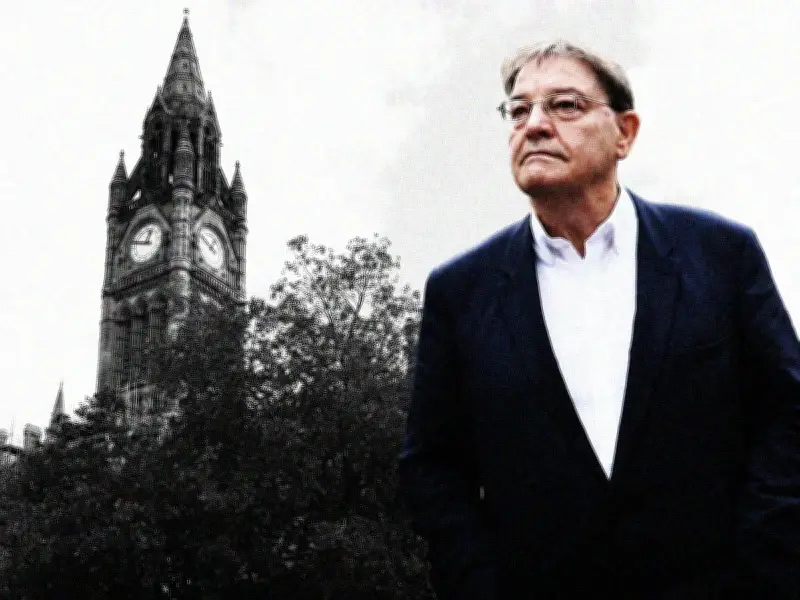
Pat Karney, the long-serving Manchester councillor known as the city's 'Mr Christmas', has died aged 78. He had been receiving treatment for cancer at The Christie. His death was announced this week.
Karney devoted his life to Manchester and its people. He was first elected to represent the Harpurhey ward on Manchester council in 1979, having grown up on Factory Lane, attended Mount Carmel School and later lived in Collyhurst. He remained a councillor until his death on Tuesday (October 13).
His political career spanned almost half a century, during which he became the face of the city centre and a fierce champion of its growth. He was also Manchester's 'Mr Christmas', who would happily keep the festive markets open all year round if he had his way.
Champion of LGBTQ+ rights
Karney was one of the most vocal advocates for gay rights during the 1980s, a time when Manchester council became an outlier in the country as a significant supporter of the cause. In 1984, Greater Manchester Police raided Napoleon's for 'permitting licentious dancing', a local bylaw dating back to 1882.
Speaking to the Manchester Evening News last month, Karney recalled: "They went upstairs in Napoleon's and said 'men can't dance with men' and just closed it. Then they came to the council and said 'we're going to revoke its licence, there's men dancing with men'."
"We said 'why don't you catch some burglars or car thieves or something? Why are you stopping men dancing? Is that a priority?'. They'd convinced themselves of the culture - that this was the enemy. But we stood up to them and we said 'no, the license continues at Napoleons'. Slowly and surely they didn't want to take on the council. We learnt that we had a powerful platform."
Manchester council went on to introduce gay and lesbian sub-committees and give financial backing to the Manchester AIDSline - the organisation set up to give support and information over the phone in response to the HIV crisis, which later became George House Trust. The city also hosted the national demonstration against Section 28 in 1988, a policy brought in by Margaret Thatcher which banned councils and schools from what the government described as 'promoting homosexuality'. Karney chaired the committee which organised the protest.
Support for communities
Karney also worked with the organisers of both the St George's Day and St Patrick's Day parades, offering the council's backing to help them become showpiece annual events in the city's calendar. Brian Kennedy, trustee at the Irish World Heritage Centre and organiser of the St Patrick's Day parade, told the Manchester Evening News: "He has been an absolute giant amongst people."
"He's been so helpful to the Irish community, to the centre, for the parade and the festival. Without him a lot of the events that we have enjoyed would not have happened. We are absolutely devastated with the news. He's going to be a great loss to the Irish community, and to other communities."
Following Karney's death, the Irish World Heritage Centre in Cheetham Hill flew its flag at half mast in honour of the proud Irish Manc.
Legacy in Harpurhey and city centre
Karney's upbringing in north Manchester shaped his political outlook. He devised the annual Manchester Day parade in 2010 and was thrilled to see Harpurhey get its own parade in the last couple of years. He was dismayed at the portrayal of the community he loved in 2013's BBC show People Like Us, when he met with a BBC3 director to urge against a second series.
Paul Day, manager of the Harpurhey Neighbourhood Project for the last three years, said: "Definitely what comes across with Pat is his pride of being from north Manchester. He definitely had a passion for Harpurhey and north Manchester as a whole, and wanted to celebrate us."
Karney also led the fight to keep Direct Works in Manchester to build council houses, a campaign that protected 5,000 jobs, according to Graham Stringer, who was part of the same cohort of Labour councillors and became council leader in 1984. Stringer told the Manchester Evening News: "Pat led the fight to keep Direct Works in Manchester to build council houses. It was his first campaign. It protected 5,000 jobs, good quality jobs and apprenticeships."
Having chaired the council's city centre committee to oversee the post-IRA bomb regeneration, Karney served as a director of CityCo and the town hall's city centre spokesperson until his death. The symbols of his legacy can be found in every inch of the modern city centre - where he was once one of roughly 500 residents, but became one of around 100,000.