NSW Supreme Court Rejects Protest Restrictions as Undemocratic
The New South Wales Supreme Court has delivered a landmark ruling, striking down protest laws introduced by the government of Chris Minns following the Bondi attack. This judgment firmly establishes that the state cannot suppress public demonstrations under broad justifications like "social cohesion." The court's decision is not merely a technical legal correction but a profound rejection of a political logic that sought to redefine protest from a fundamental democratic right into a security risk to be managed.
Broad Powers and Their Impact on Public Gatherings
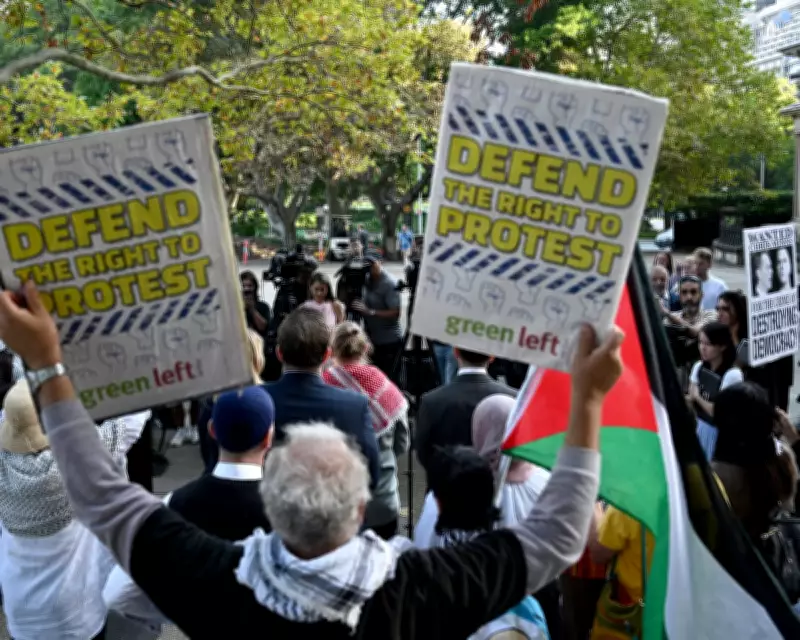
The law in question did not explicitly ban protests outright. Instead, it granted police extensive powers to issue administrative declarations covering entire areas, effectively enabling authorities to restrict or prevent public gatherings. With repeated extensions, what was initially framed as an emergency measure evolved into an ongoing mechanism to disable protest in the public sphere. These powers were not theoretical; they became a practical tool for suppressing demonstrations, including the dispersal of peaceful protests, police interventions based on vague assessments, and arrests widely described as arbitrary.
During the visit of Israel's president, Isaac Herzog, to Sydney, when large protests occurred against the devastating war in Gaza, authorities relied on these expanded powers to manage and restrict those demonstrations at a moment of heightened international sensitivity. At that point, the law transitioned from a general framework to a direct instrument for handling a specific political movement. The court found that the problem extended beyond the breadth of these powers to their effect: they did not regulate protest but deterred it, striking at the heart of political communication in the public sphere and raising clear constitutional issues.

The Political and Social Implications of the Ruling
The enactment of the law through an expedited process, with open-ended powers and repeated extensions, reveals that this was not simply an error of judgment. It represented the use of a moment of fear to expand executive and police power at the expense of the political right to protest. From a peace and conflict studies perspective, this is a clear example of securitisation, where a political issue like protest is transformed into a matter of security, making exceptional measures easier to justify yet rarely temporary.
Although the law did not name any particular group, its application was not neutral. One of its most significant effects was to restrict space for pro-Palestine demonstrations, particularly at a politically sensitive moment tied to the war in Gaza. This makes the law's impact fundamentally political, not merely administrative, and places Australia's multiculturalism under real scrutiny. Multiculturalism is not only about diversity; it is about protecting the right of that diversity to express itself politically in public, even when it is uncomfortable or inconvenient for those in power. When that right is constrained, multiculturalism risks becoming an empty slogan.
Civil Society's Role and the Future of Democratic Freedoms
The legal challenge originated from civil society, activists, and protest groups, including those leading solidarity efforts for Palestine. They argued that the law created a "chilling effect" that discouraged people from protesting and that its low thresholds allowed it to be used beyond any genuine necessity. The court, in substance, agreed, affirming that the defence of democratic freedoms came from the street, not from the state. Had this ruling not been delivered, the trajectory was clear: the normalisation of exceptional powers, a gradual expansion of police authority, and a real erosion of the public sphere without any formal ban.
From a conflict studies perspective, closing public space does not produce "cohesion"; it produces accumulated tension. Protest is not a flaw in democracy; it is one of the means through which democratic societies manage conflict peacefully. This ruling defines the limits of what the state can do when it finds public dissent uncomfortable, reaffirming a basic principle: the public sphere is not a space subject to the comfort of power but an open arena for expression and accountability.

After this decision, supporting Palestine is no longer just a political stance. It has become a defence of democracy itself. When the right to protest for Palestine is protected, so too is the right to dissent, to challenge authority, and to take part politically. That gives this ruling significance beyond its immediate context. This is more than a legal correction; it is a restoration of the public sphere. Fear cannot be turned into permanent law, "social cohesion" cannot be used to silence dissent, and politics cannot be reduced to what power finds acceptable. Democracy is not measured by how quiet it is but by its ability to tolerate the street, even when it is loud, uncomfortable, and disruptive – and perhaps, for that very reason, essential.