

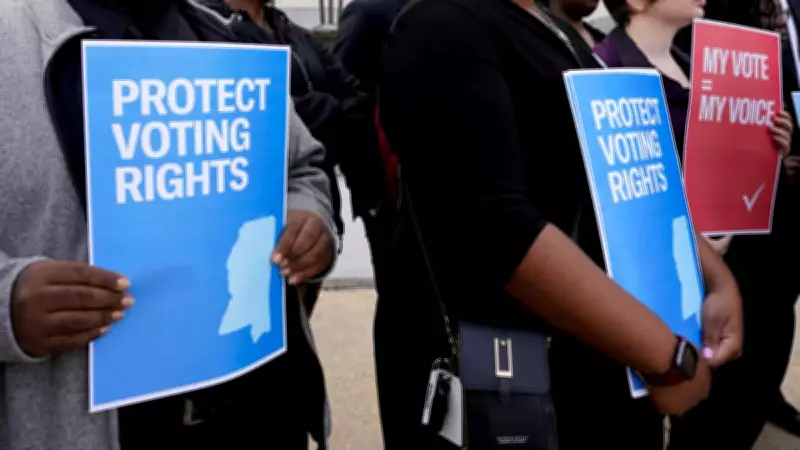
Thousands of Mississippians, joined by allies from neighboring southern states, convened at the War Memorial Building auditorium in Jackson on Wednesday to rally for voting rights. The demonstration marked the latest in a series of actions against the U.S. Supreme Court's recent decision that gutted a key provision of the Voting Rights Act designed to prevent racial discrimination. The rally was held at a site deeply tied to Mississippi's history of Black disenfranchisement.
Historic Context and Legal Battle
Section 2 of the Voting Rights Act "stopped states, counties, cities, from passing redistricting maps that discriminate against Black voters and it led to the biggest growth of Black political power since Reconstruction," said Amir Badat, southern states director for Fair Fight Action. "And now, the Roberts court has opened the door to the biggest destruction of Black political power since the end of Reconstruction."
The coalition behind the rally included the People's Advocacy Institute, Mississippi Votes, Mississippi Poor People's Campaign, One Voice, Fair Fight, Mississippi for a Just World, and the NAACP. It followed the "All Roads Lead to the South" rally in Montgomery, Alabama, over the previous weekend.

Southern States Redraw Maps
Since the Supreme Court's decision in Louisiana v. Callais, southern states have rushed to redraw congressional districts, often diluting Black political power. Florida's Republicans enacted a new map shortly after the ruling. Tennessee Republicans eliminated the state's only Black congressional district, while Alabama, Louisiana, South Carolina, and Georgia are pursuing similar measures.
Mississippi, where nearly 40% of the population is Black, initially appeared poised to enter the redistricting fray. Governor Tate Reeves called a special session for May 20, but later reversed course, though he indicated the state would likely redraw maps before the 2027 elections.
Rally at the 'Crime Scene'
In 1890, white supremacist Mississippi legislators convened at the Old Capitol, adjacent to the War Memorial, to enact a state constitution implementing the "Mississippi Plan" to disenfranchise Black voters. The special session called by Reeves was also slated for the Old Capitol, the site that effectively ushered in Jim Crow in Mississippi.
"We had to come here to the crime scene because it's time to arrest the state of Mississippi," declared Danyelle Holmes, senior social justice organizer with Repairers of the Breach and the Poor People's Campaign. "Today we come to serve notice that we will not go back to the days of Jim Crow. We will not go back to 1890. We are a people who will take a stand and fight."
March and Speeches
Participants waved signs bearing images of civil rights icon Medgar Evers, the NAACP field secretary murdered for his work to secure voting rights for Black Mississippians. Signs read "Protect our vote" and "Jim Crow Must Go." The crowd heard from speakers, activists, and advocates warning against redistricting efforts. They sang freedom songs from the civil rights movement, engaged in call-and-response chants, and offered prayers evoking Black church traditions before marching through downtown Jackson.
The procession wound from the Old Capitol past the state capitol, governor's mansion, and other government buildings to the Jackson Convention Complex, where the rally continued with thousands in attendance.
Speakers included Representative Bennie Thompson, whose district Governor Reeves and other Mississippi Republicans have targeted; NAACP President Derrick Johnson; author Eddie Glaude; and others. Justin Jones, a Tennessee state representative, drove six hours from Nashville to attend. He and student activists from Mississippi for a Just World helped lead the march.
"We're not going down without a fight. We may not be a swing state in Mississippi or Tennessee or Alabama, but we'll swing back on you," Jones told the audience. "We'll fight back with everything we have. We come in the spirit of our ancestors. We come in the spirit of those who aren't intimidated by bully clubs and water hoses. We are an intergenerational movement. We come as one, but we stand as 10,000."






