

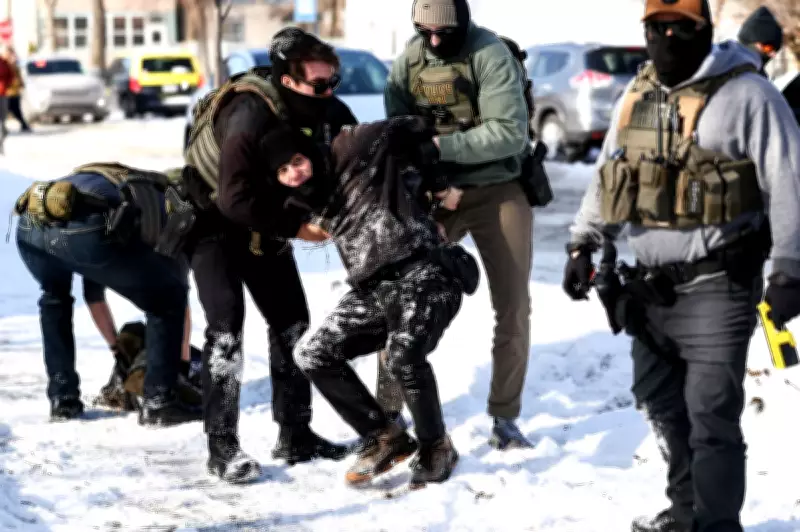
Minnesota's Federal Operation Becomes Constitutional Crucible
Federal immigration enforcement in Minnesota has transformed into something far more consequential than its original mandate. Operation Metro Surge, initially presented as a routine immigration initiative, has evolved into what legal scholars describe as a comprehensive stress test for the United States Constitution itself. The question now haunting courtrooms and civic forums across the state is whether constitutional protections can withstand the actions of a federal government seemingly determined to push the boundaries of executive power.
A Daily Reality of Constitutional Concerns
The situation in Minnesota presents a disturbing catalogue of alleged violations that touch multiple amendments simultaneously. Residents and observers report federal agents forcibly entering homes without judicial warrants, arresting journalists covering protests, defying numerous federal orders, and even killing United States citizens for noncompliance. The chilling question reportedly posed to constitutionally protected observers – "Have you not learned?" – encapsulates the confrontational atmosphere that has taken hold.
In Minneapolis, a city still grappling with its complex history of policing following the murder of George Floyd, this federal operation raises fundamental questions about law enforcement accountability and the proper limits of executive authority. Legal experts and civil rights advocates express particular alarm about what they describe as systematic violations affecting multiple constitutional protections simultaneously.

First Amendment Under Pressure
First Amendment concerns have emerged from multiple reports detailing how agents from Immigration and Customs Enforcement and Border Patrol have deployed both excessive force and sophisticated surveillance methods against suspects, observers, and journalists. When enforcement activity impedes the fundamental rights to assemble peacefully, document government actions, and criticize official conduct, it creates a chilling effect that extends far beyond any single demonstration. These rights represent not peripheral elements of democracy but its essential foundation.
Second Amendment Confrontation
The fatal shooting of legally armed Alex Pretti in Minneapolis brought Second Amendment issues to the forefront. Despite Minnesota's long-standing interpretation permitting legally armed individuals to carry firearms at public events, highly placed administration officials asserted that Americans could not bring weapons to protests. This position appeared particularly contradictory given the Trump administration's previously stated support for expansive gun rights, creating confusion about where constitutional boundaries actually lie.
Fourth Amendment Violations Documented
Thanks to widespread video documentation circulating on social media platforms, Fourth Amendment concerns have become the most visible aspect of this constitutional crisis. Allegations include warrantless home entries, the stopping and intimidation of legal observers, and detentions based primarily on appearance or accent. These actions represent clear violations of constitutional safeguards against unreasonable searches and seizures – protections originally adopted precisely to prevent the exercise of arbitrary government power.
Tenth Amendment Federalism Challenge
The Tenth Amendment lies at the heart of Minnesota's legal challenges against federal overreach. One significant lawsuit contests the federal government's refusal to allow the Minnesota Bureau of Criminal Apprehension to investigate the killings of Renee Good and Alex Pretti. Another legal action challenges efforts to pressure local governments into assisting federal immigration enforcement against their will. These disputes implicate federalism itself – the constitutional division of authority between state and federal governments that forms the structural foundation of the American political system.

Historical Context and Constitutional Retreat
The current situation represents a dramatic reversal of historical trends. Beginning in 1994, federal intervention frequently served as a necessary corrective when local police departments violated constitutional rights. From Newark to New Orleans, federal oversight – while not always welcomed – proved essential for enforcing equal protection and due process guarantees.
This federal oversight became particularly crucial in enforcing civil rights when municipalities proved unwilling or unable to do so themselves. Active monitoring of policing practices in various cities helped maintain officer accountability and encouraged adherence to constitutional standards. What experts term "constitutional policing" fundamentally requires that government authority used to ensure order remains justified, limited, and subject to proper oversight.
In this context, the 2023 United States Department of Justice report on Minneapolis policing identified troubling patterns and practices following the murder of George Floyd. The report documented unreasonable use of deadly force, racial profiling, and retaliation against journalists. The Department of Justice's proposed consent decree – grounded in constitutional policing principles – offered a constructive path forward.
However, in May 2025, under the leadership of President Donald Trump's appointee Pam Bondi, the Department of Justice withdrew this recommended agreement. Just seven months later, Operation Metro Surge deployed thousands of federal agents to Minnesota with what observers describe as a markedly different enforcement philosophy.
Executive Expansion and Constitutional Consequences
The recent expansion of federal enforcement authority in Minnesota followed what many legal scholars characterize as a deliberate retreat from federal constitutional oversight. A presidential executive order signed by Trump in late April 2025 – titled "Strengthening and Unleashing America's Law Enforcement to Pursue Criminals and Protect Innocent Citizens" – pledged to remove what were described as "handcuffs" on police agencies.
Subsequent deployments of National Guard forces to Los Angeles amid immigration protests, and later to Washington D.C. purportedly to reduce crime, reflected an increasingly expansive view of executive branch authority. Though a federal judge rejected the legal rationale for the Los Angeles deployment, the administration continued this approach. In September 2025, Trump described American cities as potential "training grounds" for military forces to confront what he termed the "enemy from within."
The Broader Constitutional Question
Whether Operation Metro Surge ultimately withstands judicial scrutiny remains uncertain as numerous lawsuits continue winding through federal and state courts. The mass resignations from Minnesota's United States attorney's office – responsible for representing the federal government in these cases – further complicate the legal landscape.
Yet the broader constitutional question has already crystallized: When the executive branch, in the name of security, directly challenges so many Bill of Rights protections simultaneously, how much strain can the American legal system realistically absorb? Will fundamental constitutional rights survive this unprecedented moment of pressure?
What unfolds in Minnesota transcends local enforcement concerns. It represents nothing less than a comprehensive test of whether the United States Constitution, as generations have understood and relied upon it, will endure this profound challenge to its foundational principles and protections.





