

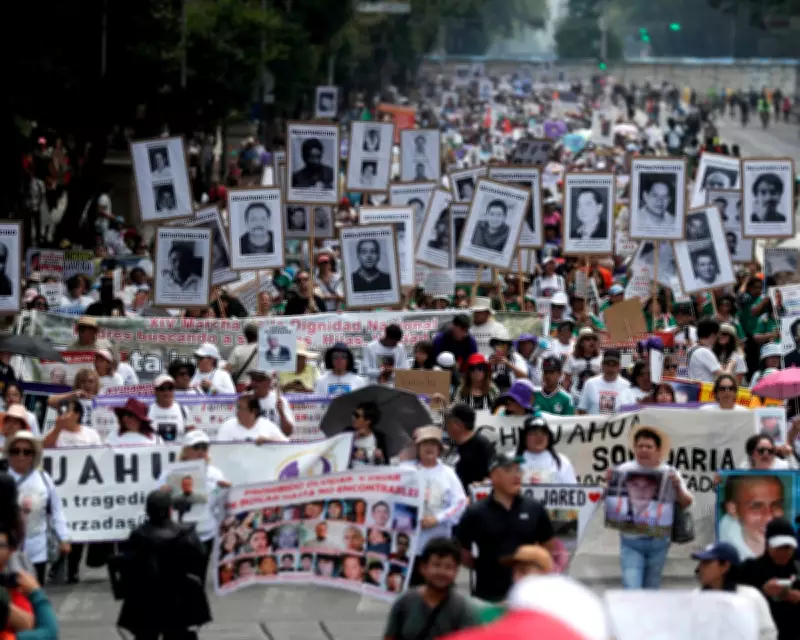
Relatives of missing people marched in Mexico City on 10 May, highlighting a crisis that has seen at least 27 people killed since 2010 while searching for lost family members. A new report from the Inter-American Commission on Human Rights (IACHR) warns of an alarming rate of state involvement in disappearances across Mexico.
State Actors and Criminal Collusion
The sweeping investigation, to which the Guardian was given exclusive access, paints a dire picture of the disappearance crisis in Mexico, where more than 130,000 people have gone missing, mostly in the last 20 years since the government declared war on drug cartels. While criminal gangs are responsible for the vast majority of disappearances, the IACHR report found that many of these crimes occur in deep collusion and coordination with state agents. Furthermore, disappearances committed directly by state agents have not yet been eradicated, with some regions experiencing almost as many state-perpetrated disappearances as those by criminals.
Historical Context and Recent Trends
Forced disappearance has a long history in Mexico, dating back to the dirty war of the 1960s and 1970s, where dissidents were thrown from planes into the Pacific Ocean. In recent years, organised crime groups have adopted this tactic to sow terror, intimidate rivals, or erase evidence by burning bodies or dissolving them in acid. In the last decade, disappearances have increased by over 200%. The IACHR report emphasises that state actors are often involved, either directly by snatching people and handing them to criminals, or indirectly by ignoring these crimes.

Government Denials and Activist Concerns
Mexico's President Claudia Sheinbaum and her government have repeatedly rejected such assertions. When the United Nations suggested evidence of widespread enforced disappearance, Sheinbaum stated, 'In Mexico there is no forced disappearance by the state.' Activists argue this is part of an effort to downplay the issue. In March, authorities presented a report suggesting a third of disappearance cases lacked sufficient data, effectively abandoning about 40,000 missing people. Maria Luisa Aguilar Rodríguez, head of the Centro Prodh human rights centre, said, 'They were trying to minimise the scale of the problem and put the responsibility on families to carry out the search.'
Families at Risk
The IACHR notes that families have organised into collectives to search for their loved ones due to the meagre state response, facing institutional challenges and risking their lives. The report chillingly describes how disappearance affects entire families, with some losing almost all relatives to this crime. Since 2010, at least 27 searchers—mostly mothers—have been killed.
Positive Steps and Ongoing Challenges
The IACHR acknowledged that the Mexican government has adopted some actions, such as reactivating the National Search Commission and recognising the crisis as humanitarian. However, the country grapples with a forensics crisis: 70,000 unidentified bodies remain in state custody. Impunity is an insurmountable problem, with only 357 people charged for disappearance since 2014 and just nine convicted. 'The numbers are staggering,' said Aguilar.






