

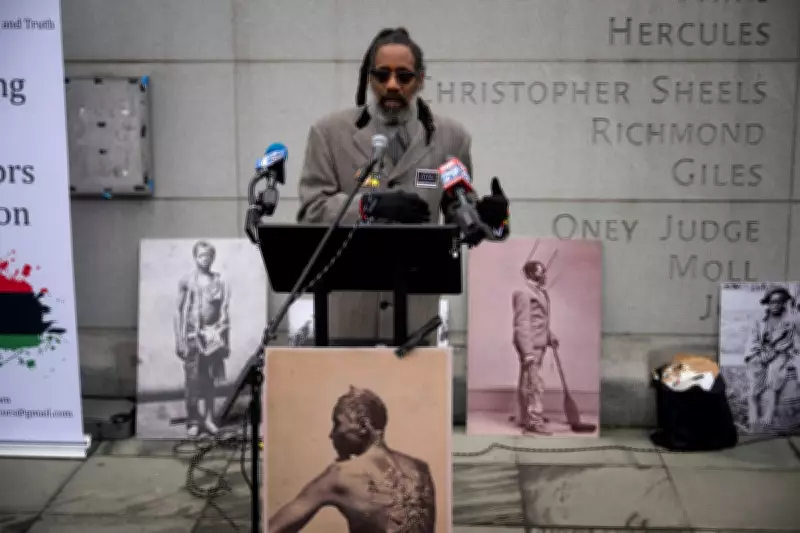
A federal judge has firmly rejected the Trump administration's request to postpone a Friday deadline for restoring a historical exhibit about slavery at Independence Mall in Philadelphia. Senior U.S. District Judge Cynthia M. Rufe, appointed by Republican President George W. Bush, denied the administration's appeal for delay during a Friday morning ruling, insisting that restoration work must be completed by 5 p.m. that day.
Legal Battle Over Historical Narrative
The legal confrontation stems from the Trump administration's abrupt removal of the exhibit panels in January, which prompted the city of Philadelphia and advocacy groups to file a lawsuit. These panels, displayed since 2010 after years of collaborative research involving the city, National Park Service, historians, and private parties, detail the history of slavery at the President's House site.
Judge Rufe emphasized in her opinion that the federal government must work with the city under a longstanding cooperative agreement before replacing the exhibit with its own narrative. The Interior Department had argued in court documents that it planned to install alternative content, removing information it considered "disparaging" to Americans from federal properties.

Constitutional Implications and Public Trust
"The government can convey a different message without restraint elsewhere if it so pleases, but it cannot do so to the President's House until it follows the law and consults with the city," Rufe stated. She further noted that the administration's side was unlikely to succeed at trial and that each day of delay harmed both the public interest and Philadelphia's reputation.
The city, Rufe explained, "is responsible for the public trust in the city's telling of its own history, its own integrity in telling that history, and preventing erasure of that history, particularly in advance of the semiquincentennial." This reference to the 250th anniversary of America's founding in 1776 highlights the timing significance, as millions are expected to visit Philadelphia this year.
Immediate Restoration Efforts
Following the ruling, restoration work that began Thursday resumed immediately on Friday morning. National Park Service employees carefully rehung panels, including one titled "History Lost & Found," which describes the surprising discovery of artifacts during an archaeological dig in the early 2000s while constructing a new Liberty Bell pavilion.
The outdoor exhibit, described by the Park Service as examining "the paradox between slavery and freedom in the founding of the nation," specifically addresses the nine people enslaved by George and Martha Washington in the 1790s when Philadelphia served as the national capital.
Administration's Response and Public Reaction
In a Friday filing to the 3rd U.S. Circuit Court of Appeals, the Justice Department criticized Rufe's ruling as "extraordinary" and "an improper intrusion on the workings of a co-equal branch of government." The appeals court subsequently requested the city to respond to the administration's emergency stay request.
The U.S. Attorney's Office in Philadelphia, representing the administration, declined to comment on the restoration work. Meanwhile, Philadelphia teacher Kimberly Gegner visited the site with her middle school students, expressing relief as a Black American. "This whole case and what happened here — the taking it down and how Mayor Parker and other Pennsylvanians had to go to court to have it restored — is an excellent case of how the Constitution was applied to win this case for Philadelphia," she remarked.
Judge Rufe's decision underscores ongoing tensions between federal and local authorities over historical interpretation, particularly as the nation approaches its semiquincentennial celebrations. The restoration deadline stands as a testament to legal processes ensuring historical preservation amid political disagreements.






