
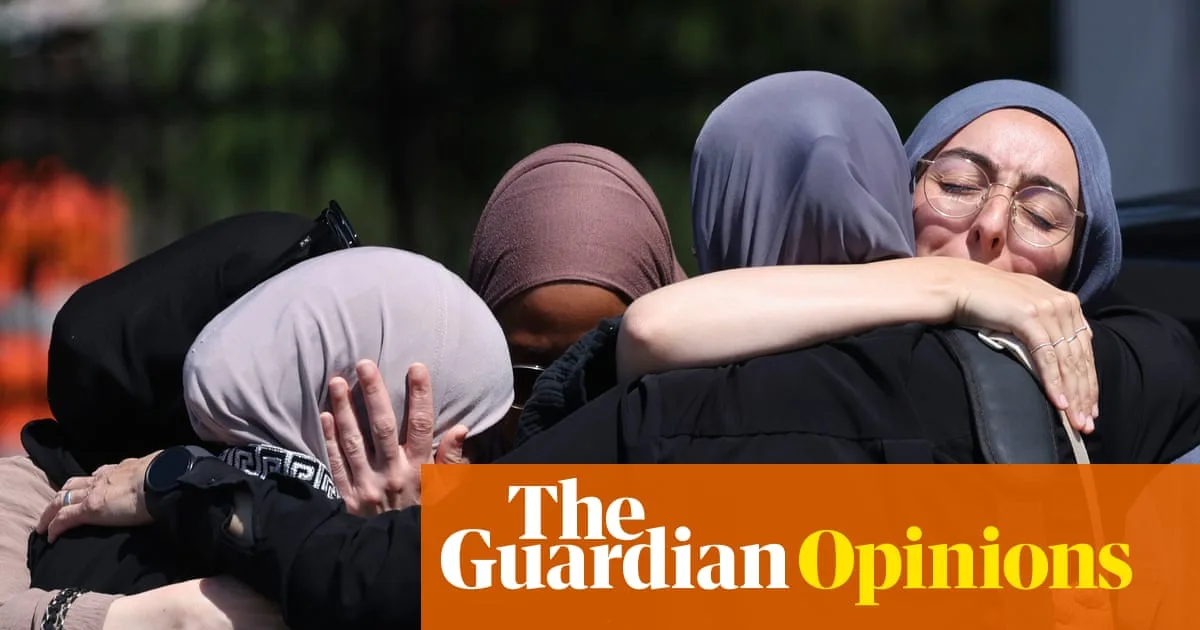
The horrific terrorist attack on the Islamic Centre of San Diego in California has been reported by many news outlets over the past few days. Yet as the story travelled across screens and news feeds, something more subtle unfolded: the language of reporting. Some outlets spoke of “teen suspects” and “three deceased” rather than murdered worshippers or a terrorist attack on a mosque. Words matter. They shape sympathy, urgency, and influence how violence is understood. Too often, the vocabulary of terror and extremism appears unevenly distributed; sharpened for some perpetrators but softened for others.
There is a growing sense that the world is slipping backwards – not through dramatic rupture, but through the steady normalisation of hate, the coarsening of public discourse and politicians increasingly fuelling division and racism. Across the world, anti-Muslim abuse has risen sharply: mosques vandalised, women in hijabs assaulted, online spaces saturated with hate, and far-right marches openly calling for the eradication of Islam. Yet such incidents rarely command sustained outrage. They appear briefly before disappearing into the churn of the news cycle.
In the US, the presidency of Donald Trump normalised policies such as the “Muslim ban”, which barred travel to the US for 90 days from seven predominantly Muslim countries, embedding suspicion within immigration systems. Across Britain and Europe, parties such as Reform UK, the National Rally and Alternative for Germany have built political capital by framing Islam as incompatible with national identity. In India, under Narendra Modi, anti-Muslim sentiment has increasingly moved from the fringes towards the political mainstream. In China, the mass detention of Uyghur Muslims represents a more extreme form of state-led repression, widely condemned, yet met with limited sustained global action.
What unites these cases is simple: Muslim identity is treated not as a constituency to be included, but as a problem to be managed. Recently, Britain’s Prince Harry condemned antisemitism and Islamophobia yet headlines overwhelmingly amplified his remarks on antisemitism while references to Islamophobia were often reduced to passing mentions, if acknowledged at all. The imbalance is insidious. More troubling still is how sections of the media shape perception through selective framing and omission. A recent arson attack was widely reported as targeting a “former synagogue”, implying antisemitism while omitting that it was the subject of a fundraising effort by local young Muslims, who had already put down a hefty deposit to transform the building into a mosque and community centre.
The problem is not whether antisemitism or anti-Muslim hatred exist – both plainly do. It is that selective framing distorts public understanding, inflames tensions and ultimately makes both Jewish and Muslim communities less safe. Today, where perception increasingly shapes reality, omission can be as powerful as misinformation itself.
Since 9/11, global narratives around terrorism, migration and geopolitical conflict have associated Muslim identities with threat. Reinforced by political leaders, media and state policy, these narratives have reshaped public perception across continents. What began as a response to a moment has hardened into a permanent structure. What distinguishes Islamophobia from other forms of racism is that it is rarely expressed in overtly racial terms. Instead, it is mediated through specific language, making it easier to defend and harder to challenge.




