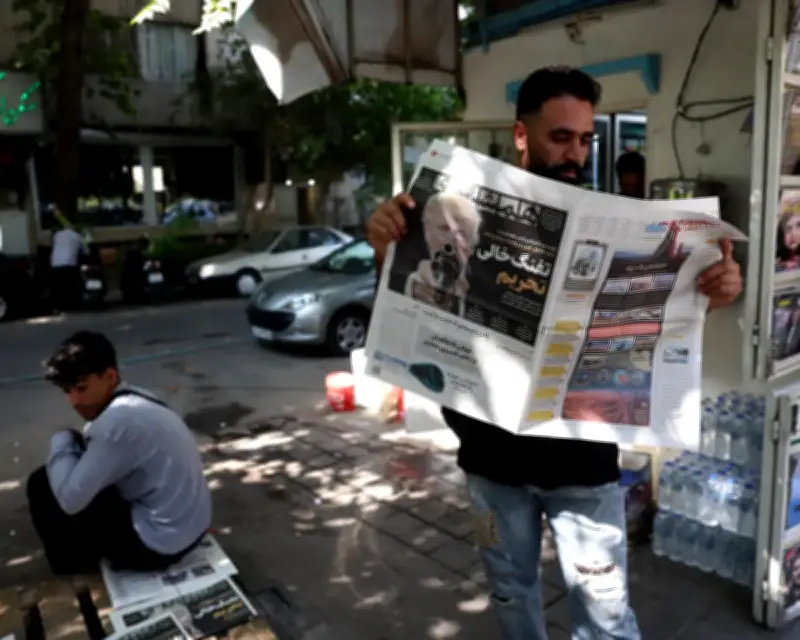
Iran's foreign minister has dismissed the threat of a fresh round of US economic sanctions as a "desperate" ploy, even as its president acknowledged that the Iranian people are facing "many problems" amid Washington's efforts to isolate and debilitate the country's economy.
Defiant Response to US Pressure
Last week, Donald Trump announced a new campaign to increase the pressure on the Iranian economy, calling it "the most crushing economic operation ever taken against any country". The US Treasury secretary, Scott Bessent, is expected to announce further punitive economic measures on Iran – which he has described as "the toughest sanctions in history" – on Monday.
Despite the threats, Iran's foreign minister, Abbas Araghchi, insisted the country remained unbowed. "The fact that [US leaders] have moved on from military operations … to bringing up the same old plans shows that they are desperate," he said in a video posted on Telegram on Sunday.

"We have never been afraid. All of their actions – whether blockades or other military moves they have made – have failed, and this new issue of theirs will fail as well." Araghchi urged Washington to speak to Iran respectfully to find "a solution based on justice and honour".
President Acknowledges Domestic Hardships
His defiant message came hours after Iran's president, Masoud Pezeshkian, said Trump had thrust his country into "a full-scale economic, military and security war".
"I understand we have many problems in society right now. We are trying to prevent these as much as we can," he said in a speech broadcast on state television. "We are striving with all our hearts to overcome inflation, livelihood problems, unemployment, and to secure the future of the people, so that they can live with dignity and pride."
The Iranian government has faced several waves of mass protest in recent years, often triggered by economic hardships, including inflation and exchange-rate swings leading to declining purchasing power. At the end of December last year, a protest movement initially sparked by the rising cost of living turned into mass demonstrations denouncing those in power.
Security Chief Warns Neighbours
The new leader of Iran's top security body has warned its neighbours against joining new US efforts to squeeze Tehran's economy, and threatened US commercial interests in the region, as Trump doubled down on his view that the strait of Hormuz was a new US territory.
Mohsen Rezaei, the hardline leader of Iran's supreme national security council, told state television that Iran would target oil-shipping routes out of the Gulf – alternatives to the strait of Hormuz – if its neighbours joined what he called the "economic war" waged by the US. Those neighbours would be "considered an enemy" and "we will target their interests", he said.
Rezaei also claimed Iran had more cards to play, saying it had "not yet attacked any American economic interests". "So far, we have only targeted military bases, but if they want to impose economic sanctions on us, the United States has oil and economic companies around Iran and elsewhere, and we will strike them," he said in the interview, which was broadcast on Saturday.
Regional and International Reactions
Trump's efforts to finish the war he started along with Israel on 28 February have foundered after a ceasefire agreement signed in June collapsed, leaving Iran in control of the strait of Hormuz, a waterway that was the conduit for one-fifth of the world's oil supplies before the conflict.
Washington has called on other governments to join its efforts to isolate the Iranian economy, notably China, among Iran's top strategic partners. However, Beijing has criticised the initiative, arguing that US sanctions will not resolve the conflict in the Middle East.
One of Iran's main trading partners, the United Arab Emirates, announced on Tuesday last week it was suspending all trade and financial transactions with Tehran until further notice.
The US treasury has for months been carrying out Operation Economic Fury, aiming to cut off Iran's funding with targeted sanctions, while a naval blockade in the strait of Hormuz has sought to block Iranian oil exports that are vital in keeping the country's economy afloat.

The US president has in recent days repeatedly raised the concept of declaring the strait a US territory, sharing a map identifying it as such in a social media post on Saturday. Rezaei said in his interview that discussions continued with Iran's cross-strait neighbour Oman over management of the waterway, and said fees would be imposed.
The French president, Emmanuel Macron, and the Saudi crown prince, Mohammed bin Salman, are expected to discuss plans to develop alternative routes to the strait of Hormuz during the Saudi leader's two-day visit to Paris that starts on Sunday. Proposals include increasing trade through Omani ports outside the Gulf, expanding or doubling pipelines in Saudi Arabia and elsewhere, and developing new rail links, officials told the Associated Press.
France and Saudi Arabia have formed a taskforce on energy and logistics connections between the Middle East and Europe that is scheduled to meet at the ministerial level on Monday. The officials said the work would focus on identifying the most strategic projects, securing financing and establishing roles for French companies.