

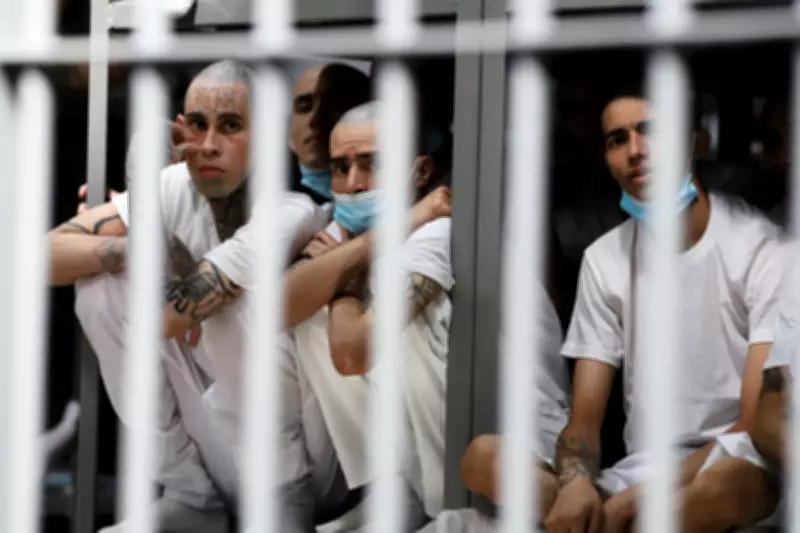
Human Rights Watch Exposes Arbitrary Detention of US Deportees in El Salvador
Salvadoran nationals deported from the United States are being arbitrarily detained in El Salvador, with their families left in the dark about their whereabouts and legal status, according to a damning report from Human Rights Watch released on Monday. The New York-based human rights organisation has documented cases where deportees vanish into the Central American nation's prison system without due process.
Systematic Disappearance of Deportees
The report focuses on Salvadorans deported since the beginning of President Donald Trump's second administration in January 2025, with more than 9,000 individuals returned during this period. Human Rights Watch interviewed 20 relatives and lawyers representing 11 Salvadorans deported between March and October 2025 who were immediately detained upon arrival in El Salvador.
"They have a right to due process, to be taken before a judge, and their relatives are entitled to know where they are being held and why," stated Juanita Goebertus, the Americas director at Human Rights Watch. "Deportation cannot mean enforced disappearance."

The organisation reports that detainees cannot communicate with their families or consult with legal representatives, creating what they describe as a pattern of enforced disappearance. In five documented cases, relatives only learned of deportees' whereabouts through litigation at the Inter-American Commission on Human Rights.
State of Emergency and Prison Conditions
This phenomenon has become increasingly common since President Nayib Bukele declared a "state of emergency" in March 2022 to combat gang violence. The measure, originally temporary but extended for nearly four years, suspends key constitutional rights and has resulted in approximately 91,300 detentions nationwide.
While Bukele claims 8,000 innocent people have been released, Human Rights Watch documents that most detainees are held based on scant evidence and vague accusations. Prisoners often face mass trials with minimal access to legal representation, and lawyers frequently lose track of their clients within the system.
Prisons in El Salvador have faced longstanding accusations of human rights abuses, including beatings by guards, sexual abuse, and deteriorating conditions. The report notes that Salvadoran authorities have provided no information suggesting any of the deportee detainees have been brought before a judge.
Families in Anguish
The human cost of these policies is devastating for families on both sides of the border. A 47-year-old mother living in Maryland without legal status described her agony after her 29-year-old son was deported on March 15, 2025.
"I still know nothing about my son, nothing," she said, requesting anonymity for fear of arrest in the United States. "I want information. I want someone to tell me that my son is OK, that he's alive."
She discovered her son was in El Salvador six months after his deportation when she saw a photograph posted online by President Bukele showing detainees at the Center for Terrorism Confinement (CECOT), a mega prison where some deportees have been sent alongside Venezuelan nationals.
Another mother in Texas, also without legal status in the US, learned her 22-year-old son had been deported when she saw him in an online photograph of Salvadorans at CECOT. "I've never spoken to him," she said. "It's total silence. We know nothing about him, we don't know what's going to happen."
Contradictory Claims and Legal Challenges
The Trump administration has claimed several of the deported Salvadorans are members of the MS-13 gang, but Human Rights Watch reports that only 10.5% of the 9,000 deportees had convictions for violent or potentially violent crimes in the United States.
Some cases have seen legal intervention, such as that of Kilmar Abrego Garcia, who was among 23 Salvadorans deported on March 15, 2025, and later returned to the United States following a judge's order. However, such instances remain exceptional rather than routine.

El Salvador's Presidential Office did not respond to requests for comment on the Human Rights Watch report, leaving families without official explanations for their loved ones' disappearances into the prison system.





