

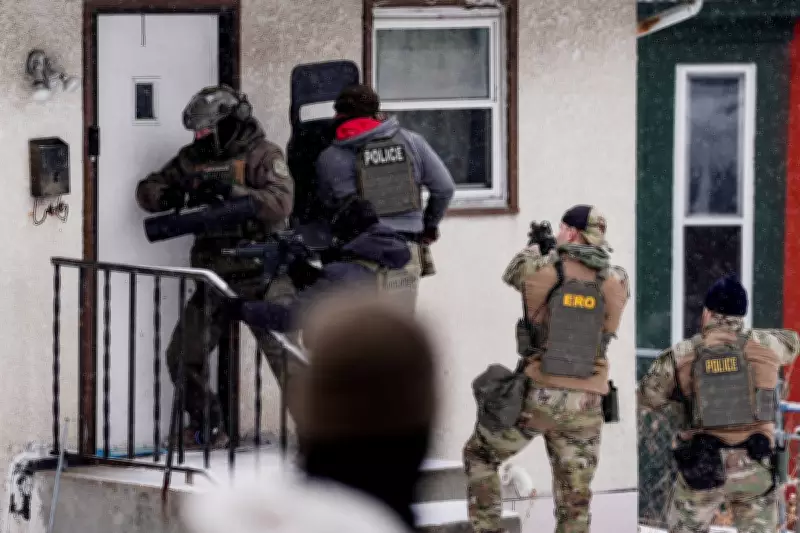
Democrats Demand End to ICE Home Entries Without Judicial Warrants
Democratic lawmakers are intensifying their demands for the Trump administration to rescind a secretive memorandum that grants Immigration and Customs Enforcement officers permission to forcibly enter private homes without obtaining a judicial warrant. Critics and legal experts have condemned the policy as a blatant violation of the Fourth Amendment, which protects citizens against unreasonable searches and seizures.
Administrative Warrants Under Fire
The controversy centres on a May 2025 memo signed by ICE acting director Todd Lyons, which instructs officers to rely on internal administrative warrants—known as Form I-205—rather than seeking approval from a judge. This document is drafted and signed by ICE officers themselves, bypassing judicial oversight entirely.
Whistleblowers within the Department of Homeland Security provided Congress with the memo, sparking outrage among Democrats and civil rights advocates. Formal demands from lawmakers and federal lawsuits urging courts to block the policy have added to a growing list of urgent Homeland Security reforms, particularly as a funding standoff threatens a partial government shutdown.

Republican Support and Legal Justifications
Despite the backlash, congressional Republicans and administration officials have defended the use of administrative warrants, viewing them as a critical tool for President Trump's sweeping immigration enforcement efforts. Texas Republican Representative Tony Gonzales argued on CBS Face the Nation that "administrative warrants work" and are necessary to apprehend convicted criminals in communities.
In a lengthy press release, Homeland Security defended the practice while attacking what it called "the mainstream media's false narratives." Further justification came from ICE general counsel James Percivil, who suggested in a Wall Street Journal op-ed that "illegal aliens" are not entitled to the same Fourth Amendment protections as U.S. citizens. He asserted that the policy is consistent with Supreme Court guidance that the "reasonableness" of a search is paramount, not whether it is supported by a judicial warrant.
Constitutional Concerns and Legal Challenges
Federal judges, constitutional law experts, and Democratic members of Congress have roundly rejected the administration's defence. A group of House Democrats wrote to Homeland Security Secretary Kristi Noem this month, stating, "ICE does not have the authority to overturn any law, let alone one of the foundational constitutional rights enshrined in the Bill of Rights." They demanded the memo be rescinded and that agents obtain judicial warrants before any non-consensual entry into private residences.
Critics have highlighted specific cases to illustrate the policy's dangers. In St. Paul, Minnesota, U.S. citizen ChongLy "Scott" Thao was dragged from his home at gunpoint while in his underwear, despite ICE officers targeting someone already in prison. In another instance, agents forcibly entered the home of Liberian man Garrison Gibson without a warrant; a federal judge later ruled his arrest unconstitutional and ordered his release.
Lawsuits and Broader Implications
A federal lawsuit filed by civil rights and immigrant organisations is calling on a judge to intervene and revoke what they term ICE's "home invasion policy." Alexandra Oliver-Davila of the Greater Boston Latino Network, the lead plaintiff, stated, "We will not stand by while ICE engages in unlawful and dangerous practices... We stand with immigrants, communities of color, and everyone fighting for dignity and the Constitution."
Brooke Simone, a staff attorney at Lawyers for Civil Rights involved in the lawsuit, emphasised that "the Fourth Amendment exists precisely to prevent government agents from breaking into people's homes without any judicial process or oversight." She warned that the policy undermines privacy, safety, and dignity, putting everyone at risk.
Political and Moral Outcry
Democratic Senator Richard Blumenthal, whose office received the whistleblower report, labelled the policy "legally and morally abhorrent." He called on Republican colleagues to prove their rhetoric about personal rights against government overreach by holding hearings and demanding accountability from the Trump administration.

As the debate intensifies, the issue has become a focal point in broader discussions about immigration enforcement, constitutional liberties, and the balance between security and civil rights. With funding deadlines looming and legal battles escalating, the future of ICE's warrant policy remains uncertain, highlighting deep partisan divides over governance and individual freedoms.





