

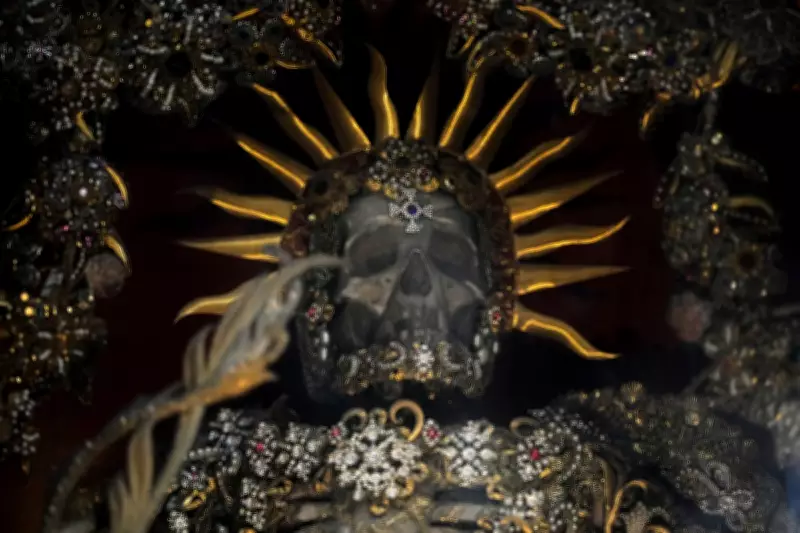
In the Catholic monastery church of Banz in southern Germany, a sight has sent shivers down the spines of many visitors for centuries: four complete skeletons draped in silk and brocade, adorned with precious stones, filigree gold, silver, and lace. Known as Vincenzius, Valerius, Benedictus, and Felix Benedictus, these remains are so-called catacomb saints or Holy Bodies, brought to the Benedictine monastery near Bad Staffelstein from Rome in the late 17th and 18th centuries.
A Creepy Yet Enduring Fascination
Church custodian Anita Gottschlich whispered, 'It is actually a little creepy,' as she looked at one of the skeletons that seemed to stare back through hollow eye sockets. She noted that older visitors who came as children always seek out the Holy Bodies, recalling their lasting impression. While unsettling to some, catacomb saints remain a fixture in many Baroque Catholic churches and monasteries across Bavaria, as well as in Austria, Switzerland, Czechia, and Italy.
Origins of the Holy Bodies
Legend holds that these relics are remains of early Christian martyrs discovered in the 16th century in unmarked graves in Rome's catacombs. Catholic priest Walter Ries explained, 'The church simply designated them all as saints. People wanted such holy remains to enhance the status of their own church or monastery, perhaps turning it into a pilgrimage site.' Ries ministers to a congregation of 211 members at the monastery church, a far cry from its golden age after its founding in 1070. The monastery was dissolved in 1803, and only the church remains active; the monastery now houses a political foundation.

Baroque Escape from Misery
The veneration of catacomb saints peaked in the late 17th and 18th centuries, when Europe was recovering from the Thirty Years' War, which caused an estimated 4 to 8 million deaths. 'That was a terrible time,' said Ries. 'People tried to open the gates of heaven through the Baroque. Everything was designed beautifully as an escape from the present, which was often so terrible. That is why these eerie skeletons were so beautifully draped and depicted as lifelike as possible.' The abbots of Banz monastery sent emissaries to Rome in 1680 and 1745, bringing back the four skeletons, which were then decorated by nuns in Bamberg.
A Glimpse of Resurrection
To make viewing the Holy Bodies exceptional, they are kept hidden behind wooden panels for most of the year. On special occasions like All Saints' Day, the covers are removed. Historian Günter Dippold, who researches catacomb saints, explained that the elaborate decoration 'is not meant to show the dead body of a saint, but rather his glorified body. It shows the faithful what we will look like after the resurrection, when we no longer have our earthly bodies but glorified ones.'






