

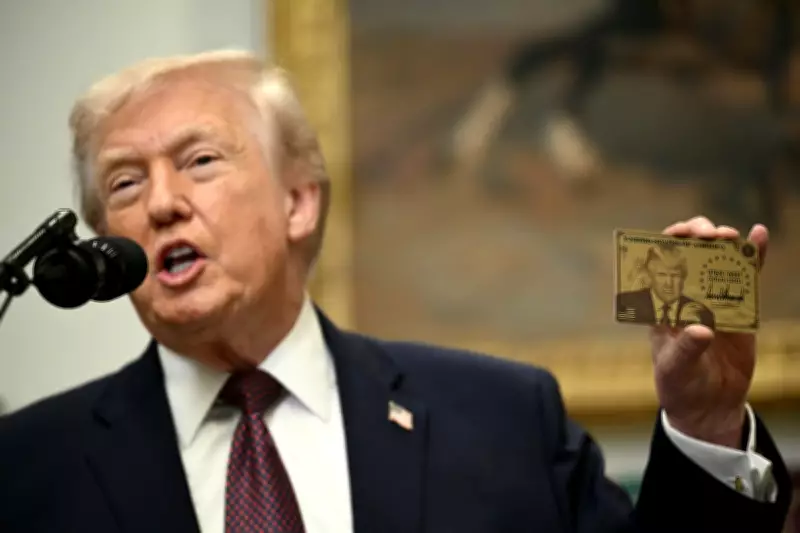
Donald Trump's 'Gold Card' visa program has reportedly attracted only a few dozen applications in several months, with immigration attorneys actively advising wealthy prospective applicants against using the scheme, according to a new report from The Washington Post.
Attorneys Refuse to Engage
The Post found that more than half a dozen immigration attorneys specializing in high-net-worth clients—the very demographic targeted by the Department of Homeland Security and the White House—are either cautioning clients against applying or outright refusing to work with those who do. Among those declining involvement is Michael Wildes, the attorney who represented first lady Melania Trump during her immigration to the United States in 1996. Melania originally entered the U.S. under an H-1B visa.
Wildes and other lawyers told the Post that the program lacks sufficient legal foundation for them to assist clients. 'It would be unethical of me to retain them,' Wildes stated.

Legal Concerns
According to these attorneys, the program's reliance on existing visa categories—rather than being established by an act of Congress as a new visa type—renders its future uncertain. The Trump administration has already faced lawsuits over the Gold Card program, including from the American Association of University Professors.
The visa utilizes two existing classes, E-B1 and E-B2, and allows applicants to make a $1 million donation to the federal government in exchange for bypassing the 'extraordinary ability' requirements normally associated with those visas. By law, applications must be processed in the order they are filed, and the administration is limited to a capped number each year. Critics argue the program violates the legal intent of the existing visa classes, making it illegal.
Low Uptake and Enforcement Context
Trump's push to attract wealthy immigrants coincides with his administration's efforts to expel millions of undocumented individuals. A surge in immigration enforcement across numerous U.S. cities has occurred during Trump's first year, including incidents in Minneapolis that led to the deaths of two Americans in confrontations with agents.
The Post reports that in one court filing regarding the program's legality, the Trump administration revealed that fewer than 60 people had submitted paperwork to DHS to begin the application process. The program was activated in June of last year. Last month, it was disclosed that only one person has been approved for a visa under the program, though their identity remains undisclosed.
'The workload from the Gold Card program is quite small,' a DHS official wrote in a note included in the court filing.
Program Details and Official Claims
Trump unveiled the Gold Card program at the White House in December, and DHS subsequently launched a website, Trumpcard.gov, to accept applications. The site promises applicants legal U.S. residency 'in record time' if they pass a background check by U.S. Citizenship and Immigration Services, submit a $15,000 processing fee to DHS, and then make a $1 million payment to the government. The president stated that the program aims to retain talent after foreign students graduate from U.S. schools.
'They graduate from college, they have to go back to India, they have to go back to China, they have to go back to France, they have to go back to wherever they came from,' he said. 'It's ridiculous. We are taking care of that. The companies are going to be very happy.'
Commerce Secretary Howard Lutnick claimed to a House committee in April that 'hundreds' more applicants were in line. 'This is a new program, and they've just set it up, and they wanted to make sure they did it perfectly,' he told the House Committee on Appropriations. 'It's a DHS program done with a rigorous, rigorous vetting.'
However, immigration experts widely agree that the plan holds little legal water without an act of Congress to validate it. 'I'm very dubious it can be done without an act of Congress,' said George Fishman, a former DHS official under Trump's first term and now senior legal fellow at the Center for Immigration Studies.






