

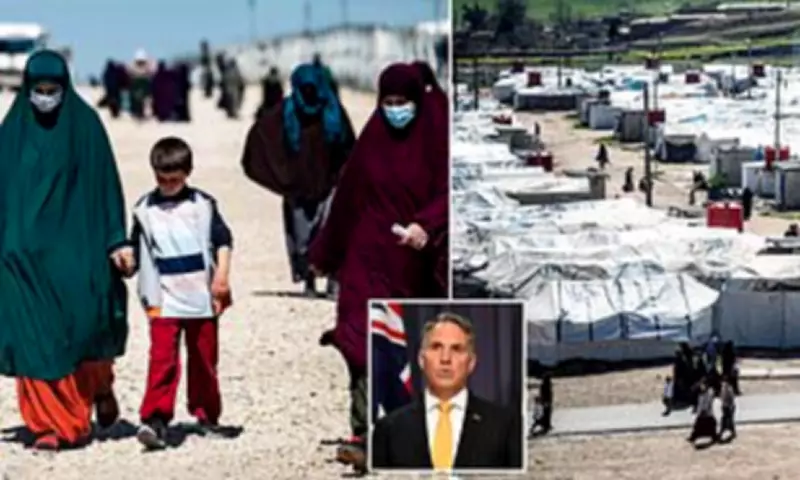
Deputy Prime Minister Richard Marles has responded to reports that a group of ISIS brides and their families have made a second attempt to return to Australia. It is understood that four women, along with nine children and grandchildren, departed from the Al-Roj detention camp in northeastern Syria on Friday, embarking on a 10-hour journey to Damascus.
Camp coordinators confirmed that 13 individuals left with the support of the Syrian government. 'We can confirm that today the coordination was perfect,' Al-Roj camp director Hakmiyeh Ibrahim told the ABC. 'It was done between us and the Syrian government, to be able to fly back these families to their country.'
Marles was reluctant to comment on the reports when interviewed on Sky News about Anzac Day on Saturday. 'Look, I am loathed to go into that on this day, other than to simply say this: the Australian government is not repatriating those people from Syria,' he said. 'But as I say, today, given the significance of it, I'm loathed to go into it in any more detail.'

A spokesperson reiterated that the federal government 'is not and will not repatriate people from Syria'. 'Our security agencies have been monitoring - and continue to monitor - the situation in Syria to ensure they are prepared for any Australians seeking to return to Australia,' they stated.
Opposition Home Affairs spokesman Jonno Duniam called on the Albanese government to ensure the cohort does not return. 'These ISIS brides chose Syria over Australia. They made a choice to ditch Australian values for the values of a terrorist organisation,' he wrote online. 'And to hear this on Anzac Day - our most sacred of days. Our diggers fought for our rights and liberties against people who want to tear them down.'
This development follows a failed mission in February to repatriate 11 Australian women and their 23 children, who were turned around just 50 kilometres into their journey. That unsuccessful bid triggered a political storm back home. Prime Minister Anthony Albanese swiftly ruled out government involvement, saying he had 'no sympathy' for women who travelled to ISIS territory during the height of the caliphate.
Western Sydney doctor Dr Jamal Rifi travelled to Syria earlier this year with passports in the hope of repatriating the cohort. He indicated at the time of the failed mission that the push to return the families was far from over, despite the collapse of the initial mission and escalating conflict in the region. He added that the families faced harsh conditions at the Al-Roj camp. 'They are in a waiting game,' he said. 'We have a plan A with about a 90 per cent chance of success, and plans B and C, which are riskier and more difficult. But their safety - getting them home - is our priority.'






