
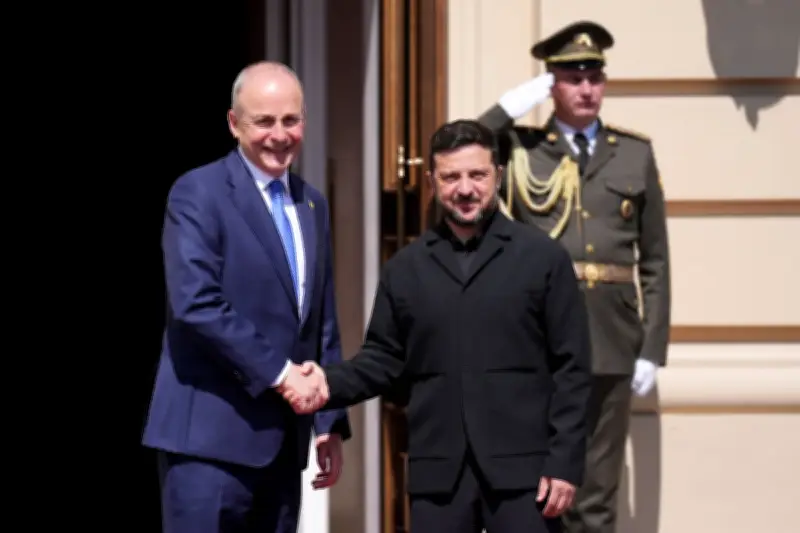
Irish Taoiseach Micheál Martin has said there is no concrete evidence to prove or disprove whether alumina exports from Ireland to Russia ended up being used by weapons manufacturers. He made the comments during a joint press conference with Ukrainian President Volodymyr Zelensky in Kyiv on Thursday.
Martin said the investigation into alumina exports from a Limerick-based refinery was “almost complete” and the results would be shared with the European Commission.
Investigation findings
“The investigation has not found concrete or definitive evidence linking the alumina to a weapons manufacturer in Russia,” Martin said. “That said, neither has it found definitive evidence that alumina may not be going to weapons manufacturers, so it’s difficult.”
He added: “So what we’re going to do now is we’re going to share the investigation with the European Commission, because this is both an Irish issue and a European issue in terms of alumina.”
Zelensky’s response
Speaking through an interpreter, Zelensky said: “Speaking about sanctions, we support sanctioning of the relevant production, and the Taoiseach and I have discussed this today.” He suggested that efforts could be made at national level to restrict the export of alumina products to Russia.
“So the number one task that we have – the issue – is that this does not reach Russia, so that this does not help weapons production and so that this does not fund this war,” Zelensky said. “If this can be achieved by certain internal steps, we would support these processes, but the EU task and sanctions, we also take this with us and we will raise this issue with the EU.”
Additional funding
Ireland also announced a further 125 million euro for Ukraine for this year, in addition to 65 million euro announced earlier. Martin said 100 million euro of this funding would be directed towards “meeting Ukraine’s defence needs”, including non-lethal military assistance to strengthen Ukraine’s air defences against drones.
Zelensky thanked Ireland for its support and mentioned the “very warm” attitude towards Ukrainian refugees in Ireland. He called for Ireland to show leadership on Ukrainian efforts to join the EU.
Political context
Martin’s visit to Kyiv comes as Zelensky is under pressure domestically over a controversial government reshuffle last week. Zelensky fired his new commander-in-chief, General Oleksandr Syrskyi, and replaced him with Major General Mykhailo Drapatyi. He has also come under pressure over the removal of defence minister Mykhailo Fedorov.
At the press conference, Zelensky was asked about which roles had been offered to Fedorov, and said he was offered vice prime minister of Ukraine, as he called for a focus on unity.
Symbolic gestures
Martin gave Zelensky an album, a framed photo of him addressing the Dáil in December, and a bottle of whiskey, while Martin received a Ukrainian football jersey. Martin also received a Ukrainian flag signed by the speaker of the Ukrainian parliament, Ruslan Stefanchuk, after they met and discussed progress on accession talks for Ukraine.
Stefanchuk praised Ireland for its support and said he was relying on them to ensure progress on accession talks by beginning discussions on certain criteria needed to join.
The Taoiseach also visited a civilian area in Kyiv, Lukianivska, which has been repeatedly damaged in Russian attacks. He heard from Liudmyla Vladyna and Oleh Kutz, who live in the area and were affected by the blasts on July 19, where 40 missiles were fired in 40 minutes.




