The town council of Heidenau in the German state of Saxony has voted to halt the laying of new Stolpersteine, or stumbling stones, that commemorate individual victims of the Nazi era. The decision, backed by the far-right Alternative für Deutschland (AfD) and the conservative Christian Democratic Union (CDU) of Chancellor Friedrich Merz, has drawn a national outcry.
The Stolpersteine project, initiated by artist Gunter Demnig in the 1990s, has placed 128,000 brass plaques across Europe, including one honouring Heidenau's former mayor Paul Gröger, who was hounded into suicide by the Nazis. The plaques are inscribed with the victim's date of birth and the date and circumstances of their death, and are laid before their last home or workplace.
Council's decision and local reaction
Anne Nitschke of AKuBiZ, a citizens' group combining history education with pro-democracy work, accused the council of trying to drive the memory of Holocaust victims out of the town centre. Her organisation had filed for permission to lay 12 additional plaques, but the council stopped them.
Residents are divided on the ban. Christine Bauer, 85, who uses a rolling walker, said, "Why would they have anything against the Stolpersteine? It's easy enough to walk around them if you don't want to step on them." She added, "It's not as if the town council didn't have bigger problems to worry about now." In contrast, Silke Schutz, 63, a baker and self-described "staunch AfD voter," called the Stolpersteine "a waste of money, regardless of who pays for them," and said, "We had nothing to do with the war and at some point it [remembrance] has got to come to an end."
Political context and criticism
The vote came as the AfD widened its lead in national polls and performed strongly in state elections. The party has long targeted Germany's memory culture, with co-leader Alice Weidel falsely calling Hitler "a communist, socialist guy." Supporters of the ban criticised that the plaques are walked on and exposed to the elements, and called for a "memorial space" in a Christian cemetery north of town.
Nitschke noted the council had not made plans or committed funding for such a memorial, and said the broad spectrum cited served to deny the "singularity of the Holocaust." Demnig reacted angrily, calling the decision "unprecedented" and wrong.
Existing stones and next steps
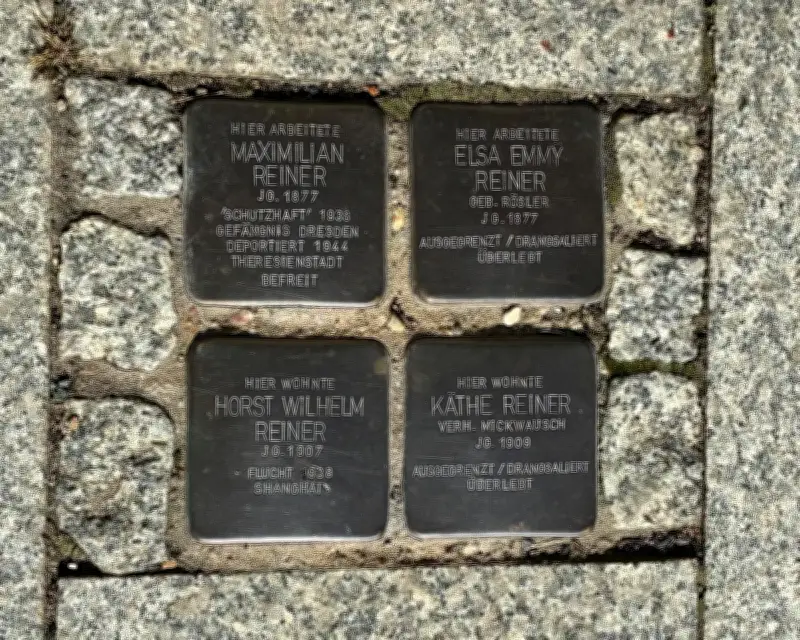
Heidenau has five Stolpersteine, all laid by Demnig. Four honour the Reiner family, whose patriarch Maximilian ran a local department store until deported to Theresienstadt in 1943; he survived and emigrated to the US, dying in 1949. Another honours Gröger, who refused to run up the swastika flag and was tortured at Hohnstein concentration camp before taking his own life.
Nitschke said no plans had been announced to remove existing stones, but the 12 planned plaques were on hold, including for Fritz Goldstein, a Jew stripped of his property and deported to the Soviet Union with his wife. Nitschke's team plans a legal challenge to the ban, and this weekend they will lead a march through town to the sites of the planned new Stolpersteine, recounting the stories of each victim.