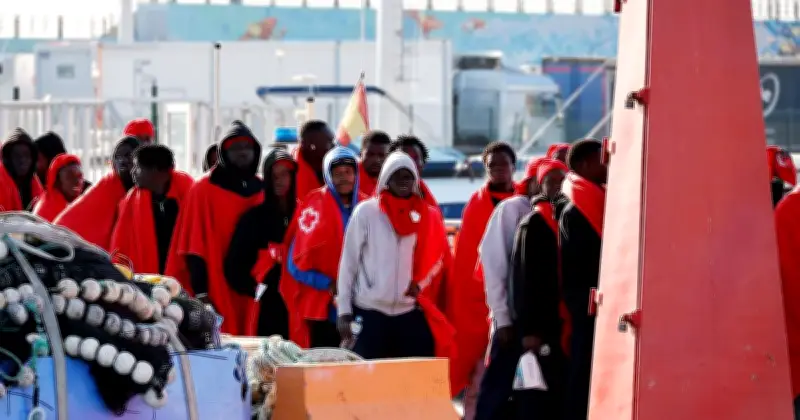
Migrant arrivals by boat at the Canary Islands could more than double in the next few years, according to experts. Around 25,000 people have reached the Spanish archipelago irregularly so far in 2026, an increase of just under 66% compared with the same period last year. Experts estimate the number of arrivals could reach 33,000 by the end of the year.
Pressure expected to continue for two decades
Population and migration think tank Catedra Juan Miguel Sanjuan has suggested that pressure on migrants to travel to the islands would continue for at least 20 years. In a report, it said: "Medium term the estimation is a fluctuating flow of between 15,000 and 40,000 arrivals per year, determined more by police co-operation in countries of origin than by demand, with longer and deadlier routes. Long-term, 2030 to 2040, demographics and climate in West Africa will sustain the pressure."
The report added: "The controllable variable is how much of this pressure is channelled through legal and orderly channels." It presented a worst-case scenario of more than 50,000 coming from the Sahel states just south of the Sahara Desert, as reported by SUR in English.
Record arrivals and shifting routes
The think tank warned: "A scenario of oscillation is today the most probable scenario, with cycles of containment and resurgence as in 2023-2026 with annual irregular arrivals of 20,000 to 45,000 migrants. The networks will continue to shift further south, to Guinea, Guinea-Bissau and Ivory Coast. We can expect fewer, larger vessels making longer crossings."
On November 14, a record 1,580 people reached the Canary Islands. This followed Spain declaring a migration emergency after a large increase in the number of migrant arrivals.
Islands seen as transit territory
Experts have described the archipelago as a "transit territory", as around 90% of African immigrants arriving in the Canary Islands "do not remain on the islands, but move to the mainland and other parts of Europe using extended family networks", Spanish journalist Juan Manuel Pardella said in a speech in July. He added: "Despite economic growth in Africa, the gap in living conditions with Europe remains enormous. Improvements in healthcare, security, and infrastructure are key to reducing migration driven by necessity, but migratory pressure is expected to persist."