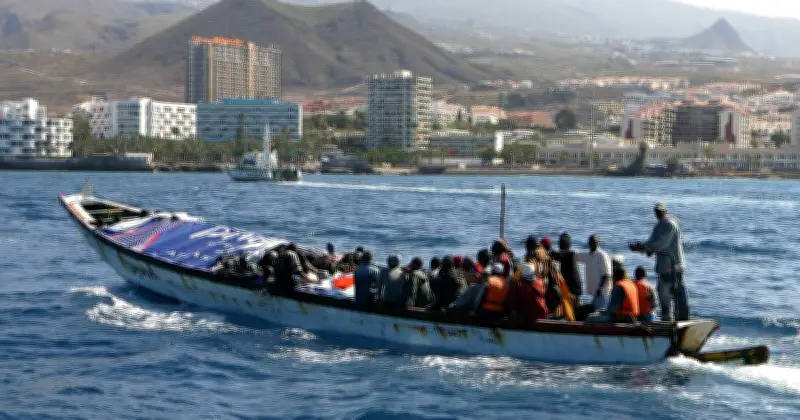
Spain has declared a state of emergency in the Canary Islands after nearly 2,200 migrants arrived at the popular British tourist destination in just 48 hours. Local officials have asked Madrid for urgent help after record numbers of people reached the archipelago from Africa over the weekend, raising fears of a repeat of July's Ceuta border crisis.
Over the past month, the number of people attempting the perilous crossing to the Canaries - primarily from Senegal, Gambia and Guinea - has skyrocketed. The tiny volcanic island of El Hierro, which has a local population of just 11,000, bore the brunt of the weekend arrivals, leaving its immigration facilities completely overwhelmed.
Record weekend arrivals overwhelm El Hierro
According to Spain's maritime rescue service, almost 2,200 people reached the archipelago over the weekend. At least 12 boats arrived at El Hierro, with additional vessels landing at the major holiday hubs of Gran Canaria and Tenerife. Saturday alone saw nearly 1,500 arrivals - the highest single-day total since 2020.
Over the last fortnight alone, more than 3,300 migrants have landed on El Hierro via at least 30 boats. Fernando Clavijo, the regional president of the Canary Islands, issued a stark warning as local resources reached breaking point. He said: "The Canary Islands cannot continue to face, practically on their own, a situation that requires the involvement of the Spanish government and Europe."
Yearly totals already surpass 2025
So far this year, 13,000 migrants have arrived in the Canary Islands, accounting for roughly half of all irregular entries into Spain. While calmer autumn seas typically bring a seasonal uptick in crossings, the Atlantic route from West Africa remains one of the deadliest in the world.
Although the islands sit roughly 65 miles off the African coast, boats frequently take longer, treacherous routes to evade police patrols, with journeys lasting up to three weeks. The escalating crisis comes at a politically sensitive moment, just two weeks before Spaniards head to the polls for a general election.
Political tensions and record numbers
Recent polling suggests Socialist Prime Minister Pedro Sánchez could be ousted, with his party trailing behind right-wing rivals. Critics and experts have pointed to Sánchez's controversial decision to offer amnesty to roughly one million undocumented migrants already living in Spain as a move that has severely backfired.
The emergency in the Canaries follows months of mounting pressure on Madrid over its handling of the Spanish enclave of Ceuta, where some 80,000 people stormed the border in late July. While most were returned to Morocco, the government claims around 5,000 remain - a figure fiercely disputed by Ceuta's mayor, who estimates the true number is closer to 15,000. Residents have voiced growing anger over strained local resources, with many migrants, including unaccompanied minors, still sleeping rough on the streets while awaiting registration or deportation.
Migrant arrivals in the Canary Islands in 2026 have officially overtaken the total for all of 2025, following a massive autumn surge that completely reversed a quiet start to the year. After hitting an all-time record of 46,843 arrivals in 2024, crossings to the archipelago dropped by 62% in 2025 to a full-year total of 17,788. For the first nine months of 2026, arrivals were tracking well below 2025 levels - at times down by 60% to 85%. Fewer than 6,200 people arrived across the entire first half of 2026.
However, calmer Atlantic waters and renewed departures from Senegal and The Gambia triggered a dramatic spike, bringing just under 6,200 people in 65 boats in October 2026 alone - more than the entire first six months of the year combined. Over 9,000 migrants reached the islands in the first two weeks of November alone, including Saturday's single-day record, surpassing the 2025 full-year figure with six weeks of the year still left to go.