

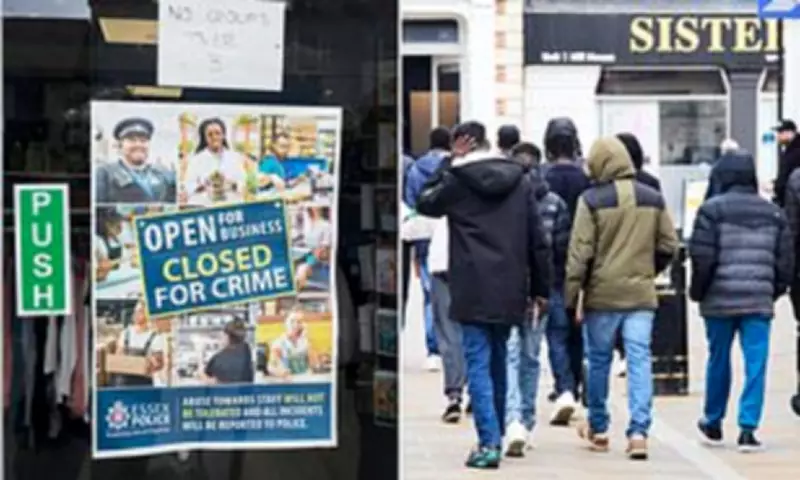
Braintree Residents Voice Alarm Over Asylum Seeker Behaviour During Town Visits
Multiple times each week, typically around midmorning, a convoy of Ford Transit minibuses arrives in the centre of Braintree, Essex. From these vehicles disembark groups of up to fifty men, predominantly in their twenties and thirties. These individuals are asylum seekers, recently arrived in the United Kingdom via small boat crossings from France, with origins spanning the Middle East, Africa, and Asia.
With limited activities available to them, the men often congregate in the town for several hours before being collected and returned to their accommodation at the former RAF Wethersfield base. While these scheduled visits might appear harmless on the surface, alleged misconduct by some during these outings has triggered significant anxiety and a strong backlash from the local community.
Reports of Harassment and Intimidation Towards Women and Girls
Although some residents expressed sympathy for the asylum seekers' circumstances, numerous troubling accounts have emerged. Locals describe groups of bored men photographing schoolgirls, blowing kisses at female staff in beauty salons, and wolf-whistling at teenagers to the point of reducing them to tears. More alarmingly, several women reported being followed on their way home from work, leading to widespread fear.

Many women now feel apprehensive about going out alone, with some resorting to carrying personal safety packs containing whistles and alarms. This climate of fear has been partly attributed to perceived government inaction, particularly regarding Prime Minister Keir Starmer's pre-election indication that the Wethersfield centre needed to close—a promise locals claim remains unfulfilled.
Business Impact and Community Response
The Sue Ryder charity shop in Braintree, which raises funds for end-of-life care, has implemented a strict "no groups over three" policy, prominently displayed on its door alongside a sign stating "Open for business, closed for crime." This measure was introduced on police advice following incidents where groups of asylum seekers allegedly targeted the store, resulting in stock disappearing.
Susan Doan, co-owner of Sisters Nails and Beauty, recounted disturbing experiences: "They hang around outside the shop blowing kisses at the staff here. During the dark nights you would not want to leave here on your own." She described an incident where she asked a group to move away from her shop front, only to have chicken bones spat at her. "The disrespect from them towards women is unreal," she added.
Other business owners shared similar concerns. Serena Fletcher, proprietor of Stylistic salon, noted: "I've heard a few stories of women being followed by them when they come into town." A worker at another charity shop revealed she was "living in fear" after an asylum seeker repeatedly visited to browse women's clothing and she was followed on her commute.
Political Promises and Local Frustration
Weeks before the 2024 General Election, Labour leader Keir Starmer acknowledged local opposition to the Wethersfield centre, stating it "needs to close." However, nearly two years later, the facility not only remains operational but its capacity was increased last summer to accommodate up to 1,225 asylum seekers—more than double its original size.
This perceived backtracking has fuelled anger among residents. Ms. Doan expressed this frustration: "Keir Starmer says one thing and then does another. And you wonder why people are getting angry—because you're doing nothing for us."
In a letter to the Home Office, Braintree's Conservative MP and former home secretary James Cleverly warned that the site is "creating real problems in the local area," citing intimidating groups of bored young men and declining footfall for shopkeepers.
Broader Concerns Beyond Braintree
Issues extend beyond the town centre to the Wethersfield base itself and its immediate surroundings. Local residents Len and Margaret Freshwater, who live near the former RAF base, reported asylum seekers defecating in nearby fields, leaving behind toilet paper. Simone Sutcliffe, a long-term resident, confirmed similar sanitation problems.

Violence within the camp has also been documented. Last month, Adnani Mohammed was sentenced for violently attacking security staff at the site. Former security workers described a lack of protection, with asylum seekers allegedly returning from town with alcohol and weapons, leading to nighttime parties and disturbances.
Inspection Reports Highlight Mental Health and Safety Risks
Official inspections have raised alarms about conditions at Wethersfield. In early 2024, the then independent chief inspector of borders and immigration, David Neal, warned that a lack of purposeful activity could harm residents' mental health and increase disorder risks.
A subsequent report by Médecins Sans Frontières found "high levels of mental distress" among asylum seekers at the site, describing "poor conditions and structural violence." One resident, given the alias 'Fadil', complained of anxiety, noise, and filthy shared bathrooms. Another, referred to as Mahdi, likened the environment to a prison, noting its isolation from society.
As another protest against the camp is planned for later this month, the combination of government inaction and far-right agitation has left many locals fearing that an already tense situation could escalate dangerously.





