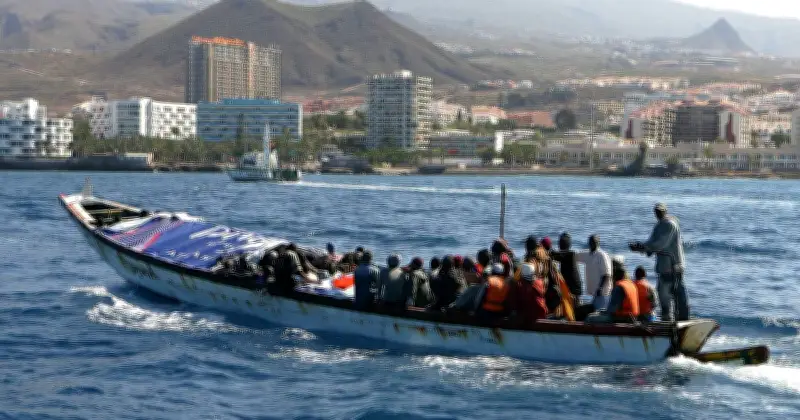
A record 1,611 migrants arrived on the Canary Island of El Hierro in a single day, the highest number recorded in Spain in 24 hours, according to emergency services at the port of La Restinga. The arrivals, which occurred on Tuesday, surpassed the previous record set just ten days earlier on November 14, when 1,580 migrants reached the shores of El Hierro, Gran Canaria and Tenerife. The prior record, dating back to 2020, saw 1,461 people rescued on November 7, with arrivals concentrated in Arguineguín in Gran Canaria.
Arrivals and demographics
Maritime Rescue confirmed that 1,611 migrants arrived on Tuesday in eleven cayucos coming from Senegal and Gambia. The group included nearly 200 women and over 100 children, including a baby of only two months. The survivors, who had been adrift across the Atlantic for between five and seven days, came from Gambia, Senegal, Guinea-Conakry, Guinea-Bissau, Burkina Faso, Mauritania, Mali, and Yemen.
In the afternoon, around 2.50pm, another cayuco from Tanji in Gambia entered the port of La Restinga with 153 occupants, including thirteen minors and 26 women, two of them pregnant. The first vessel arrived at the port accompanied by the Salvamar Acruz with 190 people around 3.15am, followed by a second shortly before 3.45am, which was rescued 55 miles south of La Restinga with 217 people. Less than an hour later, the Salvamar Diphda accompanied another canoe with 216 people.
Landings throughout the day
At dawn, around 6.30am, the landing of another cayuco was completed, escorted by the Salvamar Navia with 171 people. After 2pm, the Salvamar Acrux and the Civil Guard patrol boat accompanied two other canoes carrying 140 and 208 people, respectively. In the afternoon, shortly before 5.15pm, the Salvamar Diphda accompanied another canoe with 49 people, while the Salvamar Navia and the Civil Guard escorted another with 93 people, and then another, with 47 people, arrived on its own after being detected three miles south of the island. Maritime Rescue is still awaiting the rescue of two more boats.
The landings on Tuesday add to those on Monday, when Maritime Rescue rescued 815 people in six canoes in the waters off El Hierro and another two in Tenerife. The Canary Islands have therefore received at least 2,246 migrants in just two days, with El Hierro once again being the main destination for the boats.
Political response and concerns
The third Interministerial Commission on Migration, held this Tuesday with the participation of President of the Government of the Canary Islands, Fernando Clavijo, concluded that Spain's external action with the countries of origin of migrants arriving in the archipelago is not yielding results and fails to stop departures to the islands. The magnitude of the migratory surge in the Canary Islands this month, with more than 12,000 people arriving in over a hundred cayucos, explains why historical records are being smashed. More than 80% of these arrivals have been concentrated in El Hierro, which has become the main entry point of a route that once again tests the limits of the archipelago's response capacity.
According to data from the International Organisation for Migration (IOM), at least 454 people have died or remain missing in this migratory corridor from early 2026 until last October. Many of the migrants arrive suffering from dehydration, hypothermia and skin abrasions. Local ambulances, hospitals and Red Cross teams are operating beyond capacity, and local unrest is said to be growing. Thousands are having to sleep rough on the docks because the official migration centre can only cater for 500 people. Others are being transferred to other islands in the Canaries, including Tenerife, where an old reception centre is to be reopened in La Laguna in the north of the island.
Questions are now being raised as to how so many migrants are managing to reach El Hierro and whether there is another organised trend behind the emergency. The theory of so-called mother ships reappears every time the migratory pressure on the islands increases, although the investigations and testimonies of the rescue services have not allowed their use to be proven on this route. The issue has become topical after Xavier García Albio, number one of the PP for Barcelona, called for the intervention of the Navy in El Hierro to control the alleged presence of ships that drag cayucos to the Canary Islands. However, there is no verified public evidence to support that claim. The procedure has been documented in the central Mediterranean, where in June 2019 Italian authorities detected a human smuggling operation near Lampedusa using this system.
Official statements and local impact
President Clavijo criticised the Spanish government for not doing enough to help in the crisis, saying the continuous arrival of boats "is putting a lot of pressure on the healthcare services and the Canary Islands Health Service." He called for increased patrols at the African locations where migrants leave from, mainly Senegal and the Gambia. Mr. Clavijo said Spain had promised to provide financial aid for the families and businesses adversely hit by the crisis but nothing had happened, and neither had help for the lifeboat rescue services or health personnel materialised. Regarding the possibility of using the army, he said deploying it "would mean using them as a lifeguard because the army, once the cayuco, the patera, has been detected, the only thing it can do is bring it to the Canary Islands." He added that what the Government of the Canary Islands wants is for Frontex to be deployed in the countries of origin, "which is where the intelligence work has to be done, which is where the security forces of those countries have to do the work together with European forces to prevent them from leaving and risking their lives and being able to die." He also added that the position of the Government of the Canary Islands is that "its border should be protected."
Territorial policy minister Victor Torres visited the fishing port of La Restinga in El Hierro on Sunday, where the uptick in arrivals has sparked protests from residents worried about health implications, safety and the image of the island. The former Canarian president admitted that the surge in arrivals has been ongoing since mid-October, revealing that around 17,000 people had reached El Hierro this year and around 27,000 to the Canary Islands as a whole. The Spanish government has denied not helping enough and says that of the 17,000 migrants who had reached El Hierro this year, around 2,000 only remain, with most having gone to the mainland. El Hierro has a population of just over 11,500 residents, according to official census data.
The months after summer are traditionally the busiest of the year on the Africa/Canary route, when the hostile northern trade winds ease, and the crossing becomes more navigable. That pattern is being accentuated by political and economic stability in Senegal, experts believe. Reduced coastal patrols are also taking the blame, after more than 10,000 officers were deployed to the Youth Olympic Games in Dakar. To try and cope with the crisis on El Hierro, buses have been diverted to migration operations and medical staff have been brought in from other islands. Alpidio Armas, head of the governing council for El Hierro, said they were extremely concerned about the sharp increase in arrivals, which is why they had declared a social emergency, adding that a small island like El Hierro could not manage on its own. Officials are seeking temporary accommodation for the new arrivals, while conditions at the island's hospital have become "undesirable", according to local politicians. More than 6,000 people arrived in October alone, followed by around 11,000 migrants in the first half of November. Work is being done to "remove" the canoes from the port of La Restinga so that "they are not an obstacle to the normal operation" of the dock, while the shipping company Fred.Olsen "is also lending a hand" enabling special routes that connect El Hierro with the south of Tenerife, as well as the bus cooperative. La Restinga is one of the focal points of the island and is home to numerous businesses, including many diving schools who fear their activities will grind to a halt. El Hierro is the second smallest of the Canary Islands, an idyllic tourist favourite boasting volcanic landscapes, hiking trails and historic towns, and receives around 30,000 tourists per year, making it the least-visited of the main Canary Islands. The Atlantic crossing between Africa and the Canaries is considered to be one of the most dangerous, and new figures reveal one in five migrants die en route.