

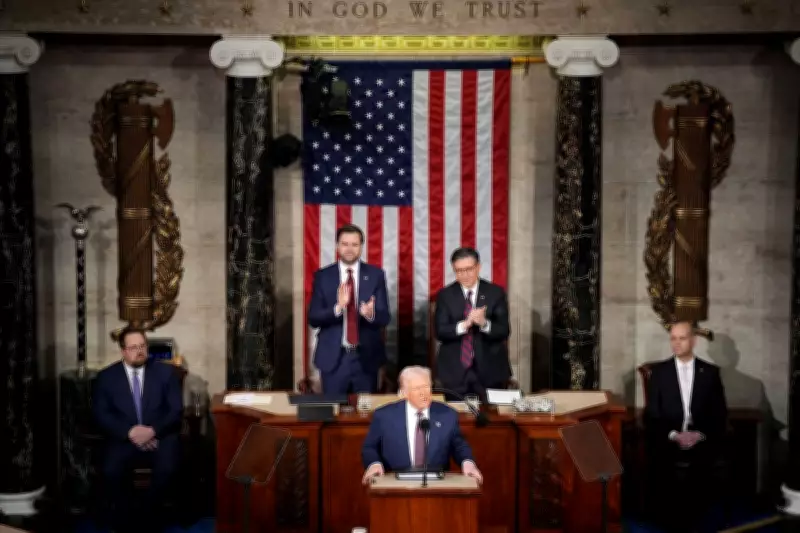
Trump's Polling Crisis Deepens as State of the Union Address Approaches
As President Donald Trump prepares to deliver his second State of the Union address since reclaiming the White House in January 2025, he confronts a severe polling crisis that mirrors the chaotic final days of his first term. Multiple recent surveys reveal growing public skepticism about his leadership and policy direction, with approval ratings plummeting across nearly all demographic groups.
Dramatic Decline in Public Approval
A CNN/SSRS survey released on Monday shows only 36 percent of Americans approve of Trump's performance, representing a dramatic 12-point drop from the 48 percent approval he enjoyed at this time last year. More concerning for the president, 61 percent of respondents believe his policies are steering the country in the wrong direction.
The polling collapse extends to crucial voting blocs that previously supported Trump. Independent voter approval has plunged to just 26 percent, the lowest ever recorded during his political career and down from 41 percent last year. Latino support has suffered an even more dramatic decline, falling from 41 percent approval to a mere 22 percent.

Policy-Specific Disapproval Mounts
A separate ABC News/Washington Post/IPSOS survey reveals widespread dissatisfaction with Trump's handling of key issues. Supermajorities of Americans disapprove of his approach to inflation (65 percent), tariffs (64 percent), and foreign relations (62 percent). Even on his traditionally strong issues of immigration and the economy, clear majorities express disapproval at 58 percent and 57 percent respectively.
Overall, the ABC/Post survey finds 60 percent of Americans disapprove of Trump's performance, matching his highest disapproval rating from when he left office in 2021 after losing to Joe Biden and refusing to accept the election results.
Historical Precedent Versus Trump's Approach
Traditional politicians facing such polling setbacks would typically adjust their policies or messaging, particularly with congressional control at stake in upcoming elections. Historical precedent exists for such course corrections, most notably when President Bill Clinton responded to midterm losses by declaring "the era of big government is over" in his 1995 State of the Union address.
Trump, however, shows no signs of following this pattern. During a White House event on Monday, he dismissed negative polling as fraudulent, claiming his actual approval rating is "much higher" than the 40 percent figure he referenced. He further accused the press of dishonesty regarding both news coverage and polling data.
Doubling Down Amid Declining Support
The president's response to declining numbers has been consistent with his established pattern of doubling down rather than adjusting course. Despite the Supreme Court's recent rebuke of his signature tariff policies and mounting public concern about economic issues, Trump maintains his policies are working perfectly.
Speaking in the East Room on Monday, he declared the country is "now doing well" and promised to emphasize economic success during his State of the Union address. This approach continues his long-standing pattern of dismissing unfavorable information while claiming overwhelming mandates based on his 2024 electoral victory.
Political Implications and Future Outlook
The timing of this polling crisis carries significant political implications as voters consider whether to maintain Republican control of Congress or shift power to Democrats. Trump's declining support among independents and Latino voters, both crucial to his 2024 victory, suggests potential vulnerability for his party in upcoming elections.
As the State of the Union address approaches, the question remains whether Trump will use this platform to address public concerns or simply reinforce his existing positions while dismissing polling data as fraudulent. Given his established patterns and recent statements, all indications suggest he will choose the latter approach, potentially deepening rather than alleviating his political challenges.






