

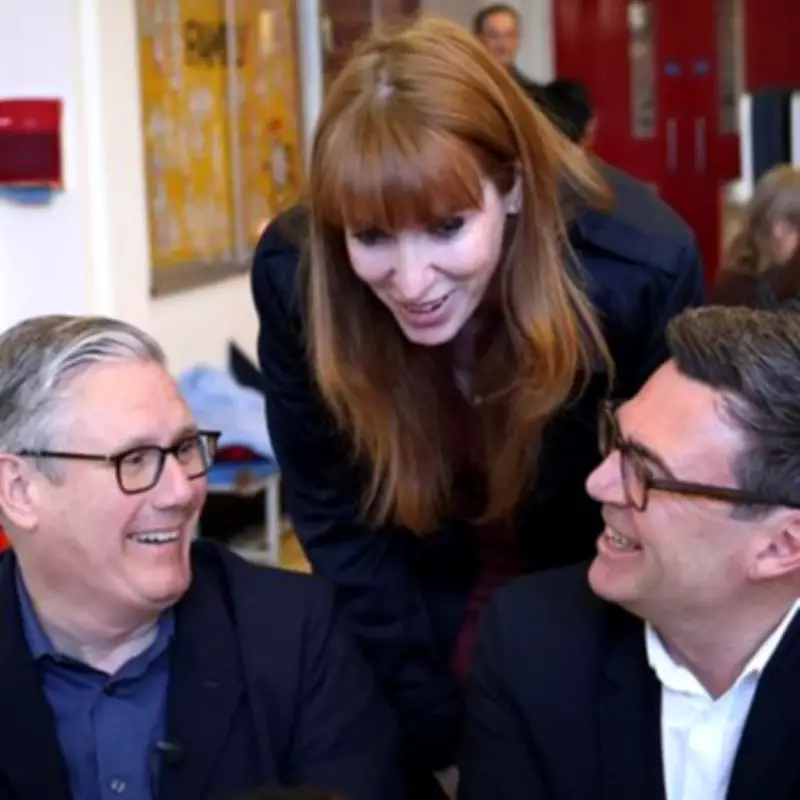
Starmer, Rayner and Burnham Display United Front Before Crucial Local Elections
Prime Minister Keir Starmer has sought to project a cohesive image alongside former deputy Angela Rayner and Greater Manchester Mayor Andy Burnham, as Labour braces for potentially devastating local election results next month. The Prime Minister's public appearance with the two prominent figures comes amid grim forecasts suggesting the party could lose as many as 2,000 council seats in the upcoming May polls.
Starmer Dismisses Resignation Speculation Despite Dire Predictions
Addressing reporters during a visit to Greater Manchester, Starmer firmly rejected any notion that he would consider stepping down if Labour suffers significant defeats. "I have received a five-year mandate to change this country," he declared, referencing his 2024 general election victory. "I intend to carry through that mandate." The Prime Minister emphasized that his party would "take nothing for granted" in the approaching local elections, acknowledging the challenging political landscape.
Surface Unity Masks Underlying Tensions
While Starmer, Rayner and Burnham appeared harmonious during their joint engagement—even sharing lighthearted moments with schoolchildren—substantial policy disagreements simmer beneath the surface. Rayner, frequently mentioned as a potential future Labour leader, has grown increasingly critical of the government's direction in recent weeks. Her public comments have highlighted growing tensions within the party's upper echelons.

Last month, Rayner delivered a stark warning at an event organized by the campaign group Mainstream, stating Labour was "running out of time" to deliver meaningful change. She argued the party risked being perceived as representing "the Establishment, not working people," a pointed critique of the current leadership's approach.
Rayner's Sharp Criticism of Immigration Policy
The former Deputy Prime Minister specifically targeted the government's flagship immigration plans, spearheaded by Home Secretary Shabana Mahmood. In what appeared to be a direct attack on the proposals, Rayner stated: "Many people came here to Britain on the understanding that if they worked in sectors where we needed them, obeyed the law and paid their taxes, they could stay."
She continued with forceful criticism: "If we suddenly change that, it pulls the rug from under those who have planned their lives and commitments and are contributing to our economy and to our society. That would be not just bad policy but a breach of trust." Rayner emphasized that existing immigrants "now fear for their future" and "do not have stability."
Her remarks took on a patriotic tone as she added: "We cannot talk about earning a settlement if we keep moving the goalposts, because moving the goalposts undermines our sense of fair play. It's un-British."
Broader Concerns About Labour's Direction
Rayner's critique extended beyond immigration policy to encompass broader concerns about the party's trajectory. "As a party, and as a movement, we cannot hide, we cannot just go through the motions in the face of decline," she warned. "There's no safe ground and we're running out of time. The change that people wanted so desperately needs to be seen, it needs to be felt, and we have to show that it is a Labour government that will deliver it."
This public airing of internal disagreements occurs against the backdrop of Burnham's own political frustrations. The Greater Manchester Mayor recently had his bid to contest the Gorton and Denton by-election blocked by Labour's ruling executive committee, adding another layer of complexity to the party's internal dynamics.
As May's local elections approach, Starmer's attempt to present a united front with Rayner and Burnham represents a strategic effort to minimize public divisions. However, the substantial policy disagreements and personal ambitions within Labour's senior ranks suggest the party faces significant challenges beyond the immediate electoral threat. The coming weeks will test whether this display of unity can translate into electoral success or whether underlying tensions will further complicate Labour's prospects.






