

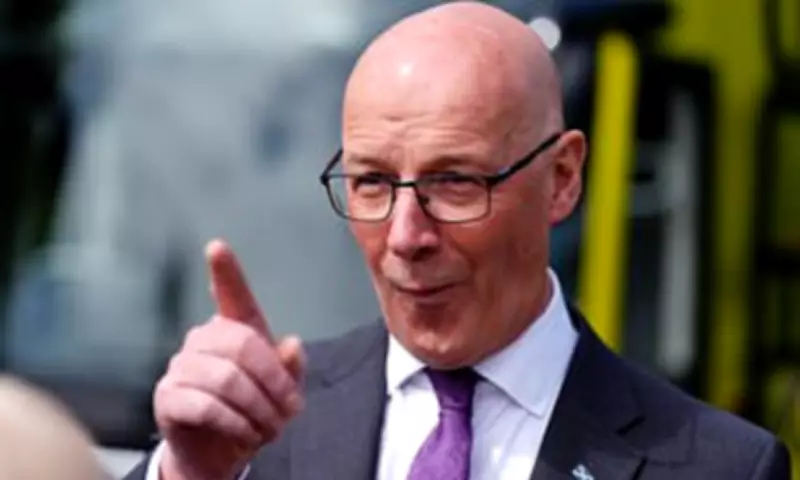
SNP support has slumped during the Holyrood election campaign, and the party is on track to fall short of John Swinney's target of a majority, according to the latest polls. As the final day of campaigning got under way yesterday, an Ipsos poll found that support for the SNP on the constituency vote has declined by four percentage points since the start of the campaign, while it was down three percentage points on the regional list.
The SNP remains on track to be the largest party, with support standing at 35 per cent on the constituency vote and 26 per cent on the list. However, a seat projection based on the result suggests it would return 57 MSPs – eight short of the total Mr Swinney claims would be a mandate for another independence referendum. Another poll by More in Common also estimated that the SNP is down three percentage points on both the constituency and regional list votes, at 32 per cent and 23 per cent respectively.
A detailed seat projection from Survation yesterday, following its multi-level regression with post-stratification (MRP) poll, put the SNP on 59 seats, with Reform UK in second place on 18 and Labour third on 17. Emily Gray, managing director of Ipsos in Scotland, said: 'Our final poll of this Holyrood election campaign may dent the SNP's confidence in achieving its hoped-for majority, since it shows the party's share of the vote falling back slightly on both constituency and regional votes.'

'Meanwhile the race for second place in voting intentions looks too close to call, with Scottish Labour narrowly ahead of Reform on the constituency vote but Reform outpacing Labour on the regional list vote – where the Greens also appear to be in contention, if they can get their voters to turn out. This could be the worst ever performance at a Scottish election for both Labour and the Conservatives if these numbers are replicated on polling day. But with one in four voters still saying they may yet change their mind, all the parties still have something to play for in the final day of campaigning.'
The Ipsos poll of 1,255 Scottish adults carried out for STV News from May 1-4 found the SNP on 35 per cent on the constituency vote, four percentage points lower than its previous poll from March 26-31, while Labour was in second place on 20 per cent (+5), Reform 18 per cent (+3), the Liberal Democrats 11 per cent (+1), Conservatives 11 per cent (+0), and Greens two per cent (-5). On the regional list, the SNP is on 26 per cent, three percentage points lower than the end of March, Reform 18 per cent (+2), Greens 17 per cent (+1), Labour 15 per cent (+0), Lib Dems 11 per cent (+2), and Conservatives 10 per cent (-3). It is estimated that the result would mean the SNP would get 57 MSPs, with Reform UK on 20, Greens 18, Labour 15, Lib Dems 11, and Conservatives eight.
The Ipsos poll also found that 15 per cent of those intending to vote for a party say they are doing so to try and keep another party out in their constituency, rather than because it is the party that most represents their views. The likelihood of tactical voting is highest among those who intend to vote Lib Dem, Labour or Conservative, and lowest among those who intend to vote for Reform. The final poll by More in Common put the SNP on 32 per cent on the constituency vote, three percentage points lower than its last poll on April 30, while Labour is on 20 per cent (+3), Reform 18 per cent (-1), Lib Dems 13 per cent (+0), Conservatives 13 per cent (+0), and Greens 2 per cent (+0). On the regional list, the SNP is on 23 per cent, three percentage points lower than the end of April, Reform 22 per cent (+0), Labour 19 per cent (+4), Lib Dems 12 per cent (+1), Conservatives 10 per cent (-2), and Greens 10 per cent (-1).
Survation's final MRP poll, which uses voter intentions, demographics, previous voting behaviour and constituency information to project the number of seats parties could win, puts the SNP on 59 seats, six short of a majority, while Reform is on course to finish second on 18 seats. It found that the SNP is on course to win 51 constituency seats outright, while 14 are 'too close to call' with no party having a clear majority. According to Survation's analysis, an SNP majority is possible but not likely. It said: 'On current polling, Scotland looks set for a minority SNP government.'






