

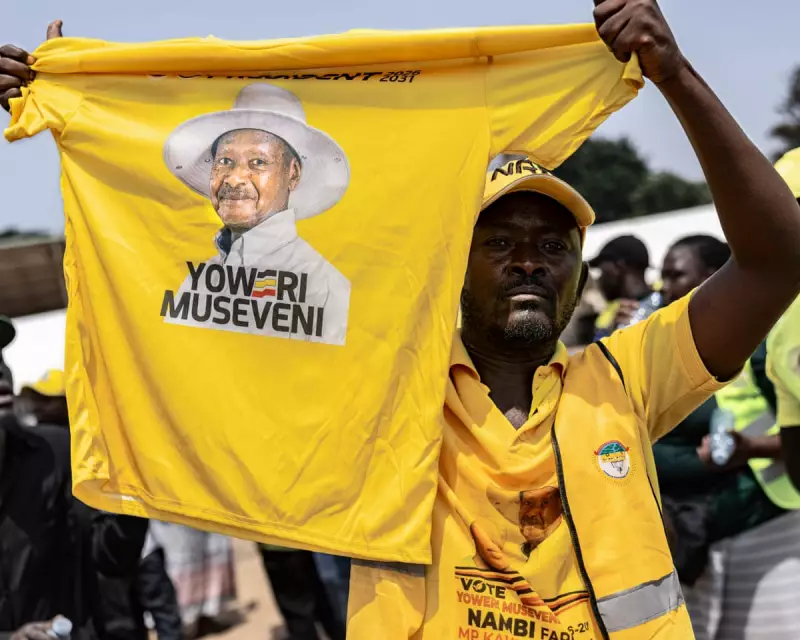
Uganda's long-serving President, Yoweri Museveni, has secured a controversial seventh term in office, using his victory speech to label political opponents as "terrorists". The 81-year-old leader, who has held power since 1986, claimed a landslide victory with 72% of the vote according to official results released on Sunday.
Contested Victory and Opposition Crackdown
The electoral process has been widely criticised by international observers and human rights organisations. Key points of contention include a government-imposed internet blackout and what monitors described as the heavy-handed repression of opposition figures. The whereabouts of main challenger Bobi Wine, whose real name is Robert Kyagulanyi, remained uncertain after he claimed to have escaped a police raid on his home on Saturday.
Police denied raiding the opposition leader's residence but simultaneously blocked journalists from approaching it. Wine, who officially garnered 25% of the vote, has not been active on social media since Saturday when he denounced what he called the "blatant theft" of the presidential election.

Museveni's Inflammatory Rhetoric and Security Measures
In his address, Museveni accused Wine's National Unity Platform (NUP) of planning attacks on polling stations. "Some of the opposition are wrong and also terrorists," he stated, adding unfounded allegations that they were "working with some foreigners and some homosexual groups." He issued a stark warning to "all the traitors," telling them to "stop everything, because we know what you are doing."
The government had cut internet access two days before the Thursday vote, citing the need to prevent "misinformation" and "incitement to violence." Although some connectivity was restored late on Saturday, a ban on major social media platforms remains in effect indefinitely. The capital, Kampala, saw a reduced security presence on Sunday following small-scale protests where teargas was reportedly deployed.
International Condemnation and Lasting Tensions
African election observers, including a team from the African Union, delivered a damning assessment on Saturday. They reported that "intimidation, arrest and abductions" had "instilled fear and eroded public trust in the electoral process." Human Rights Watch had previously accused the government of "brutal repression" in the lead-up to the poll.
Violence was reported on election day in the Butambala area, where an opposition MP claimed security forces killed at least ten people at his home. Museveni supported the police narrative, stating the deaths resulted from a planned attack on electoral infrastructure.
The election solidifies Museveni's 35-year rule, maintained through what analysts describe as total control of the state and security apparatus. The situation underscores the ongoing challenges to democratic processes in the region, with Museveni having taken stringent measures to avoid the violent unrest witnessed in neighbouring Tanzania during its recent polls.






