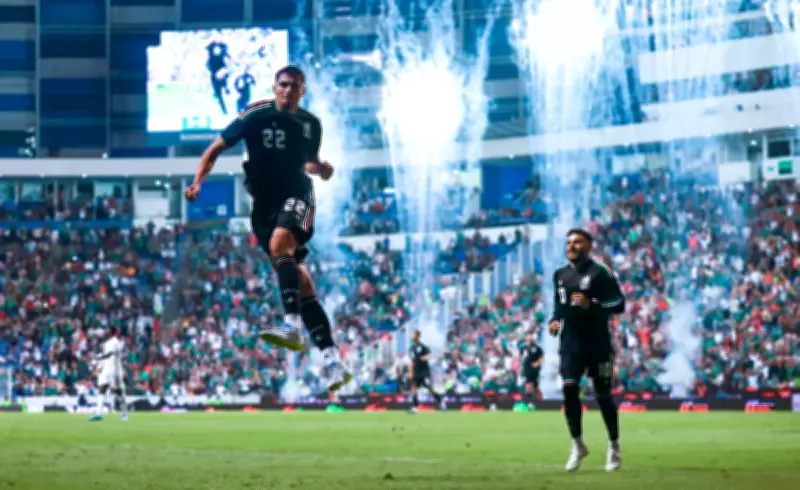
Mexico hopes a month of isolation can rekindle the magic of the 1986 World Cup. El Tri reached the quarter-finals the last time they hosted the tournament, and they are hoping old methods can revive the team after a disastrous outing in 2022.
It was January 1986, and the temperature at the peak of La Malinche, one of Mexico's tallest mountains, had plummeted to a bone-chilling cold. A group of soccer players training for that year's World Cup ran through a dense fog to the summit 14,600 feet above sea level, gasping in the thin air. Their Serbian coach, Bora Milutinovic, had pushed his players to the limit, seeking not only to test their physical endurance but also hoping for a psychological breakthrough. Up there, the Mexico players suffered, shivered, and cursed. But through hardship, they became a family. That fabled image of survival on the mountain became the foundation for Mexico's best-ever World Cup performance, the last time they played on home soil and one of only two times El Tri reached the tournament's quarter-finals.
Forty years later, the myth of La Malinche hangs over Mexico's preparation for this summer's tournament, which once again will be played on home turf. The team's coach, Javier Aguirre, was one of Milutinovic's players at the 1986 World Cup, and he has seemingly been inspired by the old belief that isolation and shared struggle can work miracles. At Aguirre's urging, the Mexican Football Federation, just as it had in 1986, took the controversial step of removing national team players from their clubs during the most decisive phase of the Liga MX playoffs. By the time the World Cup kicks off on 11 June, the players will have been sequestered together for 30 days.

The departure of 12 players from Liga MX, first for a period of forced rest and then for training at Mexico City's High-Performance Center, generated considerable discontent among the fans of clubs competing in the playoffs. The result: the tournament, which is supposed to be the highlight of the year, has become a lackluster affair. Chivas de Guadalajara, who traditionally only field Mexican players, lost five teammates to the national squad. Missing half of their starting lineup, the Red and Whites lost in the semi-finals to Cruz Azul, who only gave up one player, Erik Lira, to international duty. Cruz Azul went on to beat Pumas in a low-quality final.
Former Mexico goalkeeper Felix Fernandez, now an analyst for ClaroSports, voiced concerns that are shared by many fans in the country about Aguirre's decision. "I think there's no better way for a national team player to reach the World Cup than after playing in the (playoffs), because those are the most intense, most demanding matches," Fernandez says. "Yes, of course, there's a risk of injury, but injuries can also happen in training."
But there are reasons why Aguirre and his staff made their decision. In 1985, Milutinovic took the players away from their clubs for a full year. They toured the world, playing more than 20 friendlies in Asia, Africa, Europe, and South America. Decades later, Milutinovic still believes the decision was correct. "In my time, the only way we could accomplish anything was to be together," the 81-year-old says over the phone from China, where he is travelling. "Thanks to that time spent together, we created a suitable environment where we were mentally prepared, and it was so effective that we played a very, very successful World Cup in '86." He says the team spent two weeks on La Malinche, climbing up and down the dormant volcano many times, including at night. Players in later interviews talked about being terrified of heights and crawling on all fours. A couple of players wandered off and got lost, and the team had to rally together to find them. "That lesson we learned helped us create a positive atmosphere and have confidence in ourselves," Milutinovic says.

He says that in 2026, a player spending a year away from a club is "impossible ... times are different." But he warns that "a month is nothing." Part of Milutinovic's plan in 1986 was for Mexico to gain a wealth of experience on the global stage, something this year's team won't have time for. "Before the World Cup, we played 56, we had won (29) of them. There was confidence and everything ... You play the game the way you train," he says. "Every training session is a competition, a desire to be better, to compete, and above all, to enjoy it. Enjoy the game."
Critics such as Fernandez worry the current players aren't capable of absorbing a message of unity and joy similar to the one Milutinovic preached back then. "Nowadays, the amounts of money (players) earn can easily detach them from reality," Fernandez says. "The camaraderie has been greatly diminished. Today's footballer is constantly on his cell phone, watching TV series and movies. It's not like before when you'd get together in a room with four or six of you to talk. This lack of interaction ends up affecting them on the field."
Mexico have played six times this year, but only half of those have come with their full-strength squad. Their Europe-based players were missing for their most recent match, last week's 2-0 win over Ghana. But Ghana fielded a weakened team too, and their coach, Carlos Queiroz, didn't even attend the game. Fernandez and others also believe there are deeper problems that can't be fixed with a month of extra training sessions. The roots of these deficiencies lie in top-level decisions made since the team's failure at Qatar 2022, when El Tri crashed out in the group stage, their worst finish at a World Cup in four decades. The insularity of Mexican soccer means young players often stay at home rather than gain valuable experience in the top European leagues. The decision to end promotion and relegation in Liga MX also means a lack of jeopardy that can sharpen players' edges.
"The Mexican national team today doesn't have the level to be among the top 17 in the world," Fernandez says. "Terrible decisions have been made, and nothing has been done. It never crossed their minds that Mexico was hitting rock bottom." With the exception of the team's two best players, Genoa captain Johan Vasquez and Fulham's Raul Jimenez, the squad is either in poor form or lacking match fitness. Milan's Santiago Gimenez is coming off a series of injuries and his scoring has dried up. Edson Alvarez (Fenerbahce), Luis Chavez (Dynamo Moscow), and the inconsistent rookie Obed Vargas (Atletico Madrid) have all missed time at their respective clubs.
Fernandez says the lack of stars in their prime has led to an unusual phenomenon. Billboards on Mexico's streets show the faces of former stars such as Rafael Marquez, now an assistant coach for El Tri, instead of members of the current squad. Milutinovic, ever an optimist, believes Mexico's passionate fans will ignite pride in the players. He saw how the country pulled together in the aftermath of Mexico's devastating earthquake in 1985. "The fans and everything else had a huge influence on Mexico achieving that result in '86," he says. Milutinovic also believes Mexico's preparations for this World Cup could benefit some Liga MX teams. For example, the five Chivas players who missed the playoffs to join up with El Tri will come back with invaluable World Cup experience and make their club team even stronger. "For me, Chivas is the champion," he says. "Working with young players is key. It leaves behind a squad with a future, in a World Cup environment that will serve them well."
For now, on the training pitches in Mexico City, the players are racing against time, under the guidance of Aguirre, to find the rhythm and mental strength they need to face their biggest challenge. Thirty days in a bubble to try to fix years of systemic problems. The outcome is uncertain, but if history is a guide, maybe coming together for an intense period will give the team the boost they need. Milutinovic says he never told his players they had to win. He just told them they had to give everything of themselves and look out for each other. Before every game at the 1986 World Cup he repeated a mantra: "La Malinche, La Malinche, La Malinche," evoking the mountain in front of them they needed to conquer. We will find out if this year's team are up to a similar challenge in the coming weeks.