
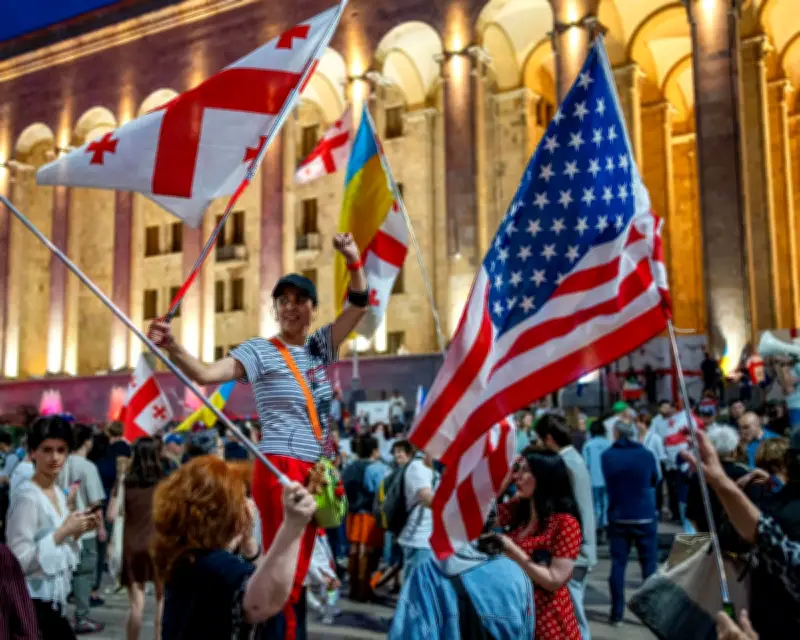
Demonstrators in Tbilisi marked the 556th day of their protest outside the Georgian parliament on 6 June 2026. Photograph: Moe Zoyari/Zuma Press Wire/Shutterstock
Here in Georgia, our festivals are full, but our poets are in prison – and now we feel abandoned by Europe.
Anti-government protests continue, but our young people are leaving. Increasingly destitute cultural gatherings have become my places of solace.
“They want us to stop seeing each other, to lose contact, to feel alone,” the Icelandic writer Sjón told me. By “they”, he meant the dark forces rising across the world: populists, fascists, fundamentalists.
That was in September 2025, at the Tbilisi international festival of literature, attended by more people than ever before. The halls were full, and I think everyone present felt grateful to the foreign guests for coming – in defiance of “them.”
I do not think coming to Tbilisi is an act of great heroism – yet. But already I have countless examples of people no longer coming – people who hold this city and this country dear, people who understand the context, who do not need things explained to them. Their absence gives me a completely new and unfamiliar feeling of abandonment.
Europeans who put down roots here over decades are leaving Tbilisi. Most of them came in the 1990s on humanitarian missions. My father jokingly called them “cultural refugees”. They fell in love with this place and stayed here for ever. But nothing lasts for ever, and their departure feels like an alarm bell to me.
Our young people are leaving, too. Quietly, without fuss. You think someone is still here because they remain active on social media, and then it turns out they are already trying to settle in Lisbon, Dublin or Berlin.
View image in fullscreen: Zviad Ratiani. Photograph: EyesWideOpen/Getty Images
There are too few of us to create communities and diasporas abroad. We will simply dissolve, scatter across the world, and disappear. Or rather, the part of us that loves thinking and is incapable of flattery will disappear.
For those of us who remain here, literary festivals and similar cultural events are places where it is possible to breathe freely. You see like-minded people and tell them how glad you are to meet them somewhere other than one of the protests that have continued since the government called a halt to Georgia’s EU membership negotiations. The festival doors are open to everyone, but regime conformists have no need to meet foreign or Georgian authors. They already know everything.
There was an empty chair for poet Zviad Ratiani at the book festival. Two months earlier, he had effectively forced his own arrest by repeating the act of another political prisoner, the nonconformist journalist Mzia Amaghlobeli, who slapped a police officer.
From my prison cell in Georgia, I implore Europe not to abandon us to Russia | Mzia Amaglobeli
Ratiani believed his action would change something. The last time I saw him was in court. He stood throughout the hearing, rolling cigarettes in his hands. Even his refusal to sit in the defendant’s chair was symbolic.
Ratiani is in prison now. Yet I often see him in the city streets, regularly mistaking passersby for him.
At the annual Tbilisi film festival in December, the name most often heard from the stage was that of another prisoner of the regime, actor Andro Chichinadze. Every speaker mentioned Chichinadze, transformed from a charming and talented young man into a hero and a symbol of resistance.
I watched every film, even Ukrainian director Sergei Loznitsa’s Two Prosecutors, about Stalinist repression from a new perspective. Following Russia’s example, the cult of Joseph Stalin has been brought out of mothballs here in Georgia, and to my astonishment it is alive. Stalin’s resurrection coincides with the rebirth of the most absurd ideas of Georgian messianism. Unknown professors and pseudoscientists have begun speaking about the uniqueness of Georgian civilisation.
View image in fullscreen: Actor Andro Chichinadze attends a court session in Tbilisi, 10 January 2025. Photograph: Natia Leverashvili/AP
The festival opened with the Italian biopic Duse. I asked the person beside me why such a boring work was chosen as the opening film, and he whispered back that outside, in the cinema foyer, there was a buffet and several bottles of wine gifted to the festival by the Italian embassy.
Everything became clear.
The Tbilisi international film festival was always poor, but this one was simply destitute.
Despite its poverty, the festival always had interesting guests who were happy to come here. And we eagerly awaited meeting them, attending their masterclasses and public lectures.
This time there was one foreign guest, the actor who played Benito Mussolini in the film. I missed the 10-minute scene featuring Mussolini because I fell asleep, but woke up after the screening to see the Il Duce actor on stage – with his thick neck and square jaw – saying that Tbilisi was a beautiful city. Why Mussolini, of all people? Perhaps the actor was simply in Tbilisi as a tourist, and his visit coincided with the festival.
The most emotional audience at the film festival was the one at the screening of Richard Linklater’s Nouvelle Vague. Nobody wanted to go home afterwards; strangers hugged, smoked together. This joy and excitement felt very real.
“We are part of this, we always were, and they want to separate us from it,” a woman from my generation, whom I know from the protest rallies, told me.
By “this”, she meant Europe.
View image in fullscreen: (L-R) Matthieu Penchinat, Guillaume Marbeck, Aubry Dullin and Zoey Deutch in Richard Linklater’s Nouvelle Vague. Photograph: Courtesy of Netflix
The film touched me deeply, too, taking me back to the day my young parents came home after seeing Jean-Luc Godard’s masterpiece Breathless.
In my Soviet childhood, everything reached us late, and I vividly remember my parents watching Breathless 20 years after its release and being overwhelmed by it.
In Linklater’s nostalgic film, the young Godard and his friends are shooting Breathless. It is a tribute to the past, made with great tact and love – to people who in the distant 1960s created a masterpiece and laid the foundation for something new and real, perhaps for that very Europe we admire so much, the Europe we aspire to, the Europe each of us imagines differently; a Europe that has already become a myth, and now even the road toward that myth is being closed to us. We are forbidden from approaching it, and we grow angry, sometimes cry, sometimes fall into complete helplessness.
Among like-minded people, you believe everything will be fine, that the efforts of so many good people cannot possibly end in defeat. Yet, still, the tragic feeling of abandonment does not leave me. It feels as though we have returned to those old days when European films reached us, but their creators never did.
Above the hall full of nonconformists hovered the spectre of isolation. The film festival ended, but the street protests continued, and so does our life in a country where laws designed to oppress and constrict us are being adopted at accelerated speed.
We have neither money nor brute force nor, thank God, weapons. They are not afraid of us, but we greatly irritate the government and those who have chosen the path of conformism – as well as others who possess the skills necessary for life in an empire but not in a free society. Such people have begun calling themselves “traditionalists”. They label the pro-European part of the population “liberals”, regardless of political views, and have learned to pronounce the word with particular hatred.
Traditionalists are driven by spite towards liberals. If liberals are noticed caring for stray dogs, traditionalists consider it their duty to treat stray dogs with cruelty.
Tbilisi is becoming a difficult and depressing city to live in.
I walk through the streets of my native city and, once again, I think I see the imprisoned poet and his carrot-coloured jacket.
Every April, I spend several weeks guiding European birdwatchers, and the work never tires me – I enjoy it. But this year, I had only one group, from the Netherlands, in May. No matter where my guests are from – the Netherlands, Belgium or Germany – at some point they will ask me why there are so many EU flags hanging in Georgian towns and villages.
I would usually answer that my country strives to join the EU, and that this is the will of the Georgian people.
View image in fullscreen: Souvenirs of Joseph Stalin on sale in his home town of Gori, Georgia, 1 March 2023. Photograph: Irakli Gedenidze/Reuters
Birdwatchers are pleasant people and they come prepared. They know everything about our birds in advance; they have even studied their calls. But most are surprised to hear that 80% of Georgia’s population wants EU membership.
And if the birdwatcher is a good person, that surprise is inevitably followed by discomfort. Especially after I tell them that people have stood in the streets for more than 500 days for European ideals, that many have lost their jobs because of their civic stance, that even more have been fined and beaten. Some protesters are in prison, showing rare resilience, committing acts of civic heroism, refusing pardons.
With my Dutch visitors, we travelled through different regions of Georgia, through various bird habitats, and the tour was a great success. Despite wars and countless disasters, birds continue their annual cycles: crossing borders they know nothing about, rebuilding nests, pairing up.
After five days on the road, none of my birdwatchers had asked the awkward question about EU flags. I do not have to give my prepared angry answer – that, yes, people here go to prison for the European idea. They have stopped asking this question because, in the cities and villages of Georgia, EU flags are now a rarity.
Archil Kikodze is a Georgian fiction writer, screenwriter, professional photographer and ecoguide. This article, published on the occasion of the Tbilisi Debates on Europe, 12 and 13 June 2026, was translated by Maia Gabuldani-Schneider. A longer version was published by VoxEurop.eu




