

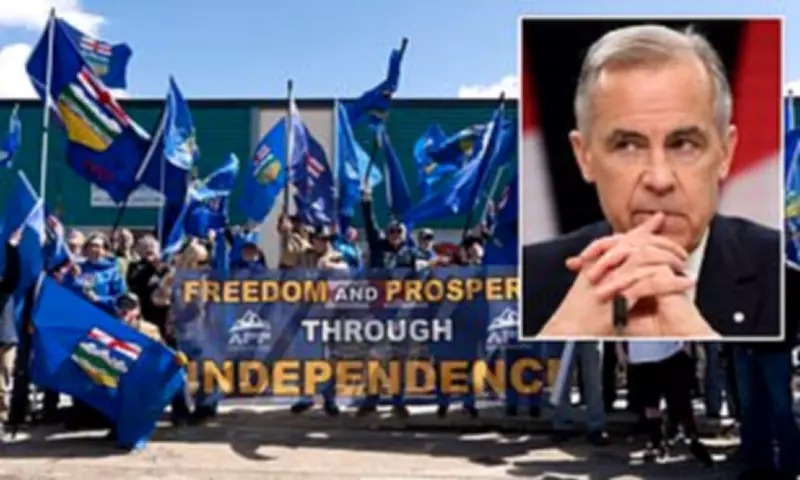
The western Canadian province of Alberta will hold a vote later this year to gauge whether its citizens want to declare independence from the rest of the country. The vote on October 19 will not be immediately binding but will ask whether Albertans want to begin the formal process of separation and hold a second, official referendum down the line.
Background of the Movement
Alberta Premier Danielle Smith announced the vote last week amid rising separatist sentiment, including a referendum petition which has attracted more than 300,000 signatures. The Alberta Prosperity Project is spearheading the movement and is run by gun shop owner Mitch Sylvestre and lawyer Jeffrey Rath. The movement believes that Alberta's economic growth has been hindered by legislation enacted by politicians in the country's eastern provinces, particularly in the nation's capital, Ottawa.
Alberta is oil-rich and separatists have said that strict environmental policies issued by former Prime Minister Justin Trudeau have prevented the province from building pipelines and benefiting from the resource. They also believe that Alberta is a victim of 'western alienation,' a decades-old idea held by some in Canada's conservative-leaning western provinces, which claims that the area is neglected by national politicians in Ottawa. They believe elites in the country's more populous eastern provinces have disproportionate sway in Alberta's internal affairs.

Population Disparity
The province's population is just over 5 million compared to Ontario and Quebec's combined population of 22.7 million. Rath, one of the separatist movement's leaders, has traveled to Washington multiple times and met with Trump administration officials to ask for a $500 billion line of credit if the province were to become independent. 'The US is extremely enthusiastic about a free and independent Alberta,' Rath said earlier this year, though the US has downplayed the meetings and emphasized that no commitments have been made.
Petition and Legal Challenges
The separatist petition, which was launched earlier this year, needed 177,000 signatures by May to be brought before the legislature. It nearly doubled that threshold. A provincial court blocked the petition earlier this month, saying that its organizers failed to consult indigenous First Nations who would be impacted by independence. But Premier Smith's administration appealed the decision, saying she would not let 'a single judge silence the voices of hundreds of thousands of Albertans.'
Support for Unity
Despite growing separatist sentiment in Alberta, the majority of the province's citizens, including Smith, are in favor of remaining a part of Canada per recent polling. An anti-separation petition organized by Forever Canadian, a group led by former Alberta Deputy Premier Thomas Lukaszuk, collected more than 400,000 signatures. Additionally, polls indicate that a large majority of Albertans would vote to remain unified with Canada. A January Ipsos poll determined that just 28 percent of the province's citizens would vote 'yes' in an independence referendum. And of the separatists questioned in that poll, around a fifth said that their support for independence was symbolic or conditional, amounting to more of a political bargaining tool than a total commitment to separation.
Prime Minister's Stance
Canada's Prime Minister Mark Carney is also committed to keeping Alberta unified with the rest of the country. He has shared ambitions of making the nation an 'energy superpower,' and Alberta's wealth of oil is key to those plans. The prime minister, who was raised in Edmonton, Alberta, said earlier this month: 'We're renovating the country as we go, and Alberta being at the center of that is essential.' This week, Carney said that the upcoming vote could become a 'dangerous bluff' and compared it to Brexit, the United Kingdom's exit from the European Union (EU) which has so far proven an economic drag.

Brexit Comparison
Carney served as governor of the Bank of England during Brexit. He said: 'I saw firsthand what happened in the United Kingdom. They're still 10 years later trying to undo what people didn't think they were voting for, but what they ended up having.' The British pound collapsed in relation to foreign currencies after the UK voted to leave the EU and it has never returned to pre-Brexit levels. Foreign investment has also suffered, and London's stock market and IPO landscape have lagged in the years since. Some economists have estimated that the UK's GDP was reduced by up to eight percent last year thanks to the cumulative effects of separation.
Upcoming Vote
Despite the prime minister's warning, the vote will still take place in five months, leaving a significant stretch of time for parties on either side of the issue to make their cases. That may lead to unexpected results when in October, the province's citizens are asked: 'Should Alberta remain a province of Canada or should the Government of Alberta commence the legal process required under the Canadian Constitution to hold a binding provincial referendum on whether or not Alberta should separate from Canada?' The vote will mark the first time in Canadian history that a province other than Francophone Quebec has put the question of separation to the public. In 1995, Quebec narrowly avoided separating from Canada when 50.58 percent of referendum voters elected to remain unified with the country.





