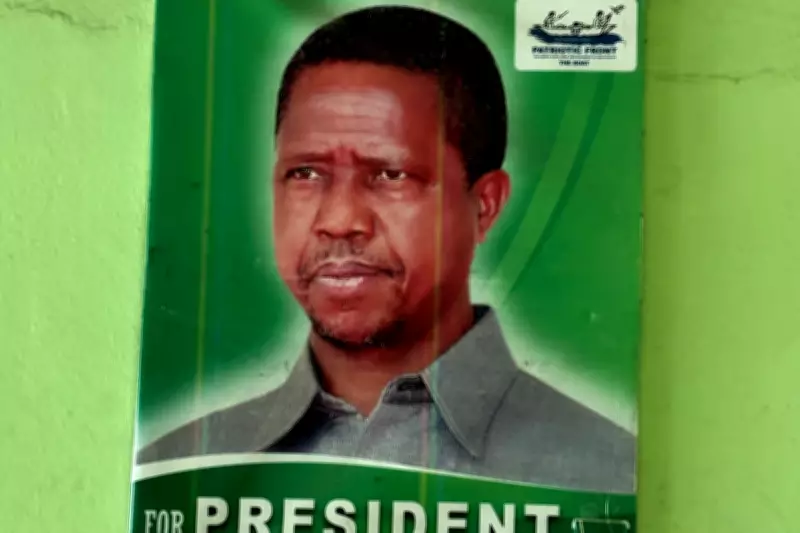
A macabre and protracted dispute has left the body of Zambia's former president, Edgar Lungu, unburied for more than eight months. His remains are currently held in a South African funeral home, caught in a bitter feud between his family and his longtime political rival and successor, President Hakainde Hichilema.
A Graphic Symbol of Division
In a cemetery in Zambia's capital, Lusaka, an unfilled, coffin-size hole stands as a stark symbol of this conflict. This site was prepared for Lungu's state funeral, which President Hichilema had hoped to oversee. However, in his final days, Lungu explicitly instructed his family that Hichilema should never be allowed near his body, even as a mourner.
The matter has escalated to the courts, which have repeatedly ruled in favour of Zambian authorities over the family's wishes. Despite this, Lungu's family continues to resist, seeking a burial ceremony that sidelines the current president entirely.

A Spiritual and Political Battle
This impasse offends deep-seated traditional beliefs in Zambia, where failing to bury the dead promptly and with dignity is considered a serious taboo. Scholars and religious leaders describe the situation as having evolved beyond mere politics into a spiritual contest.
"It has shifted from the physical, it has shifted from politics, and it is now a spiritual battle," stated Bishop Anthony Kaluba of the Life of Christ congregation in Lusaka.
Hichilema's supporters interpret Lungu's will as an attempt to cast a curse, while they argue that a state funeral attended by the president would be a generous gesture towards Lungu and his family. For many Zambians, Lungu's directive resonates powerfully, as it is not uncommon for individuals to bar perceived enemies from their funerals, often blaming them for personal misfortunes.
The Power of Last Words
Chammah J. Kaunda, a Zambian professor of African Pentecostal theology, explained that across Africa, last words are seen as a "vital force" capable of enhancing or blocking life. Elders facing death can impose curses or give blessings, and Lungu's case demonstrates how such curses "can acquire a life of their own."
A Democracy Steeped in Tradition
Zambia is a vibrant democracy, yet traditional beliefs remain deeply influential. A widespread perception exists that some political leaders, like many citizens, fear being bewitched. This is particularly potent in a nation where traditional religion thrives alongside Christianity, and spoken curses are dreaded as spiritually enforceable if provoked by injustice.
"It is a weapon," said Herbert Sinyangwe of WayLife Ministries in Lusaka. "We believe in our culture that curses work."
Suspicion has been rampant among recent presidents, including Michael Sata, Lungu, and Hichilema. The official presidential residence is now widely believed to be under a deadly spell, as all six former presidents are deceased. Hichilema works there but sleeps elsewhere as a precaution.
The Empty Tomb and Its Omen
Cemetery caretaker Allen Banda, who oversaw the preparation of Lungu's tomb site, warned that an empty tomb is culturally akin to digging "your own grave." He explained, "If nobody goes there, culturally it's your body that's going to go there."
Hichilema's willingness to risk public anger by opposing the family has only reinforced views of a spiritual battle. Zambian historian Sishuwa Sishuwa noted that the Lungu family's actions seem designed to deny Hichilema access to the body, while Hichilema appears determined to secure it, perhaps viewing it as a matter of life and death.
Legal Struggles and a Bitter Rivalry
Edgar Lungu died on June 5, 2025, at age 68, following surgery-related complications for a narrowed esophagus. To organise a state funeral, Zambian authorities needed custody of his remains, but the family resisted during negotiations.
They preferred a private charter for transport and wished to keep the body at Lungu's residence overnight, appointing three individuals to care for it during the intended state funeral. When it became clear their wishes would not be honoured, they opted for a private funeral in South Africa, only to have it blocked by Zambian authorities.

In August, a South African court ruled that Zambian authorities could take the body home for burial. Bertha Lungu, the former president's sister, was inconsolable in court, wailing and cursing at Zambia's attorney general, Mulilo Kabesha. She accused Hichilema of wanting the corpse for ritual purposes, a claim he denies, citing his Christian faith as incompatible with such beliefs.
A History of Political Enmity
The feud is rooted in a long-standing political rivalry. Lungu rose to power after President Michael Sata's death in 2014, narrowly defeating Hichilema in the 2015 election by under 28,000 votes. After Lungu's re-election in 2016, Hichilema faced treason charges and was jailed for four months.
In 2021, Hichilema finally defeated Lungu, who initially retired from politics but later reconsidered, leading to the withdrawal of his retirement benefits by authorities. Lungu faced further pressure when his wife and daughter were arrested in 2024 over fraud allegations.
When Lungu fell ill, the government restricted his travel, but he managed to slip away to South Africa in early 2025, buying a ticket at the airport counter—an incident reported as a security lapse.
As Zambian diplomat Emmanuel Mwamba, a spokesperson for Lungu's party, remarked, Lungu is "still influencing our politics from the grave. His issues remain. How he was treated in life and how he was treated in death."
The body remains frozen in South Africa, as Zambia endures this scandalous saga, a poignant reflection of the intersection between politics, tradition, and spiritual belief in a nation grappling with the legacy of its leaders.