
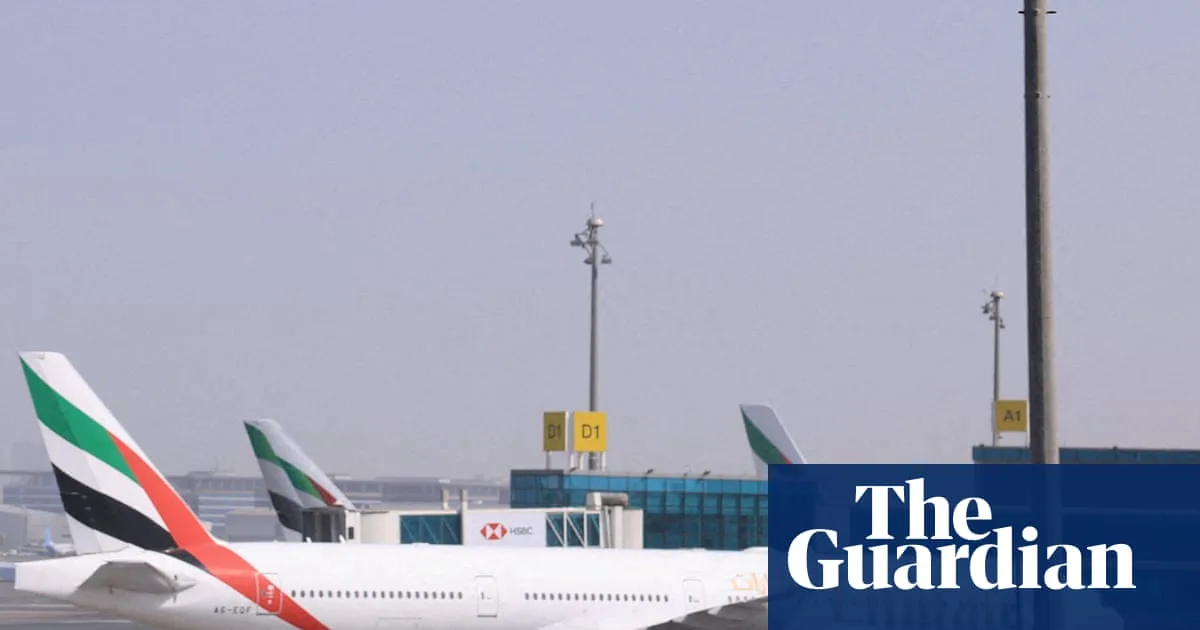
Major Middle East airlines have ruled out resuming scheduled flights until at least Thursday, as the US-Israeli war on Iran continues. Etihad, based in Abu Dhabi, suspended commercial services until 2pm local time on Thursday 5 March, while Emirates cancelled scheduled flights until midnight on Wednesday. Qatar Airways said it would provide a further update on Wednesday but its airspace remained closed for all flights.
Repatriation flights began departing the United Arab Emirates on Monday, as governments worldwide worked to extract their citizens from the conflict-hit region. Etihad, Emirates and budget carrier FlyDubai said they would continue to operate only limited cargo and repatriation flights after the chaos caused by Iranian missiles and drones. Since Saturday, at least 11,000 flights into, out of and within the Middle East have been cancelled, affecting more than a million passengers, according to aviation analytics company Cirium.
The US state department called on Americans to immediately leave more than a dozen countries in the Middle East, including Saudi Arabia and the UAE, due to safety risks. The US has not organised its own evacuation flights. In the UK, Prime Minister Keir Starmer said the government was sending rapid deployment teams to the region to support British nationals, with Foreign Secretary Yvette Cooper noting that 130,000 British nationals had registered their presence in the region, and about 300,000 were in Gulf countries targeted by Iran.
About 24,000 Australian citizens are also in the Middle East, some stranded in transit. Analysts warned that long-haul fares could rise sharply in the short term due to the loss of capacity through the Middle East. John Grant of OAG said: 'The short-term loss of capacity through the Middle East clearly puts pressure on alternate routings... Selling fares are inevitably increasing and will stay that way until there is a settlement of the current events.'
The UAE government urged passengers to go to airports only if contacted directly, warning that operations remained limited. At least 16 Etihad flights left Abu Dhabi during a three-hour window on Monday, heading to destinations including Islamabad, Paris, Amsterdam, Mumbai, Moscow and London. Airspace closures remain in effect for Iran, Iraq and Israel, with partial closures affecting Bahrain, Kuwait, Saudi Arabia and Syria.
Germany’s foreign ministry said about 30,000 tourists from the country were stranded on cruise ships, in hotels or at closed airports in the Middle East. Europe’s biggest holiday company, Tui, said it would begin to offer flights back home for its 10,000 customers stranded in the region from Tuesday, working with Etihad, Emirates and Qatar Airways.




