
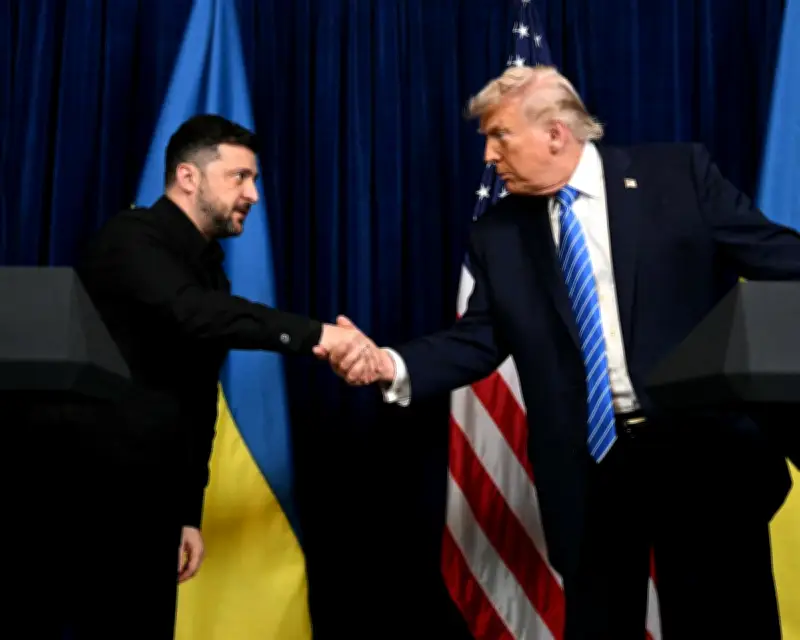
Donald Trump and Volodymyr Zelenskyy have moved from a disastrous Oval Office encounter in February 2025, when the Ukrainian leader was publicly ambushed and virtually expelled, to a run of cordial meetings. The turnaround has coincided with the US-Israeli war against Iran and appears to have accelerated as Trump has struggled to end the conflict.
The relationship is a far cry from the warmth between Ronald Reagan and Margaret Thatcher, or the pragmatic friendliness Reagan developed with Mikhail Gorbachev. Yet by late December 2025, the two were shaking hands at Trump’s Mar-a-Lago estate after talks, and this week they met again at the White House after Zelenskyy attended the funeral of Republican senator Lindsey Graham, a steadfast Ukraine supporter.
A memorandum of understanding signed in June, designed to institute a 60-day ceasefire between Washington and Tehran, has been rendered moot as hostilities resumed over the status of the Strait of Hormuz, the vital waterway Iran has effectively closed from the war’s outset, threatening the global economy.
Analysts see a transactional shift
Charles Kupchan, a senior fellow at the Council of Foreign Relations and a former White House adviser on European affairs, said the change in tone was unmistakable.
“There’s no question that he’s warmed up to Zelenskyy,” Kupchan said. “We’ve gone from a phase in which he was throwing Zelenskyy out of the Oval Office, and turning his back on him, to a situation today where they seem to have a reasonably good relationship, and where there have now been a succession of meetings that have gone well.”
The latest rapprochement follows Trump’s striking praise for Zelenskyy at last month’s Nato summit in Ankara, where he said he would grant licenses for Ukraine to develop its own Patriot missile interceptors, although he cast doubt on that promise at a cabinet meeting on Friday. It also follows an even more remarkable occurrence: the meeting in Kyiv between Zelenskyy and Laura Loomer, the far-right social media influencer with sway over Trump who had previously vocally supported Russia. After meeting Zelenskyy, Loomer said she had been “bamboozled” by Russian propaganda and admitted having believed “a lot of untrue things” about Ukraine. She said she had followed the meeting with a phone call to Trump and that her change of view was affecting sentiment across the Maga movement.
Ukraine offers help, not just requests
Several causes are possible, from Trump’s mercurial nature to Putin’s refusal to accept favorable peace deals after Trump vowed to settle the conflict “on day one.” But one factor stands out: Ukraine has stopped asking for charity and started offering help in the US war with Iran. Administration officials have offered no explanation for the shift.
“At a moment when he is stuck in a war, faced with bad military options, and suddenly the Ukrainians are approaching him no longer asking for American charity but offering help, I find it quite plausible that that could be a reason, amongst many probably, as to why Trump’s attitude appears to have shifted in a rather strong way,” said Trita Parsi, vice-president of the Quincy Institute for Responsible Statecraft.
Tehran’s drone attacks on US military bases and infrastructure in allied Gulf kingdoms have shown a shared interest between Kyiv and Washington. Ukraine itself came under sustained attack from Iranian Shahed drones after Tehran supplied them to Moscow in the early stages of Russia’s 2022 invasion. Ukraine has since become a world leader in defensive drone technology, an innovation it has trumpeted to the US and its Gulf allies. In March, Zelenskyy told UK MPs that 200 Ukrainian military experts had been dispatched to 11 countries across the Gulf, including the United Arab Emirates, Saudi Arabia, Qatar and Kuwait, to advise on combating Shahed drones.
Blurring the battlefields
Last weekend, Ukraine was accused of trying to merge the two conflicts after it struck an Iranian commercial vessel on the Caspian Sea. Kyiv justified the strike by saying the ship was being used to transport arms to Russia. Iran said the strike had killed an Iranian sailor and threatened retaliation.
Preparing to meet Trump, Zelenskyy said Iran had “attacked” Ukraine by supplying weaponry to Russia. “What do you expect, if Iran transferred new technologies to Russia from the first year of the war,” he told Sky News. “These were Shahed drones. They transferred thousands of these drones in the first year of the war. Then they issued licenses. What did they do? Did they attack us? I think so.”
Zelenskyy also posted on X: “Since the beginning of July, we have recorded active Russian satellite surveillance of the Gulf states and US military facilities located there. These images subsequently appear in Iran … There is clear correlation between Russia’s satellite imagery of these sites and Iranian strikes – both before the attacks, in preparation for them, and afterward, to assess the damage.”
Kupchan said Zelenskyy was being a “good salesman” by persuading Trump that Ukraine was an ally worth supporting through concrete help. “Zelensky has done a very good job of communicating to Trump that he is going to help him on Iran,” Kupchan said. “He travelled in the Gulf and said, ‘I’m going to help you deal with Iran and drones, because we’ve been there and done that.’ It’s an investment in his relationships with Trump, and with Europe, because he’s demonstrating Ukraine’s value as an ally. And I think Trump, who is endlessly transactional, might actually agree to help Ukraine a bit more because Ukraine has stepped up when America’s chips are down in the war with Iran. The case for helping Ukraine is even stronger now, because Ukraine has demonstrated that it is not just a taker, but a giver.”
Political risks for Ukraine
Trump’s apparent vacillation over the Patriot missile pledge shows that cultivating him remains at the mercy of his mercurial nature. Some analysts warn that Ukraine risks turning two localized wars into a global conflict by “merging the battlefields,” inviting Tehran to widen the scope of any retaliation.
Sina Toossi, a fellow at the Center for International Policy, said Ukraine’s intervention strengthened Tehran’s view that the Russia-Ukraine war and Iran’s confrontation with the US are becoming a single, interconnected conflict. “Trump’s apparent warming toward Zelensky only strengthens this perception,” Toossi said. “The likely implication is not an immediate missile strike on Ukraine, but a broader expansion of where Tehran believes it can legitimately impose costs.”
Ukraine’s acting foreign minister, Andrii Sybiha, called his Iranian counterpart, Abbas Araghchi, immediately after Zelenskyy’s latest meeting with Trump. “I stressed that our goal is to avoid unnecessary escalation,” Sybiha wrote on social media. “All of Ukraine’s actions are aimed solely at defending our country from Russian aggression and never intended to target civilian vessels or people.”
Parsi said Ukraine’s involvement could have the effect of “reframing” the Iran war so that it is no longer perceived merely as serving Israel’s agenda but as helping to defend Ukraine. That might appeal to European countries and Democrats who broadly opposed the Iran war but supported Ukraine. Yet even with Loomer’s belated conversion to the Ukrainian cause, it seems far less likely to impress Trump’s base. “The centre of gravity in the Maga movement is still skeptical of foreign wars, and of sending large amounts of money to Ukraine, and I don’t see that changing,” Kupchan said.
Matt Duss, vice-president of the Center for International Policy and a former foreign policy adviser to Bernie Sanders, warned the strategy risked undermining bipartisan support for Ukraine. “Trying to draw closer to Israel in the war on Iran really undermines a lot of Ukraine’s case, because Israel is effectively trying to do to the Palestinians precisely what Russia has been trying to do to Ukraine, which is to erase them as a people,” Duss said. “That could potentially diminish what has been up until now pretty good bipartisan support for Ukraine.”




